Centuries-old Locust Street landmark sits on the edge of change
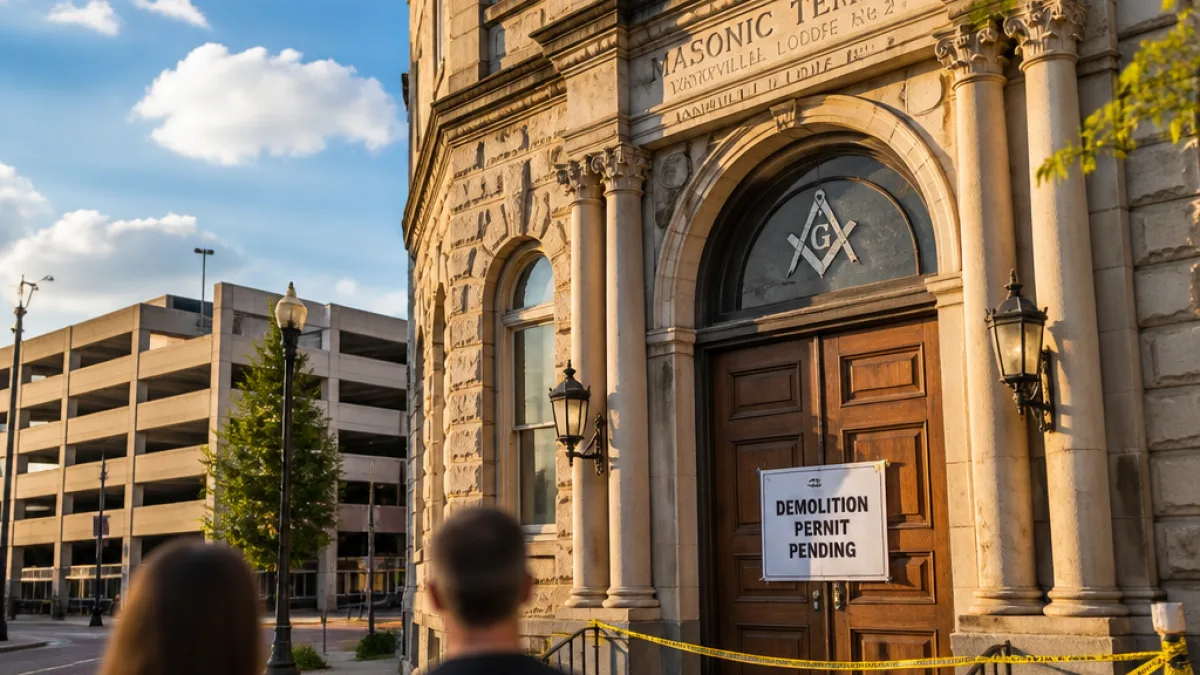
One of downtown Knoxville’s most recognizable profile pieces — the Masonic temple that anchors a stretch of Locust Street across from the city garage — may soon be gone. City permit records show a demolition application was opened on July 13; as of the end of July the permit remained pending, signaling a possible, though not inevitable, end to a building that ties the present city to its 19th-century past.
The structure’s story begins well before its temple identity. According to local historians, the building began life as an extravagant Victorian house constructed in 1872 for industrialist Charles McClung McGhee — a dominant financier of his time who helped shape Knoxville’s transportation and charitable landscape. City records note a first recorded sale in 1914, and the property underwent a significant makeover after McGhee’s death in 1907, assuming the temple-like appearance many residents now associate with fraternal orders.
“It’s one of the six or seven oldest structures downtown,” said Jack Neely of the Knoxville History Project, reflecting on the building’s long presence and design pedigree.
Neely and other preservation-minded observers stress that losing the temple would be more than the removal of a single facade; it would mark the first demolition of a prominent 19th-century downtown building in roughly half a century. That prospect has stirred questions about how Knoxville balances growth, redevelopment and the tangible traces of its shared history.
What we know and what’s next
The city’s permit log is the clearest public trace of movement: an application to demolish was filed mid-July and remains under review. The lodge that long met in the building — Charles H. McKinney Lodge 433 — posted in May that meetings had moved to Cherokee Lodge in Bearden, a sign the space may no longer have been active for fraternal use even before the permit filing.
The application itself, and any supporting documents such as structural reports or redevelopment plans, will determine the timeline if demolition proceeds. Until those records are finalized and a permit issued, the building’s fate remains unsettled — legally possible to alter and politically sensitive.
- Historic origins: Built 1872 as a Victorian residence for Charles McClung McGhee.
- Architectural shift: Renovated after 1907 into the temple style seen today.
- Preservation stakes: Listed among the oldest downtown structures and central to local architectural history.
| Year | Event |
|---|---|
| 1872 | Original construction as McGhee residence |
| 1907 | McGhee dies; later remodeling into temple style |
| 1914 | First sale recorded in city records |
| 2026 | Demolition permit opened July 13 (pending) |
Local stakes: memory, downtown fabric and development
For people who park at the Locust Street Garage or walk past the block on errands, the temple is a visual landmark: a silhouette of stone and ornament that anchors the streetscape. Its possible removal touches on several local concerns.
Preservation advocates point to the rarity of such a surviving 19th-century downtown structure. If the building is removed, it would erase not just a façade but an ordered sequence of the city’s growth — from 19th-century industry and philanthropy to the civic and fraternal uses that followed. On the other side, proponents of redevelopment often argue that downtown property is finite and that new uses can deliver economic activity, housing or parking that the central business district requires.
At stake is how Knoxville defines value in the city center: whether priority will be given to retaining tangible links to the past or to pursuing new projects that reshape the skyline. The pending status of the permit gives residents and civic groups a window — limited, but real — to weigh in with city officials, historic commissions or the property owner about alternatives, mitigation or documentation before any irreversible action takes place.
Until city planning and building departments close the loop on the permit, the temple remains a living question on Locust Street — a place where the city’s memory and its next chapter are, for now, in dialogue.