Nearly one year after the National Guard's mission in Washington began, commanders say about 4,600 troops remain stationed across the District and roughly 9,700 service members have rotated through since Aug. 11, 2025. The deployment — billed by officials as an effort to keep the capital safe and orderly — has become part of daily life in neighborhoods, on the National Mall and inside Metro stations.
Numbers and duties
At a recent roundtable held inside the D.C. Armory, Guard leaders outlined the scope of their work since the operation started. Officials credited troops with a range of public-safety actions that officials say helped prevent escalation and keep visitors and residents safe.
- 9,700 total National Guard members have served in D.C. since the mission began.
- 4,600 Guard members remain deployed in the District.
- Guard-reported responses include medical aid, interventions and assistance to local law enforcement.
Commanders provided more granular figures for specific types of responses:
| Activity | Count |
|---|---|
| Medical emergencies responded to | 788 |
| Lost children reunited with families | 43 |
| Times assisting law enforcement | 479 |
| Interventions before escalation | 262 |
| Narcan administrations | 325 |
Guard presence on Metro draws scrutiny
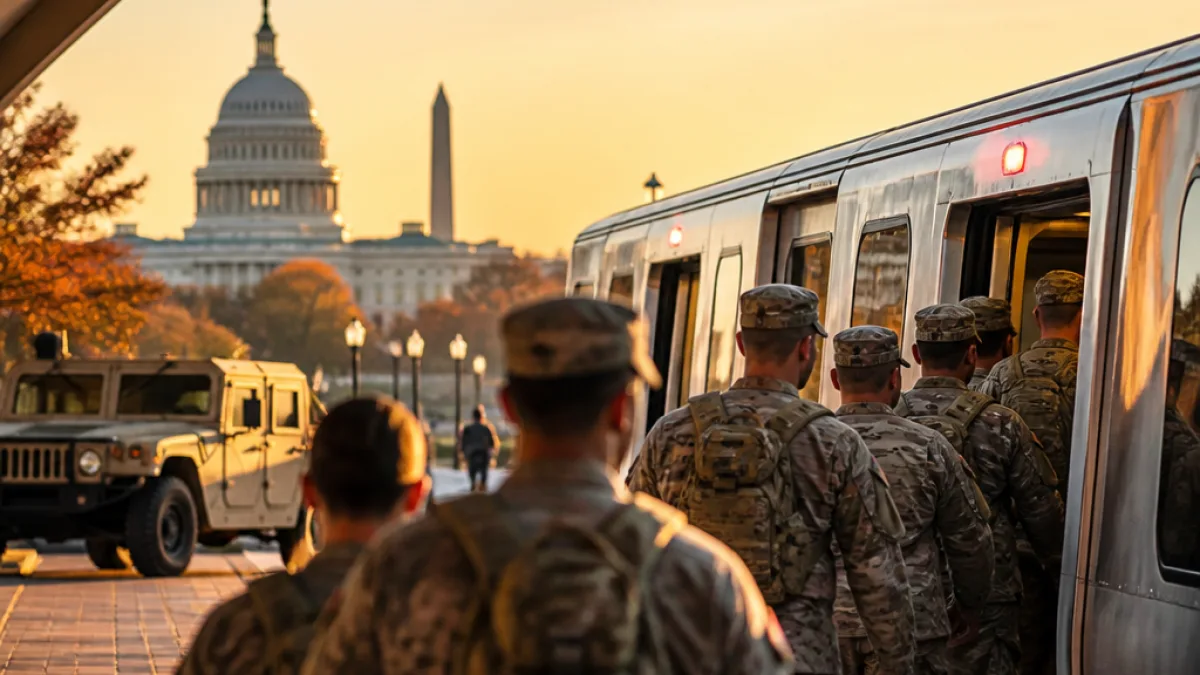
Residents and riders have reported seeing troops inside rail cars and stations, sometimes appearing to stand idly. Commanding General (Interim) Brig. Gen. Leland D. Blanchard II said riding trains is part of the Guard’s operational plan — a mission component described internally as "Ride the Rails." He defended the practice as preventive, noting that troops have stepped in to stop assaults and disarm people.
"Only in times where they would have to save, preserve human life," Gen. Blanchard said when asked about circumstances that would allow troops to draw firearms in the Metro area.
The presence of heavily uniformed troops in public-transit spaces raises both safety and civil-liberties questions for residents and advocacy groups. Officials emphasize that use of lethal force is limited to life-saving circumstances, but they also point to nonlethal interventions and medical aid as primary mission outputs.
What the Guard says it has done
Commanders described a mix of crisis interventions and routine public-safety actions. The Guard reports providing pre-EMS lifesaving assistance such as CPR and tourniquet application; reuniting dozens of lost children with family members; carrying and administering Narcan during suspected overdoses; and assisting local law enforcement hundreds of times.
Those figures, the Guard argues, show the deployment has tangible public-safety benefits. For many residents, though, the day-to-day effect is less clear: more uniformed personnel in public spaces, occasional stops or questions, and visible equipment where previously there was none.
Local implications and unanswered questions
The mission’s near-year mark prompts practical and policy questions about duration, oversight and cost. The Pentagon has been reported to plan keeping Guard forces activated in the capital through Inauguration Day 2029, a multi-year window that contrasts with typical short-term domestic deployments.
Key questions for residents and local officials remain: how long will the District tolerate a persistent military-style presence on transit and public promenades, what oversight mechanisms exist for Guard conduct in civilian settings, and how are effectiveness and civil liberties being balanced?
Officials at the roundtable sought to provide transparency by sharing activity totals and describing rules of engagement. But for many Washingtonians who encounter troops while on their way to work, shopping or visiting memorials, the deployment is as much a civic puzzle as it is a security policy — offering reassurance to some and unease to others.
With the mission approaching one year, local leaders, advocacy groups and residents are likely to press for clearer timelines and greater public reporting on outcomes, costs and conduct. For now, the Guard’s presence remains a visible, if contested, element of everyday life in the nation’s capital.