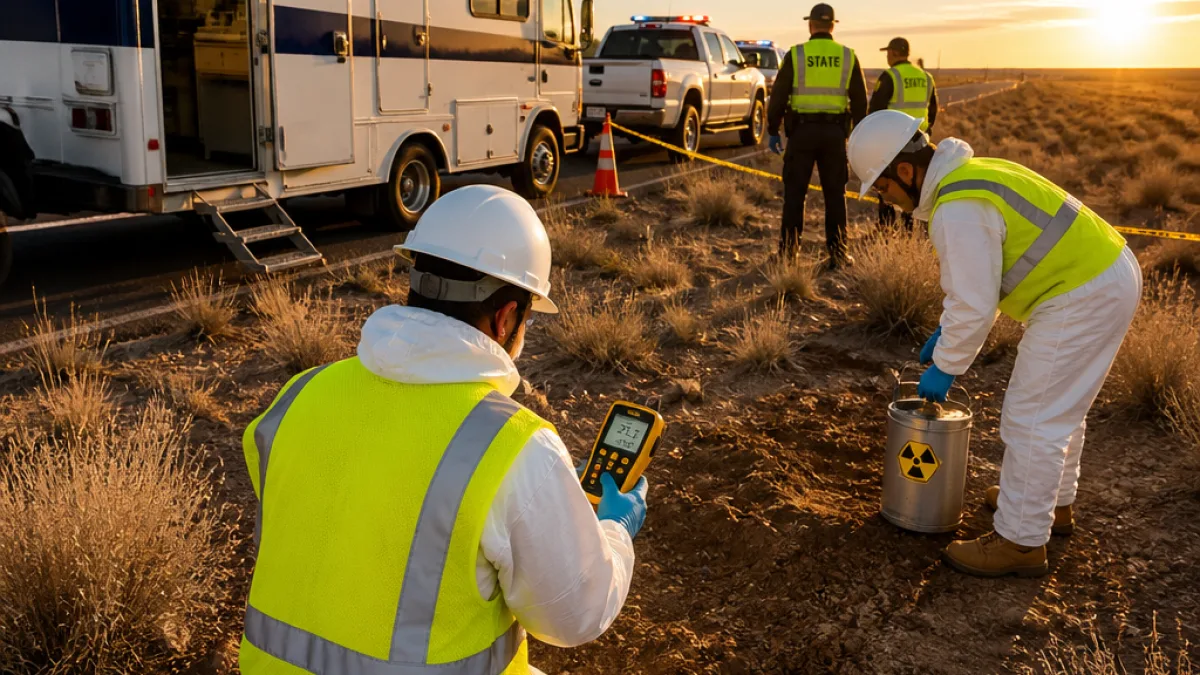
State troopers and partner agencies recovered a small, sealed radioactive capsule in Midland County over the weekend after a DPS radiation detection system alerted an officer during routine patrols, authorities said. The source was found a few inches beneath the ground and identified as a 100-millicurie Cs-137 industrial source manufactured in April 1967.
How the discovery unfolded
The initial alarm came from a vehicle-mounted radiation detector operated by a Texas Department of Public Safety corporal assigned to the Radiological/Nuclear Threat Detection Unit. Using portable instruments, the corporal conducted a methodical survey and traced elevated readings to a location where the source was buried roughly six to eight inches below the surface.
After confirming the presence of radioactive material, the corporal summoned assistance from additional local, state and federal partners. The multi-agency team performed radiological assessments and developed a recovery plan that included continuous monitoring and safety zones around the scene.
“After the source was documented and radiation readings were verified, it was safely recovered without incident. The operation concluded with no injuries, no personnel contamination and no threat to the public,”
Those details were provided in a statement from the DPS. Officials said personnel rotations and monitoring followed established safety protocols throughout the operation.
What the capsule is and why it matters
The recovered object is a sealed industrial gauge source containing cesium-137 (Cs-137), a radioactive isotope commonly used in oil-and-gas and industrial gauging systems to measure material density or thickness. The capsule’s strength—listed at 100 millicuries—is significant enough to register on detection systems but, when sealed and intact, is typically handled with strict safety procedures.
Officials did not provide details about the device’s immediate disposition after recovery, such as transfer to licensed radioactive-materials handlers or storage. It remains unclear how the capsule came to be buried at the site where it was found.
Local impact and public safety
Authorities emphasized there was no danger to the public. Still, the discovery underscores how legacy industrial radioactive sources can turn up in unexpected places, particularly in regions with heavy oil-and-gas activity. For residents and workers, the event is a reminder that radiation detection systems are part of routine patrol and industrial oversight in parts of West Texas.
- No injuries or contamination: DPS reported no personnel were contaminated and no one was harmed during the operation.
- Radiation monitoring: Continuous readings and designated hot/cold zones were maintained during recovery.
- Device origin: Manufactured in April 1967; likely used in industrial gauging systems.
What residents should know and watch for
For most people, the recovery is a closed chapter: the device was removed and officials said there was no public hazard. Still, residents should remain aware of the following:
- Do not touch or move any unfamiliar metal canisters or devices found in fields, construction sites or near oilfield pads; report them to local law enforcement.
- If you encounter a situation with visible signage indicating radioactive materials or special containers, keep a safe distance and notify authorities.
- Follow instructions from first responders at any scene involving radiation alarms; responders are trained to establish safe perimeters and monitor exposure.
Quick facts about the recovered source
| Item | Detail |
|---|---|
| Radioisotope | Cesium-137 (Cs-137) |
| Activity | 100 millicuries |
| Manufacture date | April 1967 |
| Burial depth | Approximately 6–8 inches |
| Location | Midland County |
Because the capsule was sealed and removed without incident, DPS said there is no ongoing contamination investigation open to the public. The agency did not say whether the source will be returned to the manufacturer’s designee or disposed of through licensed radioactive-waste procedures.
In West Texas, where drilling and industrial work are routine, old radiological sources sometimes surface during excavation, decommissioning or simply by chance. When they do, trained detection teams and interagency protocols are in place to limit exposure and secure the material. This incident in Midland County was resolved without harm, but it highlights an occupational and environmental hazard that persists decades after many such sources were first deployed.
Officials urged anyone with information about the history of equipment or abandoned industrial materials in the area to contact local law enforcement or the Texas Department of Public Safety so authorities can assess and, if necessary, secure old sources before they become a risk.