
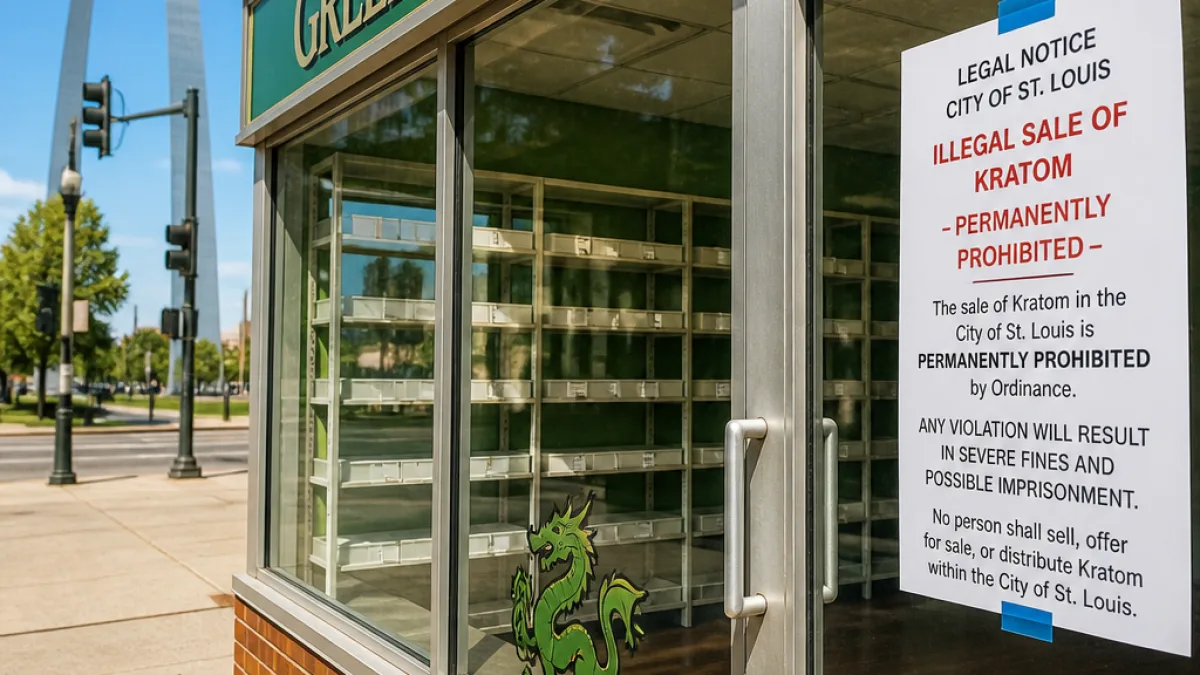
The Missouri attorney general has reached an agreement that will bar the owners of a St. Louis retail operation from selling or profiting from kratom products in the state, an action that dovetails with federal moves to temporarily classify certain concentrated kratom derivatives as controlled substances.
Terms of the agreement
Under the settlement announced Thursday by Missouri Attorney General Catherine Hanaway, St. Louis-based Green Dragon and its owners, David and Matthew Jadwin, are prohibited from owning, operating or holding a financial interest in any Missouri business that markets, advertises or sells 7-OH or other kratom products to consumers or distributors. The agreement also requires Green Dragon to remove kratom products from its Missouri stores and to stop selling, distributing or advertising them within the state.
- Who is affected: Green Dragon and owners David and Matthew Jadwin.
- What is banned: Ownership, operation, financial interests and in-state sales, distribution or advertising of 7-OH and other kratom products.
- Context: The settlement follows similar agreements with other Missouri-area distributors.
Enforcement history and local context
The Green Dragon agreement follows a pattern of enforcement by Hanaway’s office against distributors of concentrated kratom alkaloids. Her office has reached similar resolutions with Kansas City-area companies, including American Shaman and Relax Relief Rejuvenate Trading LLC, signaling a sustained effort to curb distribution of the compounds locally.
7-hydroxymitragynine, commonly called 7-OH, is an opioid-like compound that occurs naturally in kratom in trace amounts. Manufacturers frequently increase its concentration by chemically converting another kratom alkaloid, mitragynine, producing products sold as gummies, liquid shots, tablets, powders and other formulations.
“These unregulated, highly addictive drugs have taken lives and fueled addiction across our state. This resolution is another decisive step to protect Missouri families from the deadly impact of gas-station opioids,” Hanaway said in a press release.
Federal action and what it could mean
The state action comes as federal regulators move toward temporarily scheduling concentrated 7-OH and three related substances in Schedule I of the Controlled Substances Act. On July 1, the U.S. Drug Enforcement Administration announced its intent to temporarily schedule 7-OH above specified concentration thresholds, along with mitragynine pseudoindoxyl, MGM-15 and MGM-16.
| Substance | Federal action (announced July 1) |
|---|---|
| 7-hydroxymitragynine (7-OH) | Intended temporary Schedule I listing above concentration thresholds |
| Mitragynine pseudoindoxyl | Intended temporary Schedule I listing |
| MGM-15 | Intended temporary Schedule I listing |
| MGM-16 | Intended temporary Schedule I listing |
Federal scheduling would mark a significant regulatory shift for concentrated kratom derivatives, creating criminal penalties and restricting legal distribution in ways that could affect retailers and suppliers across Missouri. The AG’s settlement with Green Dragon goes further than some past resolutions by explicitly barring the Jadwins from maintaining any financial interest in Missouri businesses that sell kratom products.
Local implications
For St. Louis residents, the agreement reduces access to concentrated kratom products through a local retailer, and signals continued scrutiny of other sellers throughout the state. Many kratom-derived products are sold in convenience stores, smoke shops and online; the attorney general’s language highlights concerns about widely available formulations that regulators and public health officials say can pose addiction and overdose risks.
The Independent, which first reported aspects of the settlement, was unable to reach David and Matthew Jadwin for comment. The attorney general’s office said it will continue pursuing distributors and retailers it believes are placing Missourians at risk.
As federal action progresses, businesses and consumers in St. Louis will be watching for final determinations by the DEA and for any further enforcement actions by state authorities.