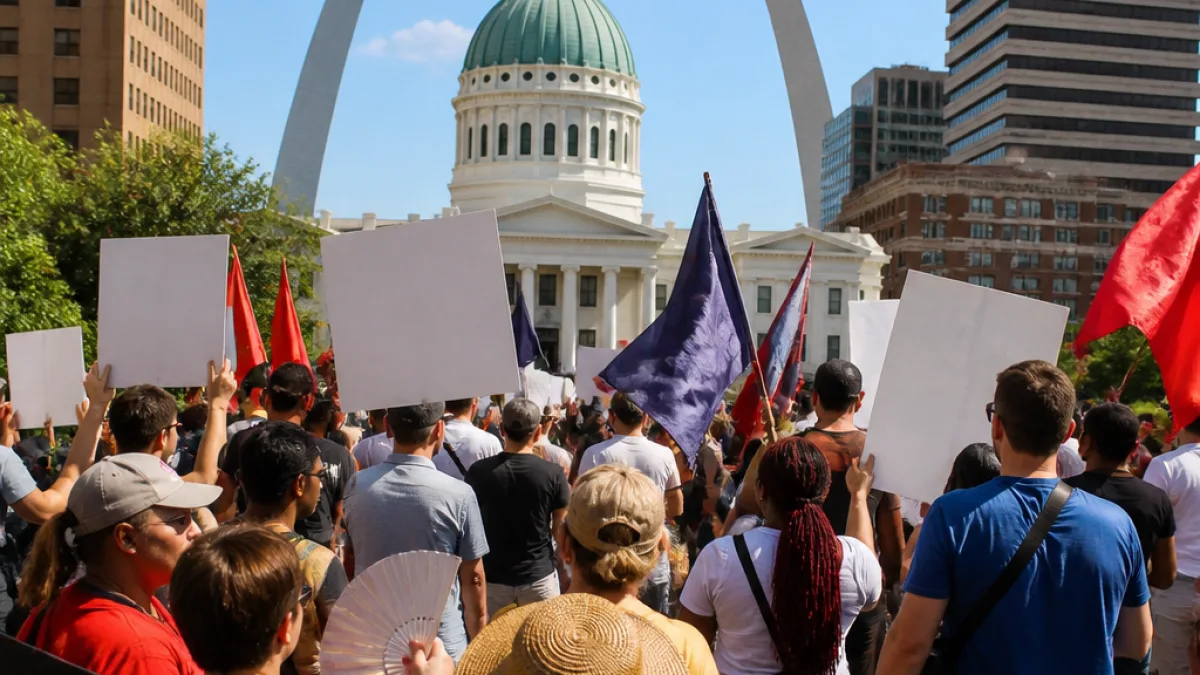
ST. LOUIS — The courthouse steps where the Dred Scott case was argued in 1847 became the backdrop for a political showdown as former U.S. Rep. Cori Bush framed her comeback bid as a moral imperative to reverse her ouster from Congress.
Speaking to a crowd near the Gateway Arch, Bush invoked history and urged supporters to restore what she described as a wrong. Her campaign drew a coalition of pro-Palestinian activists, Black Lives Matter organizers and democratic socialists who traveled to St. Louis to canvass in the summer heat.
“We’re standing here saying, send back that descendant, send her back to the place that enslaved people built,”
That image encapsulates the stakes of the rematch: a contest between two Black leaders whose public profiles grew from the modern civil rights movement that followed the 2014 police shooting of Michael Brown. Both candidates trace their careers to that moment, but they have taken divergent political paths since.
Two approaches to Democratic politics
Bush, a progressive firebrand who began as a Black Lives Matter organizer in Ferguson, served two terms in Congress before losing the Democratic primary to Wesley Bell two years ago. She argues that activism and legislation are inseparable, and she has sharpened her criticisms of party leaders and U.S. policy in recent months.
Bell, a former local prosecutor who positioned himself as a pragmatic moderate, has courted different constituencies, meeting with senior citizens at community gatherings and emphasizing a practical governing approach. The race sets up a clear referendum on whether Missouri Democrats prefer Bush’s activist-driven agenda or Bell’s more centrist, prosecutorial record.
What’s driving the intensity
Several factors are intensifying the rematch:
- Party fractures: Discontent with party establishment choices and strategy, especially among younger and activist voters.
- Foreign policy divisions: Rising skepticism of the U.S. alliance with Israel has become a more visible fault line within the Democratic coalition.
- Progressive momentum: The growing influence of democratic socialists and Black Lives Matter–affiliated organizers, whose ground game supported Bush’s campaign events.
Bush has publicly blamed outside spending groups for her previous loss, singling out the American Israel Public Affairs Committee for its role in the last contest. After that defeat, she told supporters that “all they did was radicalize me,” language she has used to underline a continuing shift in her political posture.
“All they did was radicalize me.”
Close margins, national attention
The 2024 primary was narrowly decided: Bush lost by less than six points. That tight margin helps explain why both campaigns have attracted attention beyond Missouri, turning the contest into an indicator of how the Democratic Party balances its progressive and moderate wings.
| Detail | Known fact |
|---|---|
| Bush’s congressional tenure | Two terms |
| Margin in previous primary | Less than six points |
Outside groups and national activists have shown up on both sides. For Bush, that has meant volunteers traveling from other states to help canvass and rally in St. Louis. For Bell, who is locally known for his prosecutorial role, the emphasis has been on building broad-based, pragmatic support among voters wary of ideological purity tests.
Local roots, national implications
Both candidates’ histories are entwined with the Ferguson protests that reshaped politics in St. Louis and beyond. Voters here are being asked to choose not just between two personalities but between competing visions for the Democratic Party: continued insurgent protest and radical critique, or a centrist, governance-oriented approach that emphasizes incremental change.
For many voters, the choice will hinge on whether they prefer a representative who mixes activism and legislation or one who focuses on pragmatic solutions and coalition building. The outcome will be watched nationally as a bellwether for similar intraparty contests in other urban districts.
As campaign activities accelerate, both sides will continue to court the same constituencies they relied on in the past, while attempting to expand their reach into the broader Democratic electorate. What happens in St. Louis this primary could reverberate across Missouri and offer a snapshot of where the party is headed in the years ahead.