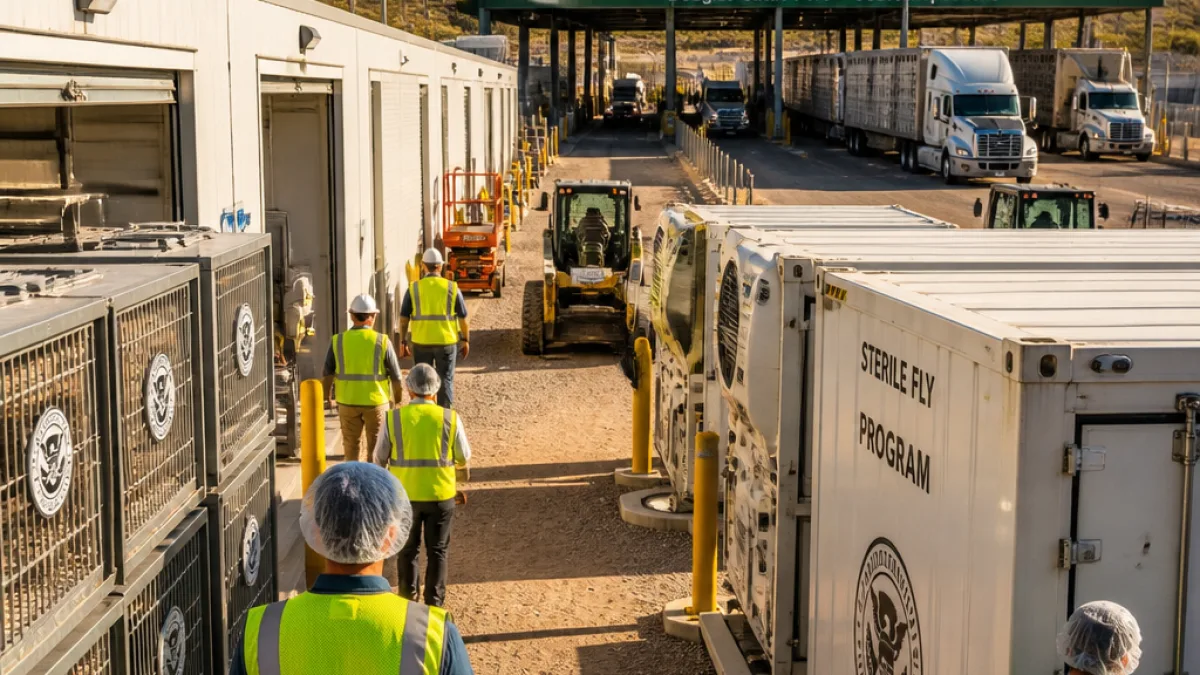
The U.S. Department of Agriculture announced this week it will invest $25 million to establish a new sterile fly dispersal facility in Arizona as part of ongoing efforts to contain and ultimately eradicate New World screwworm, an insect-borne outbreak that has prompted trade restrictions and heightened inspections along the U.S.-Mexico border.
Why Arizona was chosen
Agriculture Secretary Brooke Rollins made the announcement during a visit to Arizona, joining three Republican members of the state's congressional delegation in outlining federal containment steps tied to a phased reopening of cattle ports closed after the outbreak was detected in June 2025. Federal officials say the sterile insect technique — releasing sterilized male flies to interrupt breeding — is the primary, proven tool to eliminate the pest.
“The sterile insect technique is the only proven method to eradicate New World screwworm, and we will continue expanding this critical tool to protect America’s livestock and food supply,”
Rollins also said the department looks forward to partnering with state and local authorities to site and operate the Douglas facility. She described the federal response as “aggressive” and voiced confidence in the phased reopening plan for border inspection stations.
Reopening border ports and inspections
The USDA is planning a phased reopening of southern cattle ports affected by the 2025 detections. The department has set a target date of Aug. 24 to reopen the cattle port in Douglas, Arizona, with two New Mexico border ports — Santa Teresa and Columbus — to follow if Mexico meets obligations under a bilateral Joint Action Plan. Animals entering at these points will be subject to full USDA inspection for any signs of screwworm infection.
Federal officials say the risk to the general public and to companion animals remains very low, and the Centers for Disease Control and Prevention continues to report no human cases linked to this outbreak.
Scope of the outbreak
According to a USDA dashboard, the government has confirmed 42 cases since the outbreak began and lists 8 of those as currently active. The detections traced back to early June 2025 prompted the temporary closure of border cattle ports that move livestock and were designed to slow the spread while containment measures were implemented.
| Metric | Number / Date |
|---|---|
| Cases detected since outbreak | 42 |
| Cases currently active | 8 |
| Outbreak began | June 3, 2025 |
Local impacts and next steps
For Arizona ranchers and livestock handlers, a sterile fly facility in the state could shorten the logistical chain for dispersal operations and improve rapid response times. The sterile insect technique requires producing and releasing large numbers of sterilized male flies over affected areas; locating a production and release hub closer to outbreak zones reduces transport time and operational complexity.
- Trade: Reopening ports could restore cattle movement and trade flows that had been restricted since the outbreak.
- Surveillance: Animals entering reopened ports will undergo full USDA inspection for signs of infection.
- Coordination: Continued cooperation with Mexican authorities under the Joint Action Plan remains a condition for reopening multiple ports.
Rollins said the department will keep expanding the sterile insect tool as part of containment work. “The fight isn’t over, but we are making real progress. We will keep building on that momentum until New World screwworm is eradicated,” she added.
What residents should know
State and federal officials emphasize the immediate risk to the public is very low. Nonetheless, livestock owners should remain vigilant for signs of infection — typically wounds infested with larvae — and report suspicious cases to state animal health authorities. The USDA and state veterinary services continue surveillance and targeted control operations while assessing the readiness of reopened ports.
As federal investments move forward, Arizona will host operations intended to protect a major part of the state's and the region’s agricultural economy. Locating a USDA sterile fly dispersal facility here indicates a continued federal commitment to rapid, localized response in the event of future detections.
More details on facility location, staffing and operational timelines are expected as federal, state and local partners finalize plans in the weeks ahead.