Board approves delivery plan to launch intercity rail service in three years
The Front Range Passenger Rail Board of Directors unanimously approved an 80-page delivery plan Friday that lays out the district’s timeline and funding approach to begin daily intercity train service between Denver and Fort Collins in 2029. The decision moves the long-discussed rail corridor into the design and pre-construction phase for an initial service of three daily trips.
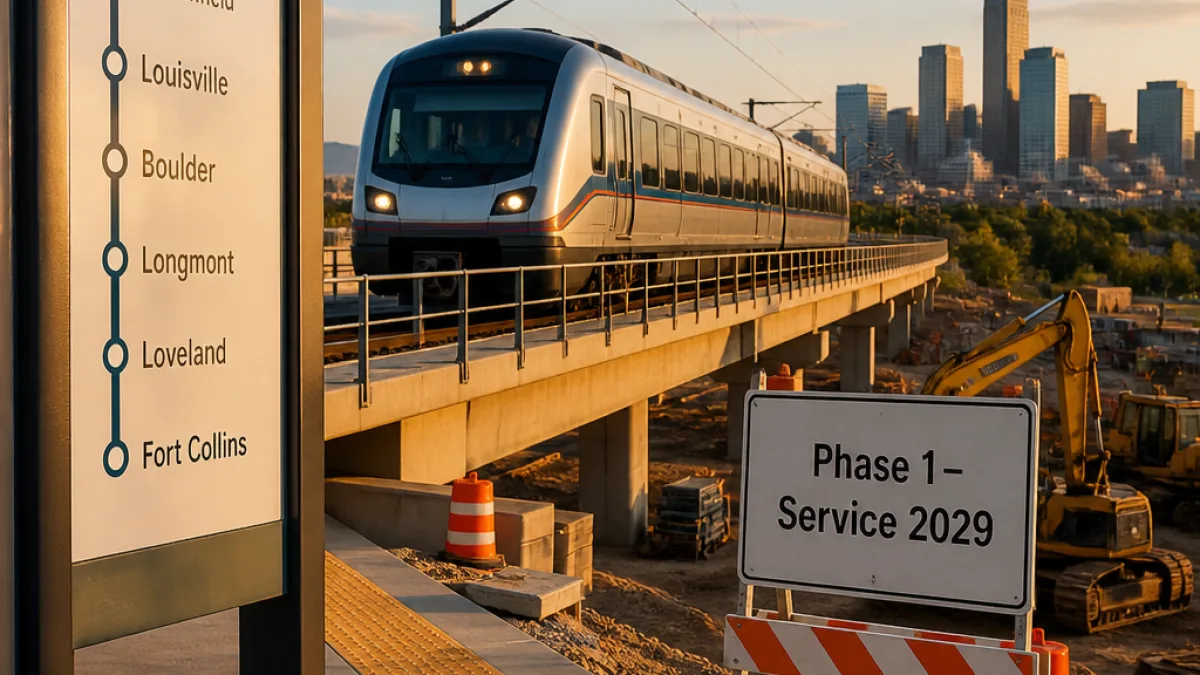
The approved plan calls for trains to run between Denver and Fort Collins with intermediate stops in six Front Range communities: Westminster, Broomfield, Louisville, Boulder, Longmont and Loveland. The board and district leaders framed the measure as the first, fiscally scoped step toward a broader vision: eventually linking 13 cities along the Front Range and expanding service to as many as 10 daily trips.
“This puts us one step closer to referring the ballot issue and one step closer to Colorado Connector rail service across the Front Range,”
The quoted remarks came from Front Range Passenger Rail General Manager Sal Pace as the board outlined a phased approach. The first phase, according to the delivery plan, requires no new taxes and will be funded by the Regional Transportation District (RTD) and the Colorado Department of Transportation (CDOT). That funding path is intended to fulfill the delayed FasTracks connection between Boulder and Denver while establishing the foundational service between Denver and Fort Collins.
What the first phase includes
- Begin running three daily trips between Denver and Fort Collins.
- Stops at Westminster, Broomfield, Louisville, Boulder, Longmont and Loveland.
- Design work already under way; a construction approval vote to come before the rail district and RTD by late this year.
District officials said design work for the first phase has already begun. A separate vote on whether to move into construction is expected to be taken by the rail district and RTD before the end of the year, according to the delivery plan summary.
How expansion would be funded and where it could go next
While the initial three-trip service will rely on existing RTD and CDOT resources, the delivery plan sets the stage to ask voters to approve a sales tax to expand the system. If referred and approved, the proposed ballot measure would support:
- Adding a second daily Denver–Fort Collins trip (eventually growing to 10 total trips across the corridor over time).
- Twice-daily service on an east–west spine connecting Denver with southern and eastern communities, including Littleton, Sterling Ranch, northern Colorado Springs, Colorado Springs and Pueblo.
Board members are scheduled to consider referring the sales-tax measure to the ballot at a public meeting in Pueblo next month. Approving the delivery plan does not yet obligate voters to a tax, but it is the formal precursor to any ballot referral.
| Phase | Service | Funding |
|---|---|---|
| Phase 1 (2029) | 3 daily trips — Denver ↔ Fort Collins (6 intermediate stops) | RTD and CDOT (no new taxes) |
| Expanded service (future) | Additional daily trips; twice-daily Denver–Pueblo/Colorado Springs spine | Potential future sales tax (to be referred to voters) |
For Denver commuters and residents, the plan represents a tangible advance on a regional transit promise that has seen fits and starts for years. Supporters argue improved rail connectivity could relieve congestion on I‑25 and I‑76, offer a transit alternative for daily and occasional travelers, and stimulate economic development around station areas. Opponents of a future tax measure are likely to press questions about long-term operating costs, ridership projections and the impact on local road budgets — issues the district will need to address in coming public outreach and the ballot campaign.
The delivery plan’s approval marks an administrative milestone: design and pre-construction are moving forward, and leaders have set the public timetable for the next series of decisions — including a construction vote before year’s end and a potential ballot referral next month. As work accelerates, Denver-area residents will see more detailed engineering, cost estimates and service plans that will shape how the corridor is built and operated.
This is a developing story and the rail district has signaled further updates as the design and public-engagement phases proceed.