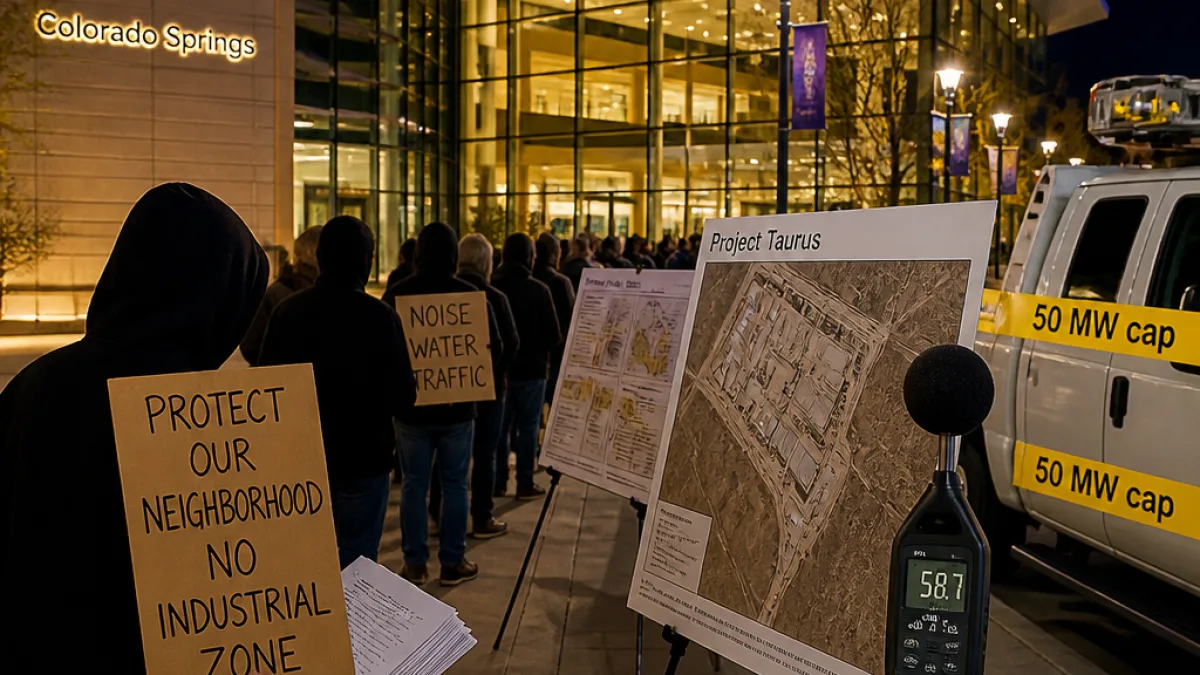
The Colorado Springs Planning Commission voted 6–2 late Thursday to deny appeals to the city's approval of the proposed Project Taurus data center, allowing the project to proceed after nearly 14 hours of public testimony and deliberation at the Ent Center for the Arts.
The hearing drew months of community attention, with residents, neighborhood groups and business interests pressing concerns about power use, water, noise and local impacts. Those concerns were the focus of public testimony that stretched well into the night before commissioners cast their votes.
What the commission approved — and what it required
While the vote allows the data center development to continue, the commission attached a set of conditions intended to provide ongoing oversight. Among the conditions included in the record are requirements for the project operator, Raeden, to:
- Report utility use data for the first 10 years of operations.
- Limit utility use to 50 megawatts, with any request to exceed that threshold requiring return to the commission for approval.
- Provide a corrected "single sheet" to the existing building plan.
- Modify the project's sound-monitoring plan.
The commission’s decision does not end the procedural process. The appellants — neighbors and others who challenged the city's prior approvals — have a 10-day window to file an appeal of the Planning Commission’s ruling.
Where Project Taurus would be built
Project Taurus is proposed along Garden of the Gods Road, a corridor that has seen increased attention as the city considers industrial-scale projects near established neighborhoods. The proposal has been the subject of dozens of public meetings since it was first announced in April.
The project's chief operating officer addressed community questions at multiple public forums in recent months, according to prior coverage. Still, residents repeatedly raised concerns about the scale of electrical demand, potential effects on local water supplies, and noise from equipment and cooling systems.
Community reaction and next steps
Reaction among community members was mixed as the hearing concluded. Some residents left the Ent Center frustrated by the outcome and vowed to pursue further appeals, while proponents argued the conditions adopted by the commission will provide necessary transparency and limits on operations.
News5 and other local outlets said they plan to follow up with residents and the company about the decision. If an appeal of the Planning Commission’s vote is filed within the 10-day period, that will set a new timetable for legal and administrative review; if not, the project will move forward under the terms approved by the commission and the city’s earlier approvals.
| Item | Commission action / requirement |
|---|---|
| Vote | 6–2 to deny appeals |
| Public hearing length | Nearly 14 hours |
| Utility cap | 50 megawatts, commission approval required to exceed |
| Reporting requirement | Utility use data for 10 years |
Planning commissioners said the conditions were intended to balance the city's development goals with community protections, including measurable limits and ongoing reporting to ensure compliance. The requirement to return to the commission if power needs increase was highlighted as a way to maintain local oversight as the facility’s operations evolve.
Opponents have argued that even with conditions, large-scale data centers can produce outsized demands on municipal systems and alter the character of surrounding neighborhoods. Supporters have pointed to job creation, tax revenue and the strategic need for computing infrastructure as reasons to allow development under controlled terms.
For now, the immediate question is whether appellants will use the statutory 10-day appeal window. If they do, the dispute will move into the next stage of the city's review and potentially to court. If they do not, Project Taurus will be permitted to proceed under the revised conditions set by the Planning Commission.
The commission’s vote underscores the tension Colorado Springs faces as it seeks to attract economic investment while responding to residents’ concerns about utilities, noise and livability. How the company meets its reporting and noise-monitoring obligations will likely shape the next chapter of public discussion around Project Taurus.