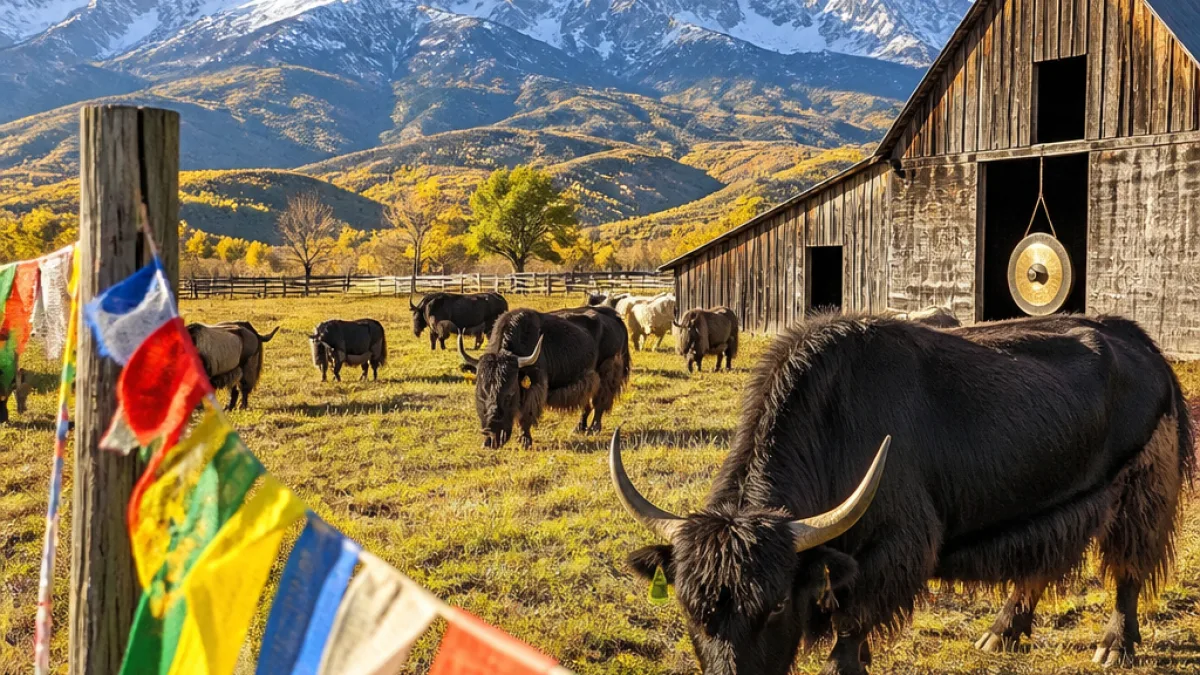
On a windswept mesa in western Colorado, prayer flags snap against a jagged mountain skyline and a gong serves as a doorbell. It’s an unexpected scene on land that is also home to a herd of shaggy, low-slung bovines more commonly associated with the high plateaus of Nepal and Tibet than with the San Juan Mountains.
A Himalayan chapter in the Colorado outdoors
Smiling Buddha Yaks, a ranch outside Ridgway, sits on roughly 120 acres of pasture, foothills and mesa tops. The ranch’s owner, retired cancer surgeon Ruth Higdon, traces her fascination with yaks to an encounter in Nepal near Mount Everest. Years later, she ran yak expeditions in Alaska, learned from Tibetan herders and studied yak husbandry at India’s National Research Center on Yak before breeding her own herd on Colorado soil.
The ranch is managed by Namgyal Sherpa, who lives on the property with his wife, Pasang — a former Buddhist nun — and Higdon. The Sherpas are from Nepal’s Khumbu region, bringing direct cultural and practical expertise to the operation. Their presence gives the ranch a deliberately Himalayan character: prayer flags, yak skulls and hair in the barn, and the distinctive garb and bells Higdon remembered from her first sighting of the animals overseas.
Animals and people: language of the herd
Yaks have a different presence from cattle. They move with a low, rumbling vocalization and a close, herd-oriented vigilance. When a calf recently slipped into tall grass, manager Namgyal walked among the animals and made a series of calls — restrained grunts followed by higher-pitched notes — that drew the youngster out and back to its mother. The scene illustrated an intimate knowledge of yak behavior that Higdon has spent decades cultivating.
"Cows moo, yaks grunt," she explained. "Their Latin name is Bos grunniens — grunting ox."
That attention to yak vocalizations and social cues is one reason Smiling Buddha Yaks functions more like a close-knit husbandry operation than a novelty farm. Higdon and Namgyal coordinate breeding, calving and pasture rotation to suit the animals’ needs and the mountainous environment.
From Everest foothills to Colorado pastures
Higdon’s path to yak ranching is not a straight line. After her first encounter with yaks in Nepal, she organized expeditions and immersed herself in traditional Himalayan animal care. She also spent time in India learning at a national research center that studies yaks, a place noted in her background for developing the first test-tube yak calf. Those experiences informed the husbandry techniques she now applies in Ridgway.
The ranch is at once a workplace and a cultural exchange. The Sherpas who manage daily operations bring inherited knowledge about animal handling in high-altitude, cold-climate environments, while Higdon provides the land and a background in scientific inquiry from her medical career. The interplay of those strengths frames Smiling Buddha Yaks as both pragmatic and personal.
What the ranch contributes locally
Yaks are unusual livestock in the United States, and a working herd on Colorado land raises questions about local agriculture, tourism and education. Smiling Buddha Yaks offers a living example of how nontraditional livestock can be integrated into a regional landscape, and it provides opportunities for residents and visitors to learn about conservation grazing, fiber and small-scale meat production practices that differ from conventional cattle operations.
- Owner: Ruth Higdon, retired cancer surgeon
- Manager: Namgyal Sherpa (and wife Pasang)
- Location: Ridgway, San Juan Mountains, western Colorado
- Size: approximately 120 acres
| Feature | Detail |
|---|---|
| Species | Yak (Bos grunniens) |
| Primary activities | Breeding, husbandry, education |
| Local setting | Pasture, foothills, mesa tops in Ridgway |
For Ridgway and the surrounding counties, the ranch adds a distinct local story and — for visitors — a rare chance to see animals most people associate with Himalayan landscapes rather than Colorado mesas.
Practical considerations and the future
Yaks are adapted to cold, high-altitude conditions and have different management needs than cattle. That makes western Colorado’s climate and elevation a plausible fit for the animals, but it also requires attentive care, knowledgeable handlers and infrastructure tailored to their morphology and behavior. Higdon’s decades of study and Namgyal’s lifelong familiarity with yaks converge to meet those needs on the ranch.
As interest in alternative livestock and specialty agricultural products grows, Smiling Buddha Yaks stands as a living experiment: a cultural transplant that has taken root where alpine vistas meet American ranch country. For the people who work there, it’s both a livelihood and a continuation of long-held traditions.
On any given day in the pasture, you can see yaks trotting across the ridge, bells chiming faintly, and the small, intimate choreography between handlers and herd. It’s an unlikely scene for Colorado, but one that has become part of this corner of the San Juans.