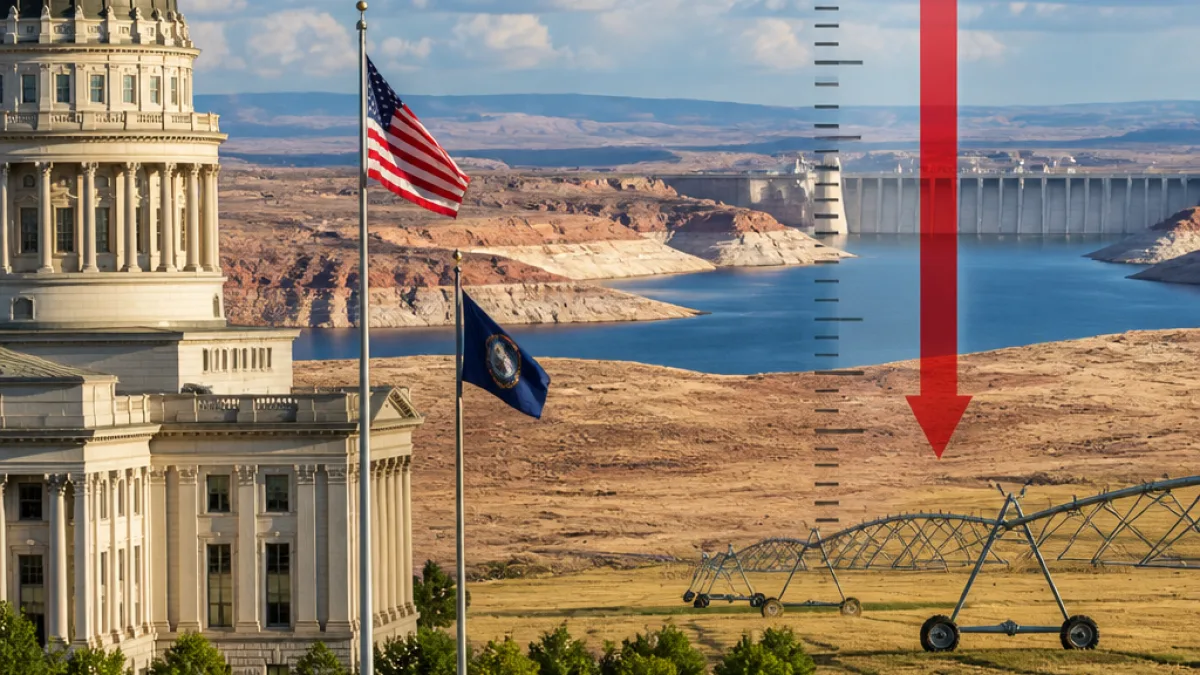
SALT LAKE CITY — The U.S. Bureau of Reclamation on Friday released its long-awaited environmental impact statement laying out how the federal government plans to manage the shrinking Colorado River system. The document would impose the largest mandatory reductions on the Lower Basin — Arizona, California and Nevada — while largely leaving Utah and the other Upper Basin states free of direct cuts for now.
Lower Basin to absorb biggest reductions
The plan outlines stepped-down supplies for the Lower Basin and cites a shortfall that the bureau says the basin cannot keep ignoring. Officials estimate the three Lower Basin states could take as much as 3 million acre-feet less water in coming years under the proposal.
“The proposal responds to a fundamental reality: the Colorado River no longer reliably produces enough water to support all the uses and expectations built around it,” JB Hamby, the Colorado River Commissioner for California, said in a statement.
That language underscores the blunt federal assessment: demand has outpaced supply for years, and climate- and usage-related declines in runoff mean the river cannot sustain current allocations without major change.
Utah largely spared — with conditions
Utah and the other Upper Basin states — Colorado, Wyoming and New Mexico — will not face the same mandatory cutbacks, according to the environmental review. State officials framed that as a reflection of geography and hydrology: Upper Basin water deliveries fluctuate with the snow and runoff they receive.
Gene Shawcroft, the Colorado River commissioner for Utah, told reporters the state is accustomed to operational variability. “We get cuts from Mother Nature every year,” he said, adding that inhabitants and managers must live with the river’s natural supply. Amy Haas, executive director of the Colorado River Authority of Utah, noted the plan appears to favor maintaining storage at Lake Powell by reducing releases downstream, an approach she said aligns with the worsening hydrology.
Federal push for basinwide agreement
Although Upper Basin states are largely spared mandatory curbs, the federal plan still pressures them to set conservation goals. The document calls for a series of short-term arrangements — described as “10 years’ worth of two-year deals” — intended to prod the seven basin states into negotiating a new management framework.
Those rolling agreements are designed to be stopgap measures that force periodic reassessment and cooperation, rather than a single, permanent reallocation imposed from Washington.
Why the federal plan now matters
Federal intervention follows repeated failures by the basin states to agree on a long-term division of scarce water. Reclamation officials say the states’ inability to reach a durable deal left the bureau little choice but to present a federal blueprint for addressing the gap between supply and demand.
Experts and managers have warned of worsening conditions: studies cited by the bureau suggest the system faces structural risks, including projections that Glen Canyon Dam’s hydropower could stop operating by the end of the year if water levels continue to decline. Reduced hydropower generation would have downstream impacts on grid reliability and revenue streams that support dam operations.
Immediate implications for Utah communities
- Urban water providers: Municipalities will need to revisit demand-management plans and conservation targets as federal and regional negotiations unfold.
- Agriculture: Farmers could face tighter supplies through voluntary or market-driven mechanisms even if mandatory cuts are not assigned to Upper Basin states.
- Energy and recreation: Lower reservoir levels may affect hydropower and recreational economies tied to Lake Powell and Lake Mead.
The federal plan’s emphasis on short-term, iterative deals leaves many operational details unresolved. For water managers in Utah, that may be both a relief and a complication: relief because the state avoids immediate mandated reductions; a complication because the state must still commit to conservation targets and participate in recurring negotiations that could reshape water availability over the next decade.
The Bureau of Reclamation framed the move as necessary to avert a basinwide collapse of services and infrastructure depended on by tens of millions. For Utahns, the immediate takeaway is that the state will not shoulder large mandatory cuts — but it must still adapt to a drier river, align local policy with federal objectives, and prepare for a decade of frequently renegotiated agreements designed to stabilize the system.