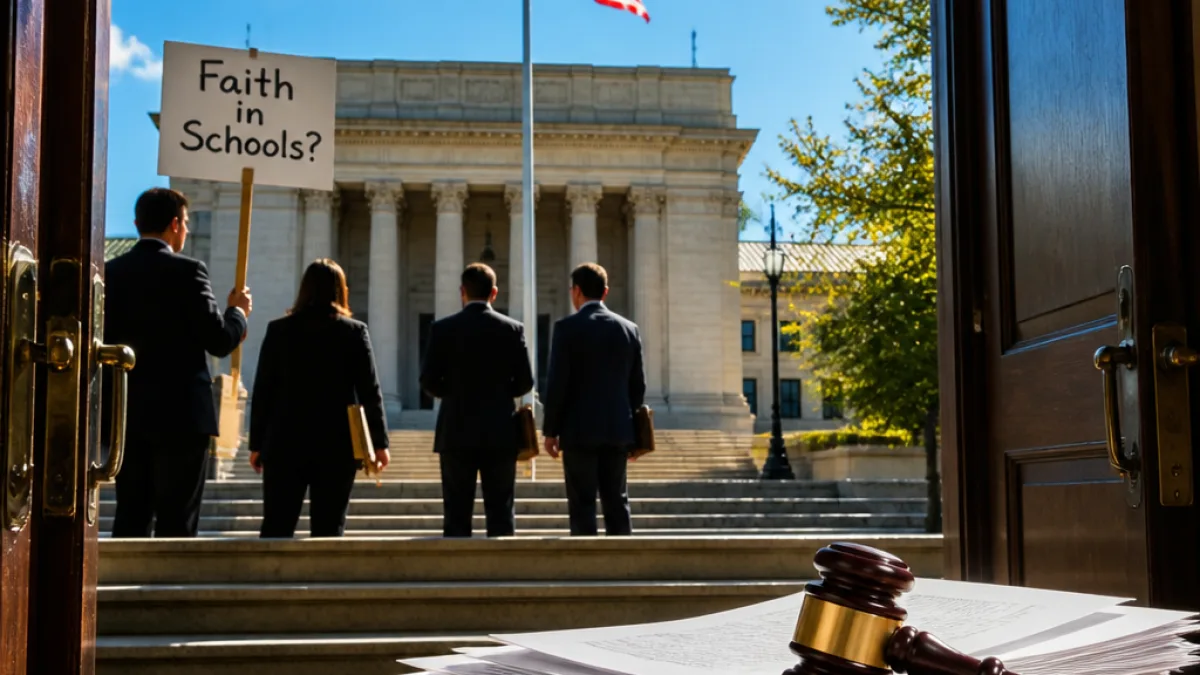
The fate of religious charter schools in Oklahoma returned to federal court on Aug. 5 as lawyers argued whether a state law that restricts charter applicants to "nonsectarian" organizations violates the First Amendment's protection for the free exercise of religion.
Long-running dispute over public funding and faith
Oklahoma created its charter school program in 1999 to allow publicly funded, privately run K–12 schools as alternatives to district-operated schools. State law, however, limits charter applicants to those that are "nonsectarian," a provision that prevents institutions with a religious identity from operating as charter schools.
The dispute sharpened after the Oklahoma Statewide Charter School Board approved an application in 2023 from a proposed Catholic virtual school, St. Isidore of Seville Catholic Virtual School. That approval prompted legal action from Oklahoma Attorney General Gentner Drummond, who opposed charter schools organized around a faith.
The Oklahoma Supreme Court ultimately sided against the religious school, concluding that charter schools are public schools and therefore must remain secular. St. Isidore appealed, but the U.S. Supreme Court was unable to issue a majority decision when justices split 4-4; Justice Amy Coney Barrett recused herself from the case, leaving no controlling opinion from the high court.
New challenge from a Jewish foundation
With the federal landscape unsettled, the National Ben Gamla Jewish Charter School Foundation later sought to establish a charter school in Oklahoma. Its application was denied, and the group — represented by attorneys with the Becket Fund — filed a federal lawsuit asking a district court to order the Statewide Charter School Board to consider religious applicants on the same terms as secular ones.
"Oklahoma makes room in its charter program for schools of all shapes and sizes, from those focused on science and fine arts to language immersion and classical education," Becket attorney Daniel Chen said in a statement. "The one it refuses to make room for is a faith-based school. That is religious discrimination, plain and simple, and the state deserves a failing grade for it."
At the August hearing, Becket asked the federal court to immediately allow the Ben Gamla foundation to proceed with its application, citing U.S. Supreme Court precedent that requires government programs to include religious organizations on equal terms. Lawyers for the state defended the current statutory limitation, arguing the state’s interpretation of charter law and the Oklahoma Supreme Court ruling require charter schools to remain secular.
What’s at stake for Oklahoma communities
The outcome could reshape who is eligible to receive public funds through the charter program and how faith-based educational preferences are accommodated in the public education system. Supporters of religious charter schools argue inclusion would expand parental choice and allow faith communities to operate schools that follow their religious identity while meeting public education standards. Opponents maintain that public schools must be secular to respect the separation of church and state.
- Charter law origins: Oklahoma’s charter system dates to 1999.
- Recent litigation: The state Supreme Court found charter schools are public and must be secular; the U.S. Supreme Court deadlocked on appeal.
- Current suit: Ben Gamla, with Becket Fund counsel, asks a federal judge to require the charter board to consider religious applicants.
For parents, educators and local officials, the legal fight raises practical questions: which schools may apply for charters, how religious instruction would be handled if religious charter applicants are approved, and how curricular and employment policies would align with both constitutional protections and state law. Those specifics were not resolved at the Aug. 5 oral arguments, leaving communities awaiting the court’s ruling.
| Year | Event |
|---|---|
| 1999 | Oklahoma establishes charter school program |
| 2023 | Statewide Charter School Board approves St. Isidore application; state AG challenges approval |
| 2024–2025 | Oklahoma Supreme Court rules charter schools are public and must be secular |
| Afterward | U.S. Supreme Court deadlocks 4-4 on appeal |
| Aug. 5 | Federal court hears new challenge from Ben Gamla/Becket Fund |
Whatever the court decides, the case will be closely watched by faith communities, education advocates and state officials. If the federal judge orders the Statewide Charter School Board to accept religious applicants, Oklahoma could see an expansion in the types of charter schools permitted. If the judge defers to the Oklahoma Supreme Court’s interpretation or upholds the nonsectarian restriction, the current status quo will remain.
For now, the issue remains unresolved in the courts, and school boards, parents and religious organizations must wait for further guidance before making long-term plans tied to charter-authorizing processes and enrollment decisions.