TULSA — Tulsa police arrested a 30-year-old man Wednesday afternoon after officers say he stole a vehicle from a Home Depot parking lot in downtown Tulsa and was tracked using the department’s Real Time Information Center.
The theft and the pursuit
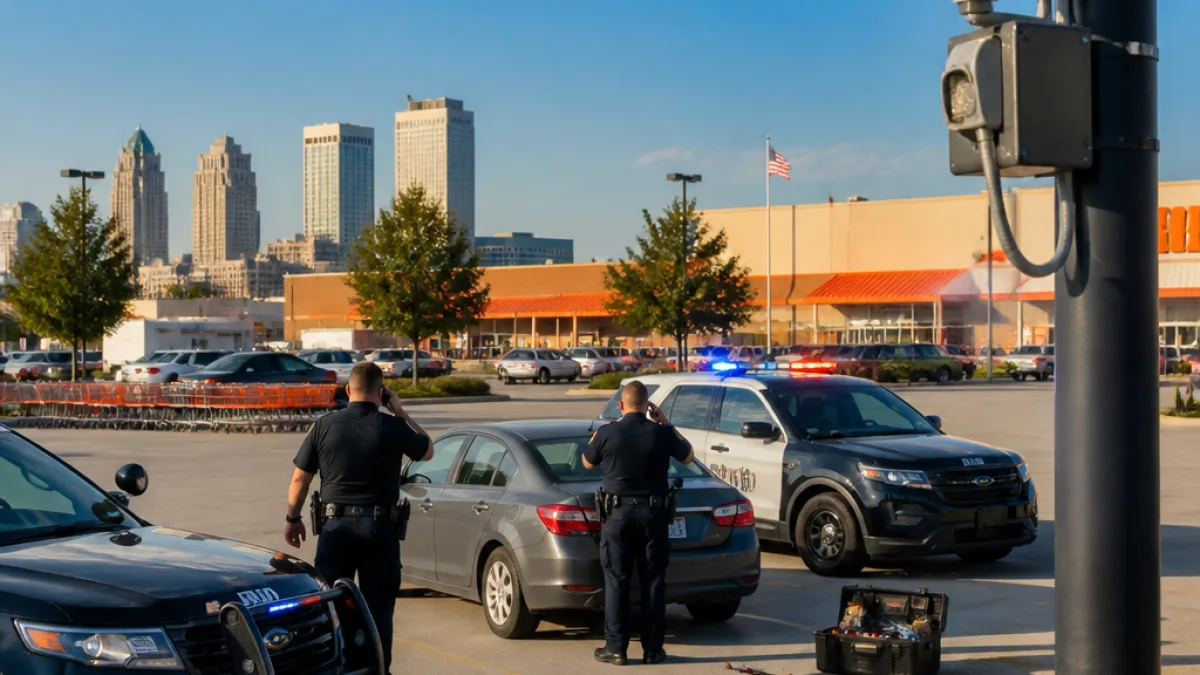
According to a police account of the incident, the theft occurred about 3 p.m. in the parking lot of the Home Depot near East 8th Street and South Elgin Avenue. Investigators say the vehicle’s owner had gone inside the store for roughly 25 minutes and returned to find the vehicle missing.
Officers say the department’s Real Time Information Center immediately began searching for the stolen vehicle using Automated License Plate Readers. The system located the car traveling north on 33rd West Avenue near West 51st Street. Officers attempted to stop the vehicle; the driver pulled into a bank parking lot, where officers surrounded the car and took the man into custody without further incident.
What police say they recovered and alleged actions
Investigators told reporters the suspect attempted to remove the vehicle’s emblem and spray-paint the lettering on the trunk. The vehicle’s owner reported about $1,000 worth of tools and equipment were missing.
- Time of theft: ~3 p.m.
- Location: Home Depot parking lot near East 8th & South Elgin
- Tracking: Automated License Plate Readers via the Real Time Information Center
- Recovered items: vehicle; missing tools/equipment reported at $1,000
“He told officers he believed that if he had a vehicle, he might be able to find work.”
Charges and booking
Police identified the suspect as 30-year-old Jason Southard. He was booked into the Tulsa County Jail on multiple counts, including larceny of an automobile, third-degree burglary and malicious injury to property.
| Suspect | Age | Charges |
|---|---|---|
| Jason Southard | 30 | Larceny of an automobile; third-degree burglary; malicious injury to property |
The department’s use of license plate readers and a centralized monitoring center underscores how Tulsa police are deploying technology to respond quickly to vehicle crimes in the city. Those systems allow rapid cross-referencing of plate data against reported thefts and other alerts, which investigators credited in locating the vehicle in this case.
Local context and consequences
Vehicle thefts from commercial parking lots are a frequent nuisance in cities; downtown Tulsa’s retail corridors and the steady flow of shoppers make quick, opportunistic theft possible when owners leave vehicles unattended. For small-business owners and tradespeople, stolen tools can be a substantial economic hit: in this instance the reported loss was about $1,000, a figure that can represent a week or more of work for some independent contractors.
Beyond the immediate loss, these incidents raise questions about safety and prevention. Simple measures — locking vehicles, removing visible valuables, using vehicle immobilizers and parking in well-lit, monitored areas — cut risk for drivers. For policymakers and business owners, they also prompt review of lighting, surveillance and security staffing in lots that serve busy retail centers.
As the case proceeds through the criminal justice system, it will be processed through the Tulsa County Jail and then to the appropriate court for arraignment and subsequent hearings. Charges as filed may be subject to change as investigators complete their work.
For residents, the episode is a reminder of both the value of vigilance in public parking areas and the growing role of data-driven tools in local policing. The department’s swift response in this incident shows the potential for those tools to shorten the time between a report and recovery, but it also keeps on the conversation the balance between technology, privacy and community policing preferences in Tulsa’s neighborhoods.
More information, including court dates and case updates, is typically available through the Tulsa County Sheriff’s Office and the Tulsa Police Department’s public information channels.