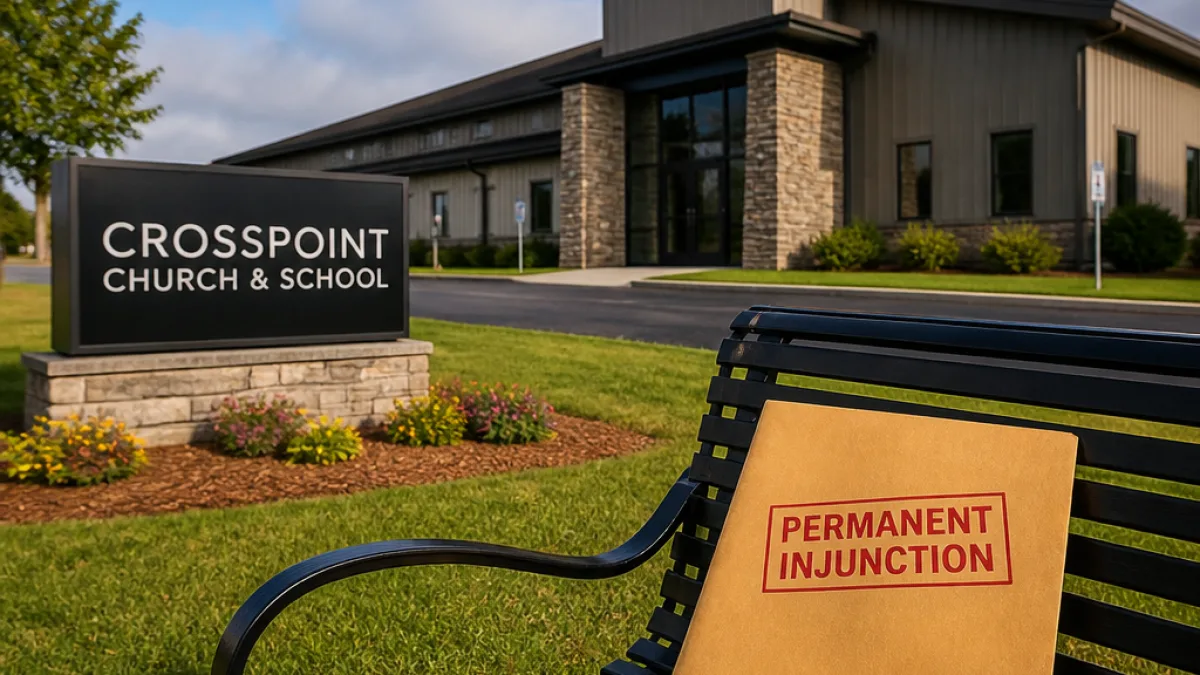
A federal judge in Maine has ordered the state to stop enforcing one element of the Maine Human Rights Act against Crosspoint Church, which operates Bangor Christian School. The ruling follows a decision by the 1st U.S. Circuit Court of Appeals that identified a constitutional problem with that particular provision while preserving the remainder of the statute.
What the order does — and does not — do
The court entered a permanent injunction preventing Maine from applying a section of the Human Rights Act that requires schools permitting religious expression not to favor one religion over another. The ruling is narrow: it blocks enforcement of that single provision against Crosspoint Church while the broader case remains pending.
The state retains the authority to enforce the law’s other nondiscrimination protections, including those related to religion, sexual orientation and gender identity. Bangor Christian School does not currently participate in Maine’s publicly funded tuition program that allows students in some communities without public schools to attend private schools with public money.
Why Crosspoint challenged the law
Crosspoint Church argued that the challenged rule could force Bangor Christian School to allow religious messages or practices that conflict with the church’s Christian beliefs. The 1st Circuit agreed with that specific argument earlier this month, concluding that the provision could be applied in ways that infringe on the church’s religious exercise. The appeals court declined to strike down the entire Human Rights Act.
The district court’s injunction implements that appellate finding, giving Crosspoint a limited legal victory while leaving most of the state’s nondiscrimination regime intact.
Practical implications for schools and the state
The decision leaves several practical questions for school administrators, parents and state officials. Among them:
- Which religious expressions a private school must permit when it accepts public tuition dollars;
- How the state will apply nondiscrimination protections while staying within the bounds set by the courts;
- Whether other religiously affiliated schools will press similar constitutional challenges.
For now, private religious schools that are not part of the tuition program remain in their current position; the court’s order applies specifically to Crosspoint Church in this case.
Where the law stands now
Summarizing the effect of the rulings:
| Action | Current status |
|---|---|
| Enforcement of provision requiring equal treatment of religions when religious expression is allowed | Blocked against Crosspoint Church by district court injunction (following 1st Circuit agreement) |
| Other nondiscrimination protections (religion, sexual orientation, gender identity) | Still enforceable by the state |
The narrowness of the injunction means the law remains largely intact for the general public but is limited in application to the challenged provision and the named defendant.
Broader context
Maine’s tuition program, mentioned in court filings, allows students from towns without public schools to use public funds at private institutions. Bangor Christian School is not a participant in that program at this time; courts have therefore framed much of the dispute around constitutional protections for religious exercise rather than around the state’s funding rules.
Legal experts and civil-rights advocates will be watching whether other religiously affiliated schools take similar challenges to the Human Rights Act or whether the state seeks to revise the law to address the court’s concerns while preserving nondiscrimination goals.
The case represents a tightrope that courts often face: balancing anti-discrimination aims with constitutional protections for religious exercise. In this instance, the appellate court and the district court found that balance tipped, at least with respect to the statute’s equal-treatment provision as applied to Crosspoint Church.
As the litigation continues, state officials, school leaders and parents in Maine can expect further legal filings and possibly revised guidance from the attorney general’s office about how the Human Rights Act will be enforced going forward.
Reporting for NEXO RADAR from Bangor.