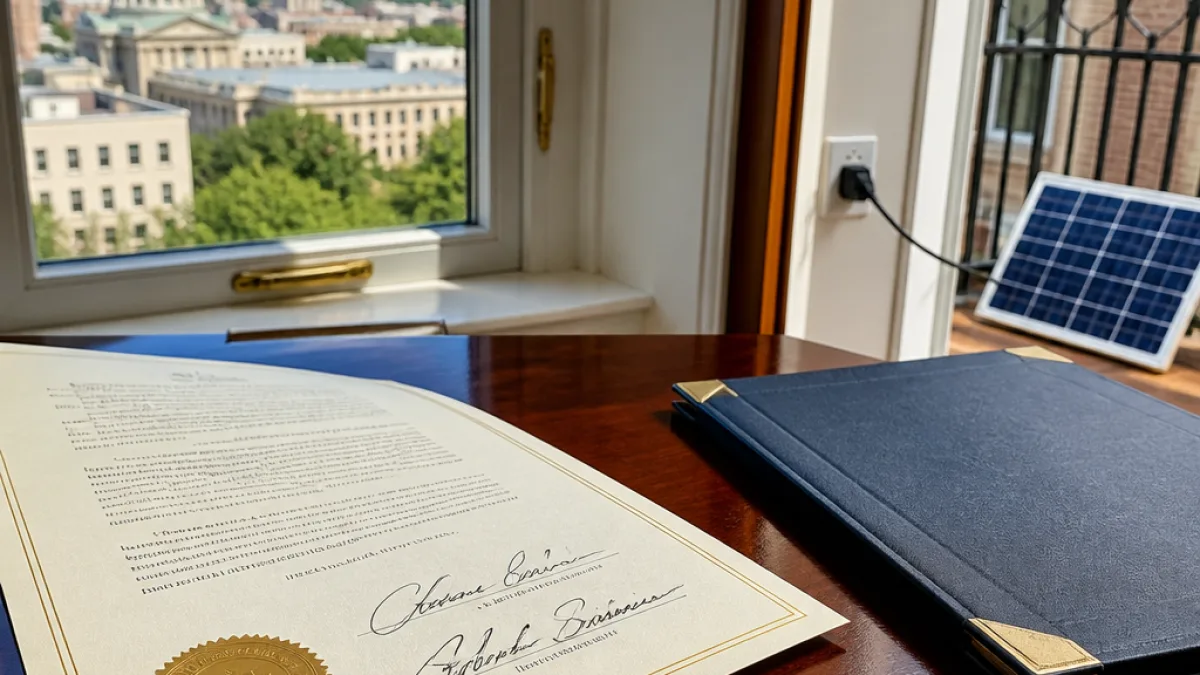
New Jersey on Tuesday moved to make small, plug-in solar panels broadly legal across the state, signing the Garden State Balcony Solar Act (S2368/A4836) into law. The measure allows residents to install and use portable solar generation devices up to 1,200 watts without going through the usual utility interconnection or local permitting process.
What the law does and when it starts
The law, approved unanimously by both legislative chambers in late June, takes effect March 1, 2027. It establishes statewide rules for so-called “balcony solar” and other small plug-in photovoltaic systems that connect to a household’s electrical system through a standard 120-volt outlet.
Under the new statute, devices that meet the technical requirements will be exempt from utility interconnection and metering mandates, and from certain fees, approvals and equipment mandates that apply to larger rooftop and grid-tied systems. The bill also curtails the ability of landlords and homeowners’ associations to blanket-ban these systems, while still allowing reasonable limits aimed at size and placement.
“From day one, I’ve been laser-focused on driving down energy costs through an all-of-the-above approach, and that includes putting clean, affordable solar power that you can simply plug in directly into the hands of New Jerseyans,” Governor Mikie Sherrill said in a statement.
Safety and certification requirements
The law requires qualifying devices to comply with the most recent National Electrical Code (NEC) and the State Uniform Construction Code and to be listed or certified under the UL 3700 Outline of Investigation for Interactive Plug-In PV (PIPV) Equipment and Systems. There is a narrower path for very small units: devices that output 400 watts or less are exempt from the UL listing and certain code requirements, reflecting their lower energy contribution and simplified connection.
- Up to 1,200 W: Allowed statewide without interconnection or permit requirements if devices meet UL and code standards.
- 400 W or less: Eligible for additional exemptions from UL listing and some code requirements.
- Protections for renters and HOA members: Landlords and HOAs cannot broadly prohibit use, though they may set reasonable limits on size and placement.
Why this matters in New Jersey
The law is part of a broader push by the Sherrill administration to expand clean energy options while addressing affordability. Officials have highlighted portable solar as an affordable, quick-to-deploy tool that can help households shave consumption from the grid without the cost or permanence of full rooftop installations.
For renters, apartment dwellers and condominium owners — groups that often face hurdles when seeking to add solar — the measure provides a clear, uniform path to adopt small-scale solar. By prohibiting broad bans from landlords and HOAs, the law removes one of the most common barriers to deployment in multi-unit housing.
How residents can prepare
Consumers interested in plug-in solar should note these practical points before purchasing a system:
- Check the device’s power rating: manufacturers typically list peak wattage. Units up to 1,200 W are covered by the new law; those at or below 400 W receive additional exemptions.
- Confirm certification: for most systems, look for UL 3700 or other recognized listings and compliance with the NEC and State Uniform Construction Code.
- Review any reasonable HOA or landlord restrictions on size or placement to ensure compliance.
| Device output | Key rule |
|---|---|
| ≤ 400 W | Exempt from UL 3700 listing and some code requirements |
| 401–1,200 W | Must meet UL 3700, NEC and State Uniform Construction Code; exempt from interconnection/permit requirements |
Officials say most portable systems include a built-in microinverter and adapter for a standard outlet, and that these units are widely available online and in home-improvement stores. The law’s exemptions do not mean utilities or authorities should ignore safety; rather, they streamline deployment while keeping requirements for listed, code-compliant equipment.
Broader policy context
The bill complements an array of actions from the governor’s office aimed at lowering energy costs and bringing more distributed clean energy online quickly. The administration has pursued rate freezes, expanded community solar targets and approved new solar and battery storage projects as part of that effort.
For New Jersey residents weighing whether to add a plug-in solar device, the new law clarifies legal standing and creates a simpler path to try small-scale solar without lengthy permitting or utility approvals. It also signals a state-level willingness to adapt rules to emerging technologies that make clean energy more accessible.
Implementation details and any guidance for consumers are expected to follow as the March 1, 2027 effective date approaches.