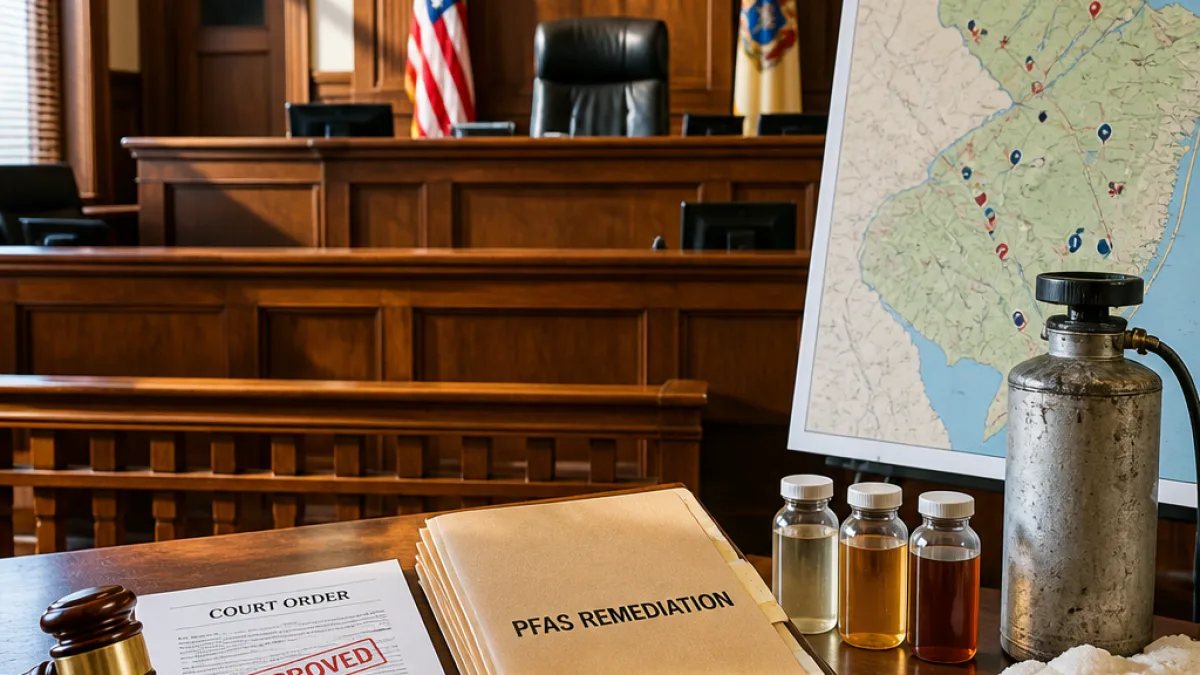
A federal judge in Camden approved settlements Friday that will send up to $2.5 billion to New Jersey over the next 25 years to address contamination from per- and polyfluoroalkyl substances, commonly known as PFAS.
Money, sites and time frame
Chief U.S. District Judge Renée Marie Bumb signed the order that ends litigation dating back to 2019 against DuPont and 3M for harms tied to long-term PFAS manufacture and use. Under the approved arrangement, DuPont and affiliated companies will contribute both direct payments and remediation commitments, while 3M will provide a multi-year payment for harms linked primarily to sales of PFAS-containing firefighting foam.
| Responsible party | Committed amount | Notes |
|---|---|---|
| DuPont and related entities | $875 million into funds + $1.2 billion in remediation commitments | Includes assets and actions for multiple New Jersey sites |
| 3M | $400 million–$450 million | Payments tied to sales of PFAS-containing firefighting foam used across the state |
| Total | Up to $2.5 billion | Paid out annually over 25 years |
The DuPont settlement specifically addresses contamination at multiple facilities, including the company’s Chambers Works site in Pennsville and its Repauno Works in Greenwich Township, Gloucester County. Two other DuPont locations in Middlesex and Passaic counties are also covered by the agreement.
Why this matters locally
PFAS have been manufactured and used in a wide range of products and industrial processes since the mid-20th century. State and federal health agencies have tied PFAS exposures to elevated cholesterol, developmental effects in fetuses and a range of other health concerns. In 2023, the World Health Organization classified some PFAS as likely carcinogens.
New Jersey has long identified PFAS as an urgent environmental and public-health threat, particularly in communities near manufacturing sites and military or firefighting training locations where PFAS-laden foam was used. The settlement’s funds are earmarked for restoring natural resources and abating damage to drinking water systems damaged by contamination.
State reaction
“This is truly a historic moment for New Jersey, which has experienced disproportionate and extensive pollution impacts from decades of PFAS manufacturing and use by DuPont and 3M,”
said Ed Potosnak, acting commissioner of the N.J. Department of Environmental Protection, in a state news release. Officials have emphasized that the settlements will support long-term remediation and help replace or clean drinking water sources affected by PFAS.
What the agreements require
- Annual payments dispersed over a 25-year schedule rather than a single lump sum.
- DuPont entities are obliged to make additional remediation commitments valued at about $1.2 billion, beyond cash payments into restoration and drinking-water funds.
- 3M’s payments reflect liabilities tied to distribution of PFAS in firefighting foams used at military bases, training academies, state facilities and local fire departments throughout New Jersey.
Neither DuPont nor 3M returned email requests for comment on Saturday.
What residents should know
The settlement does not instantly clean contaminated sites or remove PFAS from drinking water, but it creates sustained funding and obligations for remediation over decades. Residents with private wells near the named sites, or who rely on municipal systems with known PFAS detections, should continue to monitor advisories from local health departments and the N.J. Department of Environmental Protection.
Local officials will also play a role in allocating and overseeing funds and remediation projects. Because payments occur annually across 25 years, monitoring and accountability will be important to ensure the money is used promptly and effectively.
Long road ahead
Legal disputes over PFAS in New Jersey have been ongoing for years. This approval resolves the such litigation against DuPont and 3M in federal court, but it represents the start of a long implementation phase: engineering work, cleanup plans, water-treatment upgrades and monitoring will all be required.
For communities around Pennsville, Carney’s Point, Greenwich Township and the other affected counties, the approval offers a measure of relief — but also underscores the scale of cleanup still to come.
State regulators and local officials will now need to translate the settlement’s funds and commitments into concrete projects that protect drinking water and restore damaged natural resources over the coming decades.