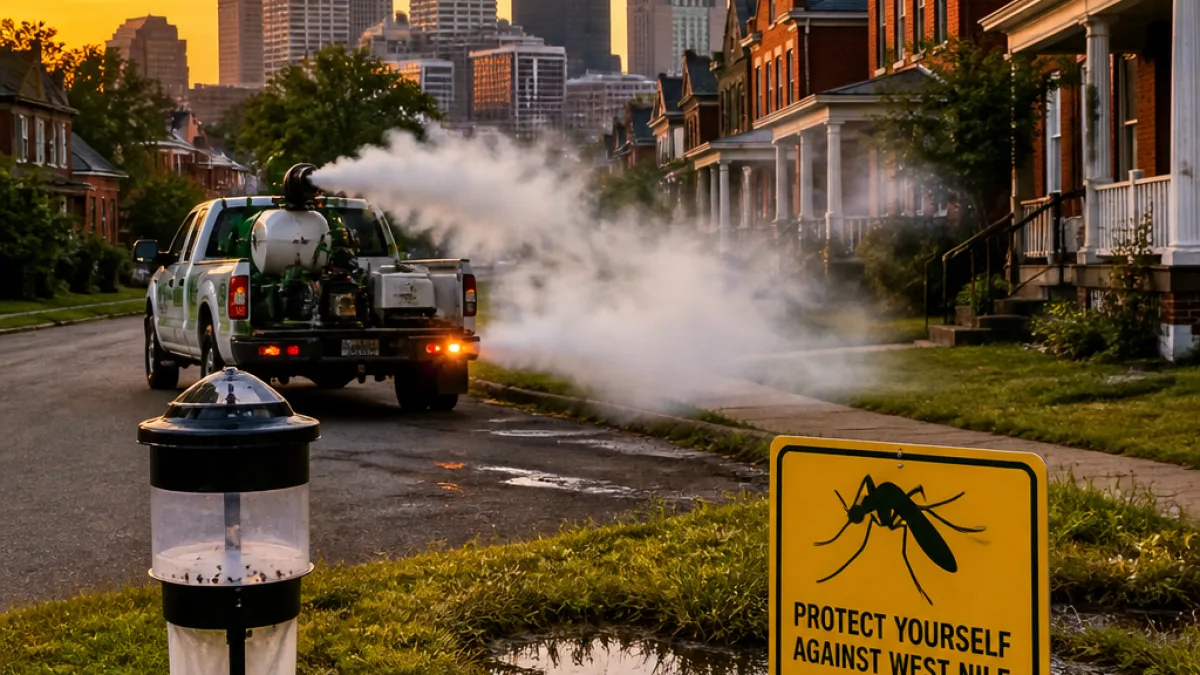
LOUISVILLE — Mosquitoes infected with the West Nile virus were found in traps placed around seven Louisville neighborhoods, the Louisville Metro Department of Public Health and Wellness said Monday, prompting targeted fogging and renewed reminders to residents to reduce exposure.
Where the mosquitoes were detected and where fogging will happen
Officials listed the affected areas as Buechel, Smithfield Acres, Crescent Hill, Irish Hills, the Central Business District, the Churchill Downs area and the Camp Taylor/Poplar Level Road area. Mosquito-control crews are scheduled to apply insecticide from trucks in those neighborhoods Monday, Tuesday and Thursday during early morning or evening hours, weather permitting.
| Neighborhood | Planned Fogging Days |
|---|---|
| Buechel | Monday, Tuesday, Thursday (early morning/evening) |
| Smithfield Acres | Monday, Tuesday, Thursday (early morning/evening) |
| Crescent Hill | Monday, Tuesday, Thursday (early morning/evening) |
| Irish Hills | Monday, Tuesday, Thursday (early morning/evening) |
| Central Business District | Monday, Tuesday, Thursday (early morning/evening) |
| Churchill Downs area | Monday, Tuesday, Thursday (early morning/evening) |
| Camp Taylor/Poplar Level Road area | Monday, Tuesday, Thursday (early morning/evening) |
What officials are telling residents
Last month, a Louisville resident tested positive for West Nile virus; that remains the only confirmed human case in the city this year. There have been no West Nile–related deaths in Louisville since 2023. While most infections produce no symptoms or only mild illness, health authorities remind the public that a small fraction of infections can progress to severe neurologic disease such as encephalitis or meningitis.
"Experts said the best thing you can do is pay attention to open water on your property."
The department emphasized that older adults and people with underlying conditions are at greater risk of serious illness. Those conditions include cancer, diabetes, high blood pressure, kidney disease and having received an organ transplant.
Practical steps residents should take
Public-health guidance issued with the announcement repeats familiar but important prevention measures. Officials are asking all Louisville residents — not just those living where positive mosquitoes were trapped — to take the following steps:
- Use insect repellents when outdoors; choose products containing DEET, picaridin, IR3535 or oil of lemon eucalyptus.
- Wear long sleeves, long pants and socks during early morning and dusk when mosquitoes are most active; treat clothing with repellent when appropriate.
- Eliminate standing water in and around homes — empty flowerpots, gutters, buckets, pool covers and pet dishes that collect water.
- Install or repair screens on windows and doors to keep mosquitoes out of living spaces.
Fogging is intended to reduce adult mosquito populations in the short term, but officials say it does not replace the need for residents to remove breeding sites on private property. The effectiveness of truck-based fogging can be limited by weather, local vegetation and the fact that mosquitoes can breed in many small, hidden containers.
For most people, West Nile infection will be asymptomatic or cause only mild fever and aches. While the chance of severe neurologic illness is estimated to be less than 1 percent, the consequences can be serious for those who are affected, particularly people over 60 and those with the underlying health conditions identified by the department.
Officials advise residents with concerns or who develop symptoms consistent with West Nile — such as fever, headache, body aches, nausea, or, in serious cases, confusion and stiff neck — to contact their health care provider. The Louisville Metro Department of Public Health and Wellness is continuing to monitor traps across the city and will update the public on additional findings and control actions as they occur.
Keeping properties free of standing water and reducing mosquito bites remain the most reliable defenses at the household level, public-health officials say.