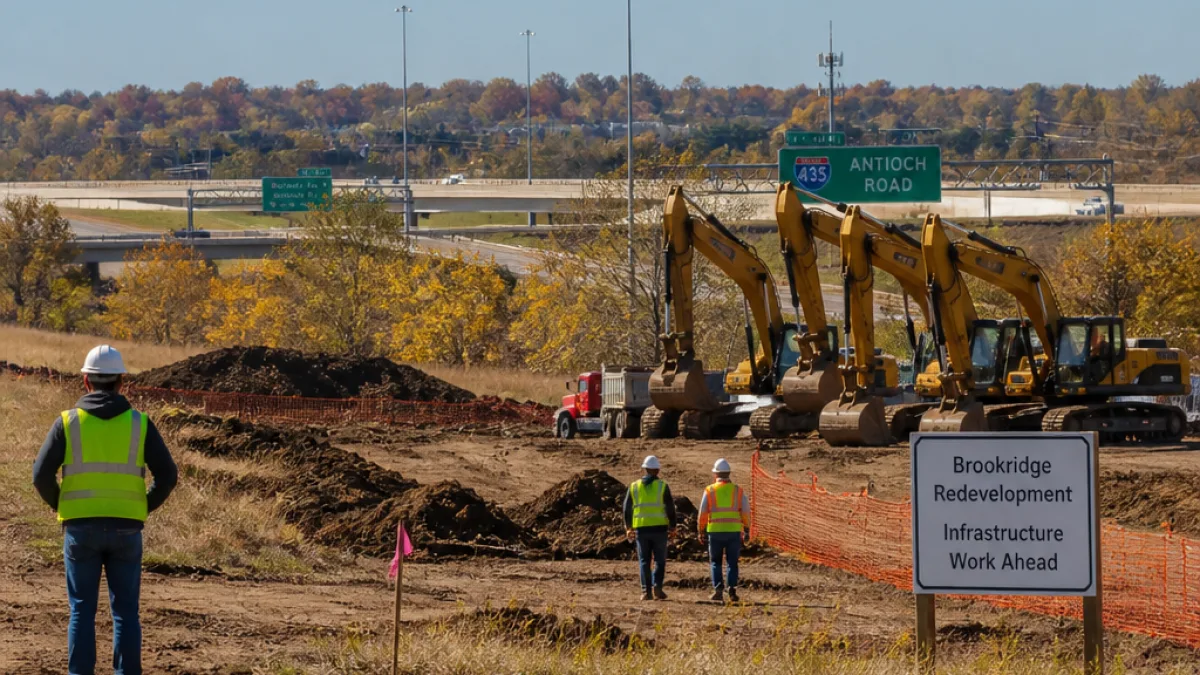
The Overland Park City Council on Monday voted unanimously to allow the city to issue up to $5 million in bonds to support early infrastructure work at the former Brookridge Golf Course, a 212-acre site northeast of I-435 and Antioch Road that developers have sought to transform for more than a decade.
The authorization comes against a backdrop of repeated delays and amendments. Developers initially pitched concepts for the Brookridge site in 2014, and the council approved a comprehensive redevelopment agreement with Curtin Property Co. in 2019 that tied city incentives to a set of construction milestones. Since then, the project — which envisions a dense mixed-use campus of residential, office, retail and civic uses — has missed numerous deadlines and sought multiple amendments to the development agreement.
Scope of the proposed development
When it was approved in 2019, the plan presented to the city called for a large-scale transformation of the Brookridge property. The proposal includes:
- 2,000 apartments
- 1.8 million square feet of office space
- an 18-hole golf course
- a 3,500-seat performance hall
- a hotel and retail space
"Curtin Property Co. proposed transforming the 212-acre site… into a mixed-use development complete with 2,000 apartments, 1.8 million square feet of office space, an 18-hole golf course, a 3,500-seat performance hall, a hotel and retail space."
Those programmatic numbers have remained central to the public discussion about the project, but the timetable has not. Groundbreaking took place nearly three years ago, yet vertical construction has not proceeded in earnest. The developer has reported completing roughly $4.2 million in infrastructure work near 103rd Street and Antioch and plans an additional investment of around $800,000 at the site, according to prior reporting cited by local business outlets.
Why the bond and what it pays for
The council’s action permits the city to issue bonds — essentially municipal debt — to underwrite or support infrastructure improvements that are necessary to make the site ready for future phases. The authorization of up to $5 million does not by itself guarantee immediate construction of buildings; it aims to bridge early-offsite and onsite infrastructure needs tied to streets, utilities and similar public-facing work.
That incremental public investment arrives after years of contentious public hearings and resident opposition. Local residents pushed back on the redevelopment for nearly five years before the 2019 vote, raising concerns that included increased flood risk, the absence of commitments on affordable housing and the appropriateness of using public incentives for private development. Despite that resistance, the council narrowly approved roughly $200 million in incentives in 2019 to support the project.
| Year | Key action |
|---|---|
| 2014 | Initial developer pitches for Brookridge site |
| 2019 | City Council approves redevelopment and about $200M in incentives |
| ~2023 | Project breaks ground but vertical construction stalls |
| 2026 | Council authorizes up to $5M in bonds for infrastructure |
Overland Park officials have approved multiple amendments to the development agreement, allowing Curtin Property Co. to push back milestones tied to those incentives as financial and construction challenges delayed progress. In July, the council approved a fourth request for additional modifications to the timeline, reflecting the persistent difficulty the project has had in advancing on schedule.
Local implications and lingering questions
The council’s bond authorization is a pragmatic step to keep infrastructure moving, but it does not eliminate the underlying uncertainties: financing and market conditions for nearly 2,000 apartments and almost 2 million square feet of commercial space remain fluid, and residents who opposed the plan continue to question long-term flood mitigation, affordability and the public cost of incentives tied to private development.
For Overland Park, the Brookridge site represents both a major opportunity and an ongoing policy test. The property sits at a busy suburban node and, if completed as originally envisioned, would reshape traffic patterns, housing density and the local economy. But the path from authorization to finished project still depends on developers securing stable financing, meeting amended milestones and winning continued municipal approvals — conditions that have repeatedly stretched timelines over the last several years.
City leaders framed the bond vote as a way to shore up early infrastructure needs so the project can move forward without further stalling. For residents and businesses around Antioch Road and 103rd Street, the coming months will be a barometer: whether the combination of private dollars already spent, new municipal bonds and amended schedules will finally produce visible construction, or whether Brookridge will remain a long-delayed vision for Overland Park.