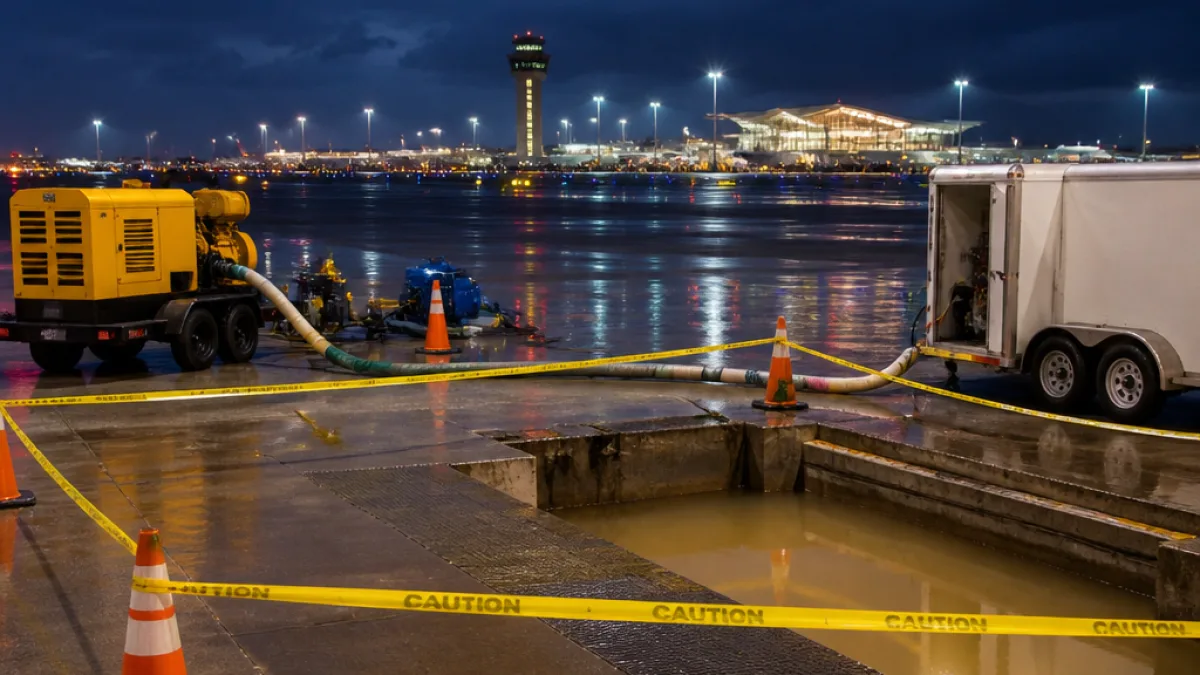
The city-owned Wichita Eisenhower National Airport is seeking emergency funding after severe flooding from a late‑June storm damaged electrical equipment that controls airfield lighting, putting nighttime operations at risk and potentially disrupting commercial service for the Air Capital.
Storm, damage and immediate risk
Airport leaders reported that the facility received 10.3 inches of rain overnight on June 25 and into the morning of June 26. The significant downpour flooded an underground airfield vault building that houses electrical components and regulators essential to the airport’s lighting and signage systems.
“The significant rain event caused flooding in the underground airfield vault building,”
That line appears in a city memorandum prepared to justify an emergency funding request. The memo warns that airfield lights and illuminated signage are required by federal regulation for nighttime operations and that an interruption of those systems could have immediate operational consequences.
Potential operational and travel consequences
The memo forecasts that an interruption of airfield lighting could force the cancellation of roughly one‑third of the daily flights, with additional departures delayed or canceled the following day. Such a loss would not only affect travelers originating from or destined for Wichita but also reverberate through connecting flights to and from major U.S. hubs.
Wichita Eisenhower is the largest airport in Kansas and serves more than 1.8 million passengers a year. The airport offers nonstop service to multiple large cities across six carriers, meaning lighting problems after dusk would constrain the schedules of a substantial slice of the airport’s daily operations.
- Immediate risk: nighttime operations may be curtailed if regulators are not replaced.
- Operational stress: airport staff have been reducing system load to keep lights working where possible, but multiple regulators have failed.
- Broader impact: cancellations could affect travel to other major U.S. cities that connect through Wichita.
Airlines and nonstop destinations affected
The memorandum specifically notes the airport’s nonstop routes and carriers. While officials have not announced flight cancellations tied directly to the damage, the airport’s route map shows the breadth of connections that could be impacted if nighttime lighting is compromised.
| Airlines | Representative nonstop destinations |
|---|---|
| Alaska | Seattle |
| Allegiant | Las Vegas |
| American | Chicago, Dallas–Fort Worth |
| Delta | Atlanta, Minneapolis |
| Southwest | Denver |
| United | Houston, Washington, D.C. |
What officials say and what comes next
The city memorandum says airport staff have been working to keep the system operating by reducing load where possible, but several regulators have nonetheless failed. The memo describes replacement of the regulators as paramount to avoid a shutdown of the airfield from dusk until dawn.
City and airport officials did not immediately provide additional comment when contacted. The memorandum serves as the public explanation for the city’s emergency funding request; it frames the replacement of regulators as necessary to sustain night operations and avoid cascading cancellations.
Context and local consequences
Nighttime operations are not an occasional convenience at a commercial airport; they are part of daily rhythm—cargo movements, red-eye arrivals and departures, and connections that feed business and leisure travel. For Wichita, where the airport supports more than 1.8 million annual passenger movements and links to major hubs, any sustained restriction on evening operations would ripple through the regional economy, affecting business travel, tourism and logistics.
Airport leadership will have to move quickly to secure funding and parts, coordinate with carriers and, if necessary, notify passengers of schedule changes. For Wichita residents planning travel in the coming days, the situation is a reminder that extreme weather can produce technical failures with immediate and tangible impacts on mobility.