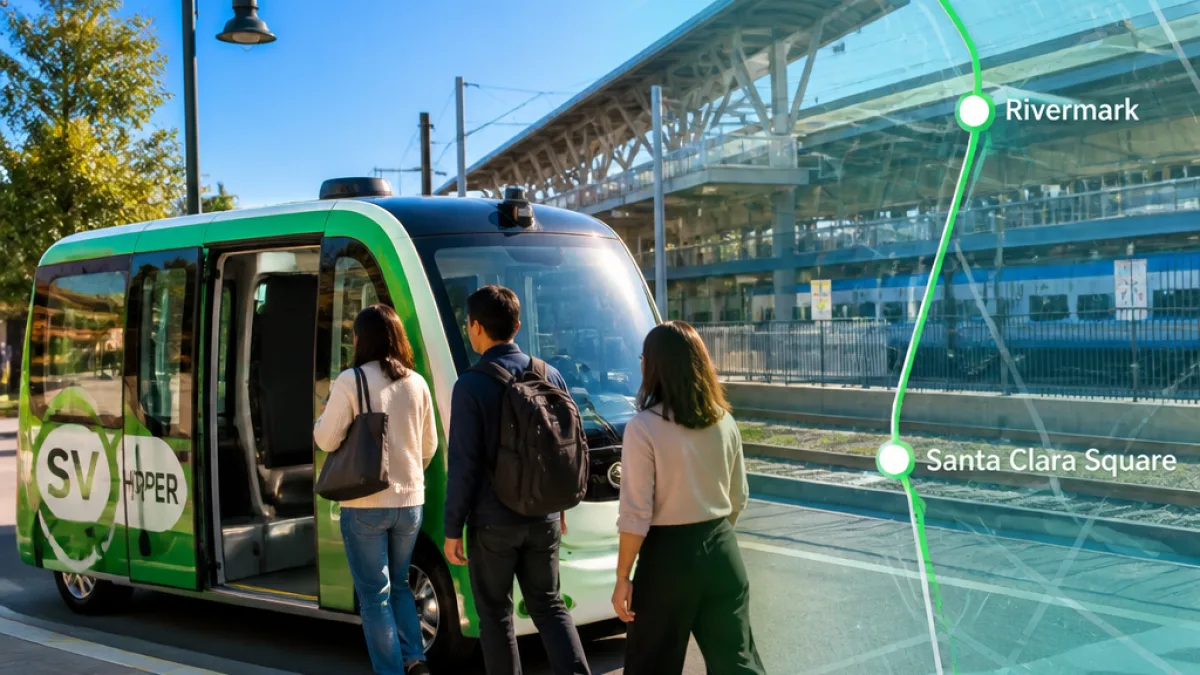
The City of Santa Clara has broadened the service area for the Silicon Valley (SV) Hopper microtransit network, extending corner‑to‑corner coverage into the northern reaches of the city and creating new direct links to the City of Cupertino and several regional transit hubs.
New stops, same fare structure
Under the expansion, riders will see new service points including Mission College, Rivermark Plaza, Santa Clara Square and Great America Station — the latter providing connections to VTA light rail, ACE rail and Amtrak. The city says the expanded zone preserves the Hopper’s corner‑to‑corner model within the service boundary and continues to offer trips to select regional destinations such as Sunnyvale Caltrain Station, Mountain View Caltrain Station and El Camino Hospital.
Fare levels remain unchanged. The published fares are:
One-way fare: $3.50 • Discounted fare: $1.75 (seniors, students, low income, disabled)
The city notes that riders seeking the discounted rate must provide proof of eligibility. Detailed eligibility rules and verification steps are available through the city’s transit information page.
Funding and policy context
SV Hopper’s expansion was made possible through public grants: the service received support from the Santa Clara Valley Transportation Authority’s Measure B Innovative Transit Program and California’s CalSTA Transit and Intercity Rail Capital Program. Those funding streams are aimed at piloting or expanding transit options that fill gaps left by fixed‑route buses and trains.
- New northern Santa Clara stops: Mission College, Rivermark Plaza, Santa Clara Square, Great America Station
- Regional connections: Sunnyvale and Mountain View Caltrain stations, El Camino Hospital
- Fare: $3.50 one‑way; $1.75 discounted with proof
City officials characterized the move as a way to provide more flexible, on‑demand travel options for residents, particularly in areas where conventional fixed‑route service is limited. The Hopper program operates as a first‑mile/last‑mile supplement to existing transit; expanding the operational footprint is intended to increase the system’s usefulness for commuters, students and shoppers traveling between neighborhood centers and regional rail nodes.
Local impacts and what to watch
For Santa Clara residents the immediate effects will be practical: more direct access to colleges, shopping centers and a major intermodal station without the need to drive or transfer to multiple buses. For employers and institutions — Mission College and businesses around Rivermark and Santa Clara Square — the extended coverage may ease employee commutes and widen the labor pool able to reach job sites without private vehicles.
Community advocates and mobility planners will be watching several outcomes as the expansion settles in: changes in ridership numbers, whether demand justifies additional vehicles or hours, and if the Hopper measurably reduces short car trips in congested corridors. Because the service is grant‑funded, its longer‑term status may depend on performance metrics and future funding allocations.
| Feature | Detail |
|---|---|
| New northern stops | Mission College, Rivermark Plaza, Santa Clara Square, Great America Station |
| Regional links | Sunnyvale & Mountain View Caltrain stations; El Camino Hospital |
| Fare | $3.50 one‑way; $1.75 discounted |
| Funding | VTA Measure B Innovative Transit Program; CalSTA Transit & Intercity Rail Capital Program |
Riders interested in using the expanded service should consult the City of Santa Clara’s transit page for maps, zone boundaries and instructions on how to book Hopper trips. The city has emphasized that the expansion is intended to integrate with the broader regional network rather than replace fixed‑route or commuter rail services.
As the SV Hopper moves into northern Santa Clara, the city will be monitoring how well the service meets needs across diverse neighborhoods and whether it provides a cost‑effective complement to existing public transit options.