Oceanside has long been bracketed by larger Southern California names and highway exits, but a closer look at downtown and the beachfront shows a compact city core rooted in history, architecture and a steady flow of visitors tied to the nearby Marine base. A recent walk through the heart of the city underlines how local institutions and built landmarks combine to make Oceanside uniquely navigable and discoverable on foot.
Historic anchors and small museums
Begin at the Oceanside Historical Society Museum at 510 Civic Center Drive. The museum, modest to passersby, collects photographs, personal narratives and artifacts that map the town’s development from early mission-era connections through land speculation and coastal development. A downtown visit quickly reveals that the museum acts as both an introduction for visitors and a reference point for residents tracing the city’s civic memory.
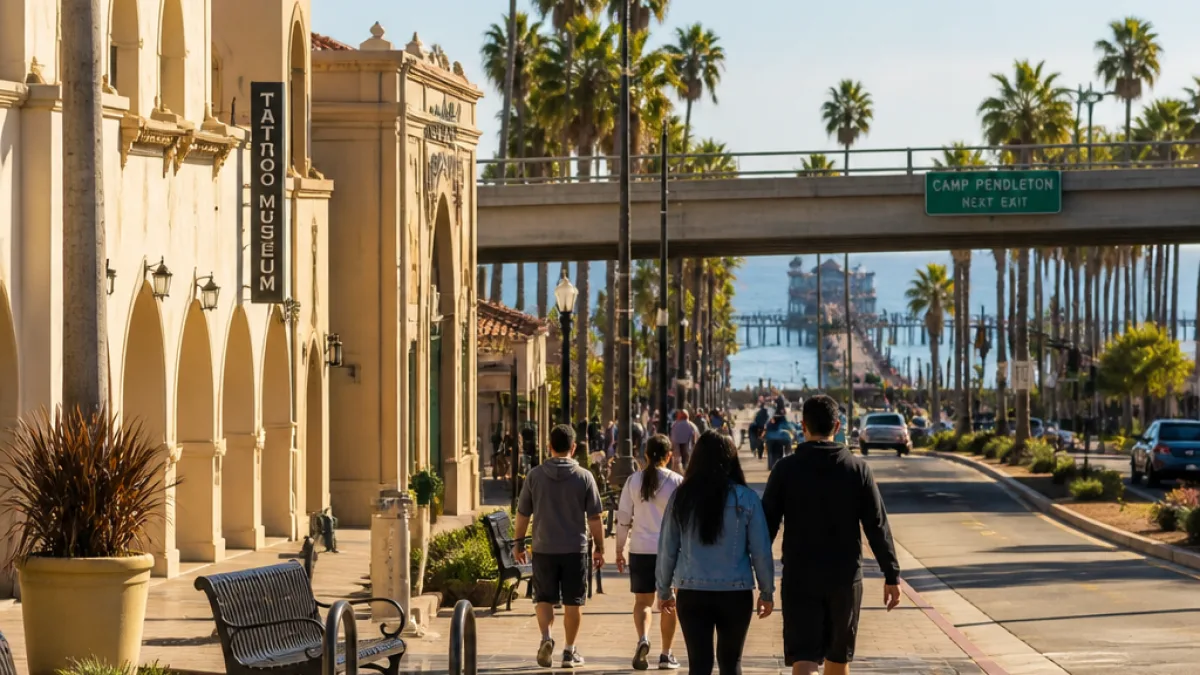
On Mission Avenue, the Arcade Tattoo Museum (604 Mission Ave.) underlines Oceanside’s layered cultural identity — where military, seaside leisure and contemporary subcultures meet. The presence of such specialized institutions speaks to the city’s capacity to host niche cultural draws alongside its more familiar beach attractions.
Architecture and civic design
Oceanside’s architectural story threads Spanish mission-era motifs with later modernist interpretation. The city’s civic complex, anchored by the Oceanside Civic Center across from the Historical Society Museum, demonstrates that fusion. Designed by Charles Moore, the complex blends clean, white lines and towering arches with decorative tile work — an explicit conversation with the work of Irving Gill, whose reinterpretation of mission arches toward modernism continues to influence local aesthetics.
These buildings are not only visual assets; they shape pedestrian movement and the public realm. The concentration of museums, civic institutions and retail along contiguous downtown blocks creates a walkable loop attractive to both residents and day visitors.
Military ties and the pier’s long view
Camp Pendleton remains a major factor in Oceanside’s social and economic life. Since its establishment in 1942, the base has routed thousands through the city and sustained a reliable pattern of recreational and commercial interaction. The Marine presence has shaped hospitality, retail and service sectors, especially along the beachfront and Mission Avenue corridors.
Likewise, the Oceanside Pier is a recurring touchstone in the city’s narrative — a facility that has been rebuilt and reimagined across generations and that serves as both a local gathering place and a destination for visitors arriving by car or foot.
"There's a lot of there there," a line invoked by recent writers to capture Oceanside's depth beyond the highway signs.
What this means for residents
Downtown’s walkable mix of museums, civic architecture and beachfront access matters for residents in practical terms: it concentrates cultural amenities within reach of local neighborhoods, supports small businesses that rely on pedestrian traffic, and creates public spaces where community identity is visible. Walkability also has consequences for planning and maintenance — wayfinding, streetscape care and coordinated programming between museums, merchants and city institutions will determine whether downtown continues to attract both short-stay visitors and repeat local foot traffic.
- Museum access: The Historical Society Museum and smaller institutions provide historical context for downtown, useful for schools and civic groups.
- Architectural identity: Civic Center design signals a civic investment in public architecture that differentiates Oceanside from generic coastal strips.
- Military connection: Camp Pendleton remains a steady source of visitors and social ties that shape local commerce.
| Site | Address |
|---|---|
| Oceanside Historical Society Museum | 510 Civic Center Drive |
| Arcade Tattoo Museum | 604 Mission Ave. |
For Oceanside residents the takeaway is immediate: downtown is more than a waypoint. It is a compact civic engine built of museums, architecture and a pier that connects generations. Keeping it lively will depend on municipal stewardship, partnerships with cultural institutions and an ongoing recognition that walking the downtown is how the city’s layered identities remain visible to locals and visitors alike.