PIERRE, S.D. — A federal judge has temporarily blocked South Dakota’s new restriction on advertising about medication abortion, dealing an early legal setback to a measure that supporters described as protecting women and opponents called an unconstitutional suppression of speech.
Quick legal timeline
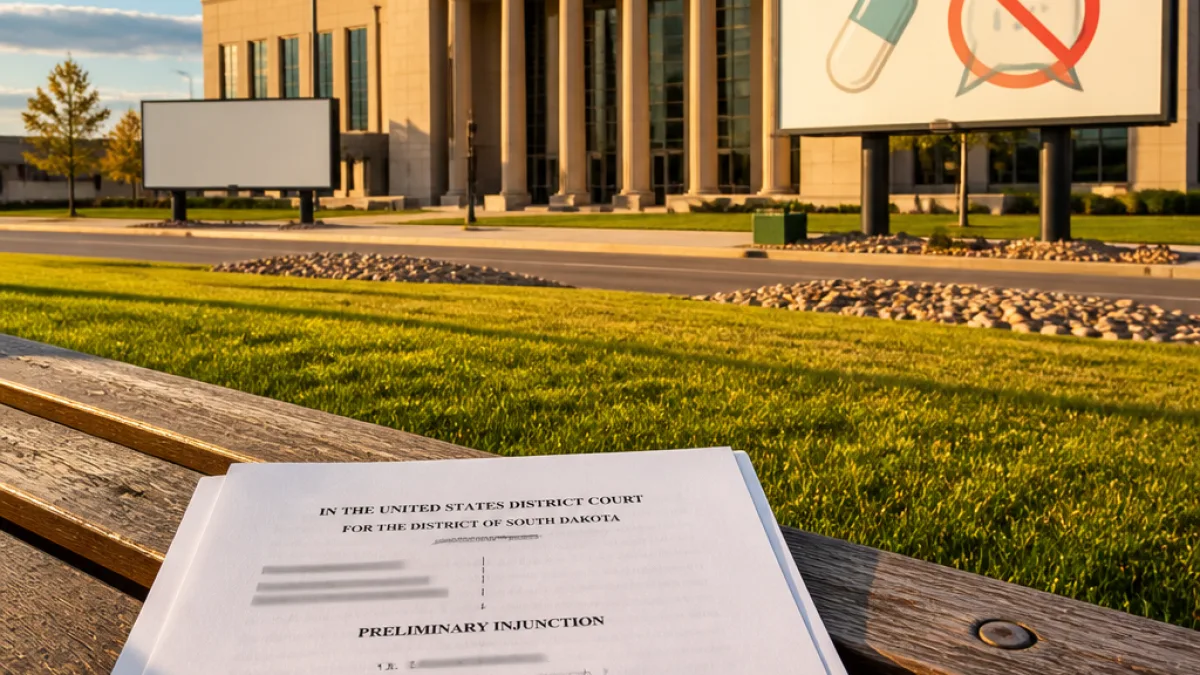
The dispute unfolded rapidly: the law took effect on July 1. Less than three weeks later, on July 17, U.S. District Judge Camela C. Theeler issued an injunction preventing the state from enforcing the ban while litigation continues. The action came in response to a lawsuit filed by Mayday Health, a New York-based nonprofit that provides information about abortion pills and telemedicine options.
What prompted the case
Mayday Health sought to run public advertising in South Dakota — including signs at gas stations — directing people to its website, which offers information and links to telemedicine providers. The group said it feared prosecution under the new state law for advertising information about abortion pills. That fear prompted the lawsuit, which argued the ban infringes on the group’s First Amendment rights to distribute truthful information about medical care.
"Pregnant? Don’t Want to Be?"
The gas-station sign Mayday proposed — which asked, in part, "Pregnant? Don’t Want to Be?" and encouraged people to learn more — became a focal point for the legal dispute. In her ruling, Judge Theeler found the plaintiffs were likely to succeed on the claim that the law restricts protected speech, and she paused enforcement while the courts sort through the constitutional issues.
Free speech and health information
At the center of the case is a long-settled principle of First Amendment law: government may not impose viewpoint-based restrictions on truthful information, particularly on matters of public concern. That doctrine traces back to the U.S. Supreme Court’s decision in Bigelow v. Virginia, a 1975 ruling that protected advertising containing information about abortion services in another state.
Legal scholars and advocates say the modern dispute reflects how the national abortion debate has shifted since the 2022 U.S. Supreme Court decisions that allowed states to restrict abortion access. The fight now often centers on medication abortion and telemedicine, and on whether states may limit information that helps people access those services.
What this means for residents and advertisers
Because the injunction is temporary, it leaves the statewide law in place but unenforceable while the federal case proceeds. That means:
- Businesses and advertisers remain in a state of legal uncertainty until the court resolves the case or the parties settle.
- Organizations providing information about medication abortion may continue some outreach during the injunction, but broader legal risk persists pending a final ruling.
- State lawmakers and officials will be watching the litigation’s next steps closely; the outcome could shape what kinds of health-related advertising are allowed in South Dakota going forward.
Next steps in the litigation
The federal case will proceed through briefing, possible motions, and potentially additional hearings. The injunction leaves open the possibility that a later ruling could reinstate the law if the court ultimately finds it constitutional. Conversely, a final decision striking down the statute would bar the state from enforcing such advertising restrictions in the future.
Broader implications
For South Dakotans, the dispute underscores how state decisions about reproductive health regulation increasingly intersect with constitutional free-speech protections and modern methods of delivering care. The case also illustrates how groups that provide informational and logistical support for people seeking medication abortion are testing the limits of state laws enacted after the national changes to abortion jurisprudence.
The litigation will be watched not just here but in other states considering or enacting similar restrictions. For now, the injunction preserves at least a temporary space for truthful informational advertising about medication abortion while the federal courts decide whether the state may lawfully ban it.
Updates will follow as the court issues further rulings and the parties continue to litigate the constitutional questions raised by the law.