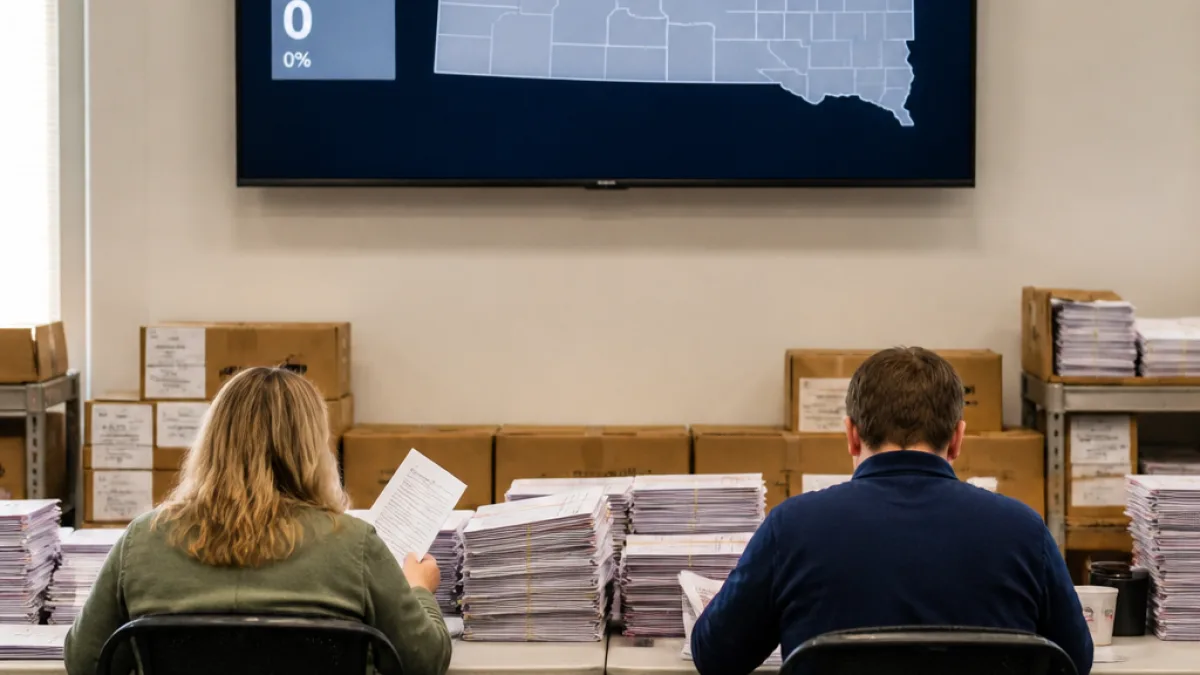
Counting in the Republican runoff for South Dakota governor showed no reported votes early Wednesday afternoon as counties continued to process ballots from across the state. The contest, between incumbent Larry Rhoden and challenger Toby Doeden, remained uncalled, with NBC News’ data indicating an estimated 130,000 votes still outstanding.
What the early returns show
As of the latest update, the statewide scoreboard published by NBC News and fed by Associated Press data showed 0 votes reported for both candidates in the statewide summary and in named counties. Several county entries — including Aurora, Beadle, Bennett and Bon Homme — listed 0 percent of returns in and 0 votes recorded for each candidate.
Officials and news organizations caution that early reporting snapshots can be misleading on election night. Local boards must reconcile absentee and early ballots, verify signatures and complete precinct-level tallies before forwarding totals to the state. Those administrative steps can delay the appearance of votes on statewide trackers, particularly in rural counties where staff resources are limited.
Why counts can lag
Election administrators and political observers point to a handful of routine reasons vote totals may not show up immediately in aggregated feeds:
- Ballot processing: Absentee and early ballots require signature verification and, in some cases, curing before being counted.
- Local reporting practices: Counties transmit results to the state at different times; some post full precinct tallies only after all ballots in a jurisdiction are reconciled.
- Resource constraints: Rural counties with smaller staffs may take longer to finalize counts on busy election nights.
The NBC News Decision Desk noted the figure for expected votes is an estimate drawn from early voting information and reports from county election officials; that figure can change as new data arrives.
What’s at stake
The Republican runoff will determine the party’s nominee for the general election. With the early feed showing no tabulated ballots, both campaigns remain in a holding pattern: they cannot claim a definitive victory until county clerks finish reporting and the Associated Press or decision desks project an outcome based on completed tallies.
For voters and observers, the most immediate concern is clarity around timing: when will counties finish reporting, and how soon can a clear picture of the statewide result emerge? Historical patterns in South Dakota show that reporting can span several hours or longer on close or logistically complex election nights.
How to follow updates
Voters seeking real-time information should consult multiple sources: local county election offices, the South Dakota Secretary of State’s office and national outlets that aggregate returns. Those sources provide the primary official and journalistic tallies; aggregated feeds from media organizations often update as counties send certified totals.
| Item | Reported in initial feed |
|---|---|
| Statewide votes for Rhoden | 0 |
| Statewide votes for Doeden | 0 |
| Estimated remaining votes | 130,000 |
That table reflects the early snapshot as published by NBC News and the Associated Press; the numbers are subject to change as counties certify and report results.
Local context
South Dakota’s mix of small towns and ag-focused counties means reporting rhythms vary widely across the state. Some counties release vote totals precinct by precinct as they finish counting; others wait until all ballots have been processed and a complete county canvass has taken place. Those procedural differences help explain why statewide trackers occasionally display long stretches with little visible movement.
Until county clerks transmit updated totals and the AP or media decision desks project a winner, the runoff remains undecided. Voters hoping for a quick resolution may have to sit tight as local officials complete the administrative work that turns ballots into certified results.
This story will be updated as new county reports and official tallies become available.