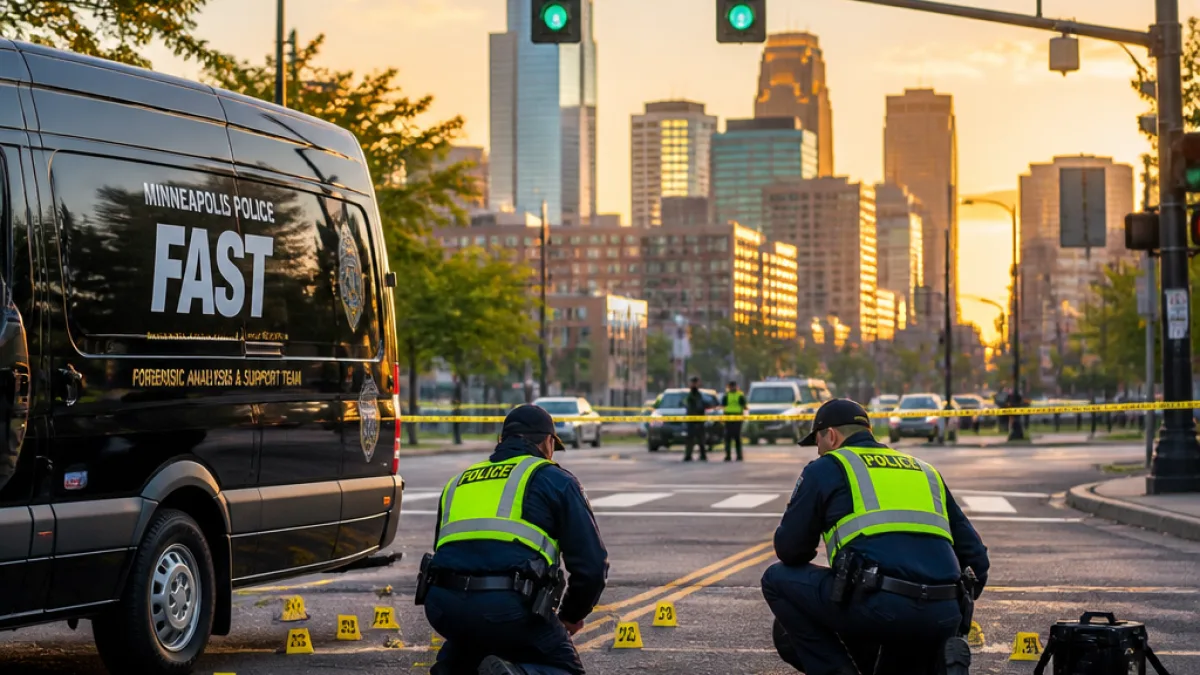
The Minneapolis Police Department’s newly created Firearm Assault Shoot Team, known as FAST, is drawing attention from investigators and community members for its rapid response to nonfatal shootings and its early promise at preventing cases from "falling through the cracks." Launched in March, the unit is intended to take pressure off the homicide squad and focus investigators on victims who survive shootings but whose cases previously received delayed follow-up.
Faster response to nonfatal shootings
Before FAST existed, nonfatal shootings were handled by the department’s homicide unit. Homicide detectives juggled both fatal and nonfatal shootings, and according to Lt. Andrew Schroeder, that left many surviving-victim cases without timely investigative work.
"We were drowning and now we're breathing," Schroeder said, describing the change in capacity since FAST began operating.
Schroeder said FAST responds immediately to nonfatal shootings to collect evidence, canvass scenes and interview witnesses while memories are fresh and physical evidence remains intact — even in incidents where witnesses are reluctant to cooperate. He told reporters that investigators with FAST are making a "tremendous difference" and that some of the team’s early inquiries have led to charges.
Notable early results and aims
Schroeder pointed to a recent downtown case in which a man accused of shooting two people on Nicollet Mall was arrested hours after the incident. The shooting took place about 8 a.m.; Schroeder noted that under the old model, detectives might have delayed active investigation until the following day because homicide detectives were occupied with other matters.
The department reported that so far this year Minneapolis has experienced 138 victims shot across 123 shooting incidents. Schroeder declined to give a precise count of cases FAST has solved in its first months but said the team hopes to clear 60% of nonfatal shooting cases this year — a sizeable increase over the department’s performance last year when more than 40% of nonfatal shooting cases were cleared.
| Metric | Figure |
|---|---|
| Reported shooting victims this year | 138 |
| Shooting incidents this year | 123 |
| Department nonfatal shooting clearance (last year) | over 40% |
| FAST clearance target (this year) | 60% |
Community impact and limits
Investigators and city officials frame nonfatal shootings as urgent public-safety matters: Schroeder described them as "failed homicides," warning that without removal of repeat shooters from the streets, a nonfatal shooting can easily become a fatal one. For residents of neighborhoods such as Uptown — where nine people were shot outside a nightclub in late July — faster investigations can mean quicker arrests, evidence preservation and potentially fewer retaliatory incidents.
- FAST was launched in March to focus on nonfatal shootings separate from homicide work.
- The unit prioritizes immediate on-scene investigation even when witnesses are uncooperative.
- Department-wide figures show 138 victims in 123 shooting incidents so far this year.
Still, the department has not released a breakdown of how many FAST cases have been cleared to date. Schroeder expressed optimism that the team can surpass the department’s previous clearance rate, but the milestone he hopes for — 60% cleared — remains an aspirational target.
What comes next
As FAST continues to investigate nonfatal shootings across Minneapolis, success will be measured by both case clearance statistics and community trust. Rapid arrests, like the Nicollet Mall case Schroeder cited, demonstrate the potential value of the unit’s focused approach. But sustained results will depend on consistent resources, case management and cooperation between investigators, witnesses and the neighborhoods where these shootings occur.
For many residents, the central questions remain whether FAST can translate quicker scene response into long-term reductions in gun violence and whether those improvements will be felt equitably across Minneapolis communities most affected by shootings.