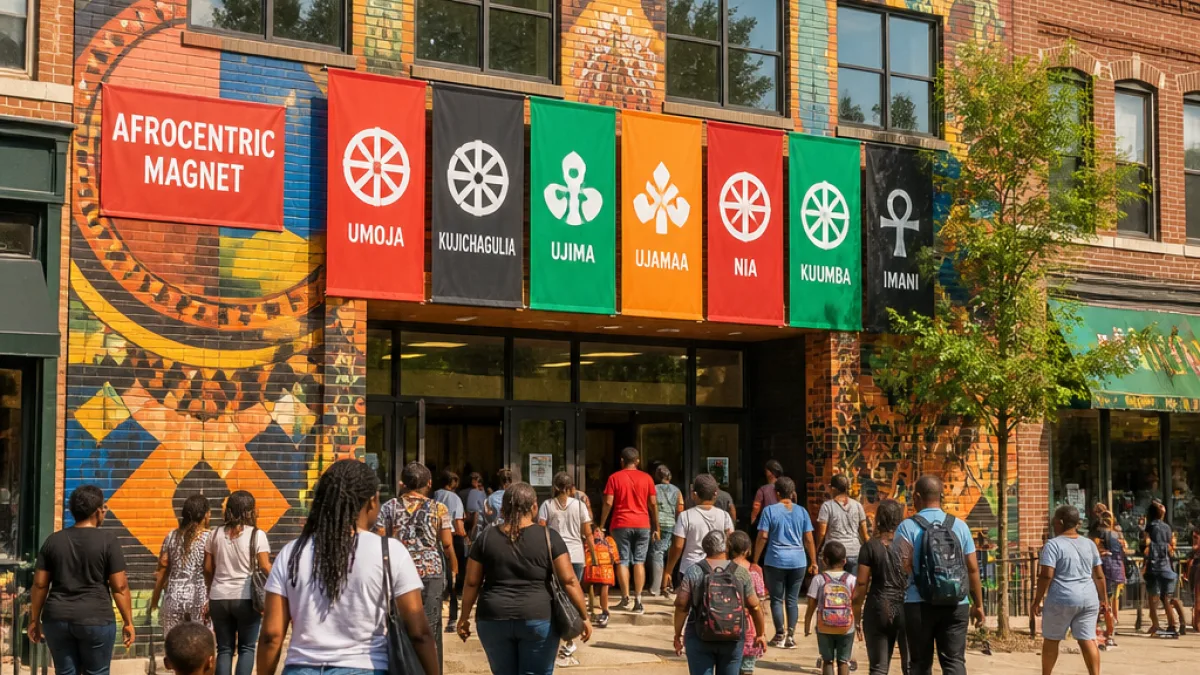
Bright murals, music and a steady stream of students marked the first day this fall at Benjamin E. Mays Afrocentric Magnet School, which opened in the heart of St. Paul’s historic Rondo neighborhood. The conversion of the school to an Afrocentric focus is the culmination of persistent community advocacy and a formal school board recommendation approved in 2024.
Roots in a decades‑long effort
For community members who advocated for an Afrocentric program for years, the reopening carried personal meaning. St. Paul Public Schools leaders said the decision grew from a workgroup recommendation and aims to center African and African‑American history, culture and values in the school’s daily life.
“This is the epitome of showing who we are,” Superintendent Stacie Stanley said.
Stanley, who grew up in Rondo, noted the emotional resonance of the moment; she recalled her mother attending a meeting to push for an Afrocentric school as far back as 1976. Fifty years after that early advocacy, the district placed the Afrocentric magnet at Benjamin E. Mays, citing its location and its high African‑American enrollment.
Program structure and daily life
The school’s daily routine will include a regular morning assembly modeled on Harambee — the Swahili concept of "all pull together" — featuring singing, dancing and chanting to begin the day. Classrooms and student life will draw on the principles of Nguzo Saba, the seven principles of Kwanzaa, and a teaching philosophy rooted in culturally responsive instruction.
Students will also be sorted into four houses, each representing an era in African history. The district has said those houses will shape student identity and community within the school.
| House | Historical reference |
|---|---|
| House 1 | Empire of Ghana |
| House 2 | Empire of Mali |
| House 3 | Kingdom of Great Zimbabwe |
| House 4 | Kingdom of Kush |
Continuity and district context
Many teachers and students at Benjamin E. Mays remain the same from last year, the district said, even as the school’s curricular focus shifted from an International Baccalaureate emphasis to this culturally centered model. The transition follows other recent moves by St. Paul Public Schools to offer culturally specific programs, including a new East African magnet school, Karen language and culture programming, and a Hmong language and culture middle school to complement an existing elementary program.
District officials framed the Afrocentric magnet as both a response to local community desires and a complement to the district’s growing suite of culturally based offerings. The program also draws from the district’s well‑known Freedom School summer program, adapting that model for the regular school year.
What families can expect this year
On the first day students arrived, the atrium filled with music — including a burst of disco‑funk to greet early arrivals — and school staff greeted kids with hugs and high fives. The district said it will continue to provide more details to families about curriculum, events and community engagement as the year unfolds.
- Location: Benjamin E. Mays Elementary, Rondo neighborhood, St. Paul
- Official shift: From International Baccalaureate focus to Afrocentric magnet (board vote in 2024)
- Program elements: Harambee morning assembly, Nguzo Saba principles, four history‑based houses
Local significance
The opening is a landmark for Rondo, a neighborhood with deep African‑American roots and a long history of community organizing. For many families and educators in St. Paul, the magnet represents not just a change in curriculum but a reinforcement of cultural identity and representation in public schools. How the program performs — in academic outcomes, enrollment patterns and community engagement — will influence future district decisions about similar culturally specific schools.
As the school year proceeds, the district has signaled it will monitor and report on implementation. For residents of Rondo and the wider St. Paul community, the magnet’s success will be measured both in test scores and in less tangible outcomes: student pride, family involvement and a sense that public schools reflect the histories and cultures of the students they serve.