A coordinated strategy aimed at reversing entrenched disadvantage
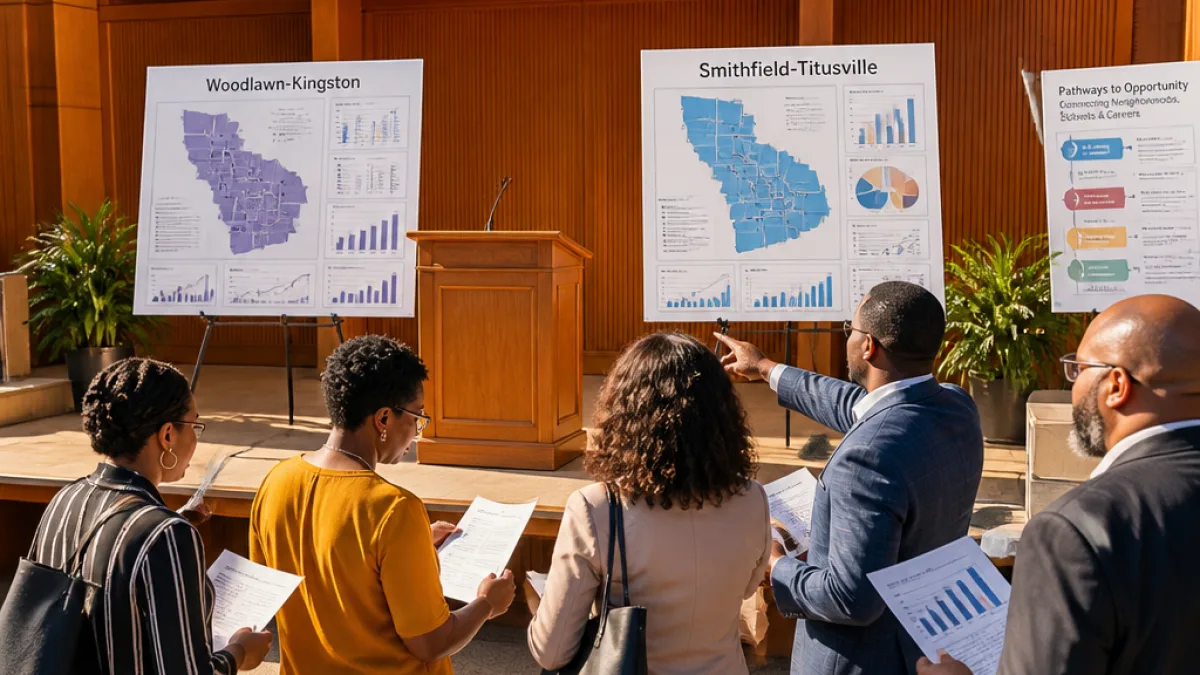
City leaders on Thursday rolled out what they describe as Birmingham’s first cradle-to-career strategy: a long-term blueprint meant to knit together schools, philanthropies, employers and city agencies so that where a child is born does not determine where they end up. The Birmingham Children and Youth Commission’s report — presented at the Harbert Center — frames a North Star vision focused initially on two neighborhoods with persistently low mobility: Woodlawn-Kingston and Smithfield-North and South Titusville.
The initiative brings together Mayor Randall L. Woodfin, Birmingham City Schools leaders, community partners and national advisers, including Dr. Geoffrey Canada, founder of the Harlem Children’s Zone. Rather than proposing a slate of new programs, the report emphasizes better alignment and coordination of existing services, investments and metrics so stakeholders can work toward shared benchmarks and be held accountable for results.
“This is about changing the trajectory of a child’s life,” Mayor Woodfin said. “Where a child is born should never determine where that child ends up.”
What the report says about the scale of the problem
The commission’s findings underscore the depth of local need. The report notes roughly 50,000 children in the Birmingham metro live in poverty. It estimates a child born into a low-income family in the metro has only a 6% chance of reaching the highest income levels as an adult; in some neighborhoods that probability drops below 2%. The commission cites low early-childhood enrollment and gaps emerging well before high school as drivers of those outcomes.
| Measure | Reported figure |
|---|---|
| Children in poverty (Birmingham metro) | ~50,000 |
| Chance a low-income child reaches highest income levels (metro) | 6% |
| Chance in some neighborhoods | <2% |
How leaders propose to close the gap
The report lays out a collaborative approach — what officials call a North Star — intended to connect the dots between early childhood programs, K-12 schools, workforce pipelines and family supports. The plan centers on:
- Aligning partners around shared outcomes rather than creating parallel programs;
- Starting place investments in the two named neighborhoods to pilot coordinated strategies;
- Using common metrics and accountability mechanisms to track progress and guide resource allocation.
Community leaders framed the effort as practical rather than purely aspirational: by organizing the work already being done across many organizations, the commission says Birmingham can concentrate strengths — local nonprofits, public schools, employers and philanthropic dollars — to improve long-term outcomes.
Local institutions sign on, with national expertise at the table
Birmingham City Schools and a constellation of civic partners joined Mayor Woodfin at the news conference, indicating broad buy-in for a strategy that seeks structural change. The presence of Dr. Geoffrey Canada — whose Harlem Children’s Zone model has been influential in national policy conversations — signals an intent to learn from established place-based approaches without simply transplanting a single model.
Officials stressed that the commission’s work is a blueprint, not a turnkey program: progress will require sustained coordination, clear performance metrics and commitments from schools, city agencies and funders. The report calls for holding partners accountable to results and for aligning investments where they can move long-term indicators.
What comes next
Leaders say the commission’s plan will begin with concentrated activity in Woodlawn-Kingston and Smithfield-North and South Titusville, with the goal of demonstrating what alignment can do at neighborhood scale. The strategy’s success — and whether it materially changes the odds that the report documents — will depend on implementation details, funding decisions and the ability of disparate organizations to operate with shared priorities and measurable outcomes.
For Birmingham residents, the report reframes a familiar problem in system-wide terms: the challenge is not only improving individual programs, but also creating a durable operating structure that ensures children encounter consistent supports from birth through career entry.