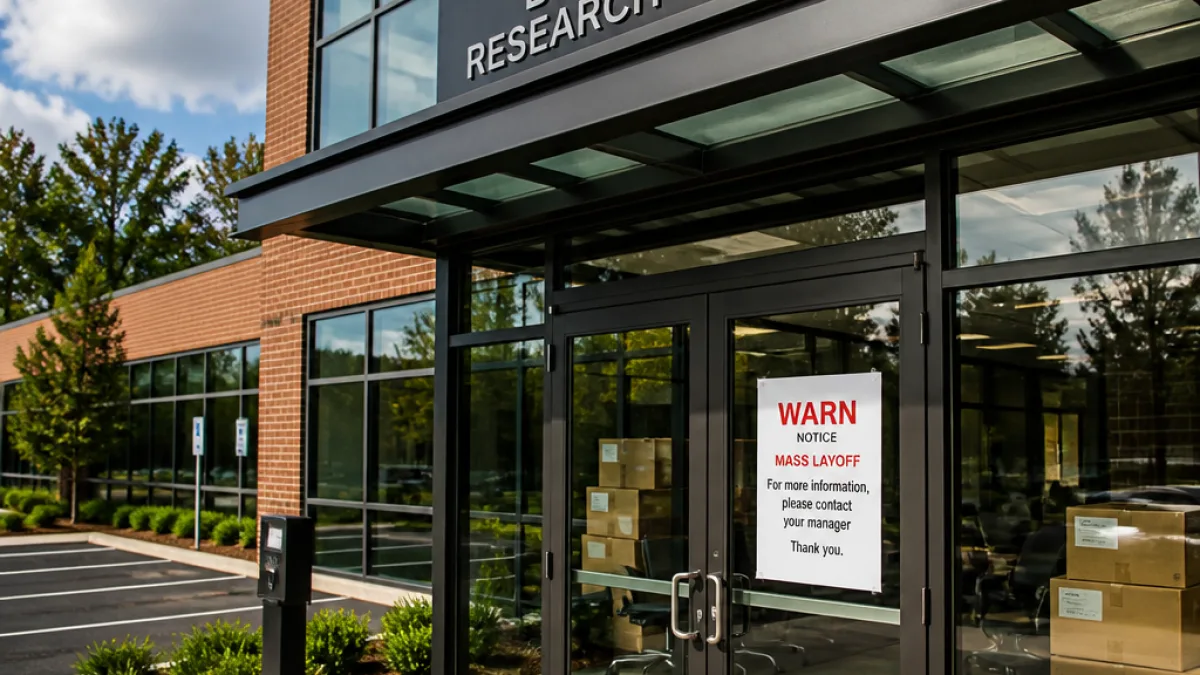
HOOVER — A biotech research site in Hoover will close, resulting in the loss of 47 jobs as North Carolina-based BioCryst retools its drug development strategy to rely on outside partners rather than in‑house discovery work.
What the company announced
BioCryst, known for Orladeyo — the first oral, once‑daily treatment for hereditary angioedema — told employees and state officials this summer that it would discontinue internal discovery programs at the Hoover location. The company filed a federal Worker Adjustment and Retraining Notification (WARN) notice on Aug. 4 with the Alabama Department of Workforce, formalizing the planned layoffs after announcing the decision in June.
In a statement accompanying the June announcement, BioCryst’s president and chief executive officer, Charlie Gayer, framed the move as a shift to a more collaborative model for finding new therapies.
“By leveraging external capabilities and partnerships, as well as our powerful rare disease commercialization engine, we can expand our opportunity set and bring new rare disease therapies to patients faster and in a more capital‑efficient manner.”
Why the closure matters locally
The Hoover facility focused on internal discovery — the early research and development work that identifies and optimizes candidate molecules that can become drugs. Shutting that function eliminates roles tied to laboratory research, discovery chemistry and related support functions.
While 47 positions may be modest compared with large manufacturing closures, research jobs often require specialized skills and represent a long‑term investment in a region’s life‑science ecosystem. Losing R&D capacity can slow local innovation, reduce technical hiring, and shrink the talent pipeline for other biotech employers in the Birmingham metro area.
How the company describes its strategy
BioCryst said it will focus on what the company called a more agile, targeted research approach by sourcing molecules or programs from external partners — smaller biotech firms, academic labs or contract research organizations — while maintaining commercialization efforts for existing medicine.
This model is increasingly common in the pharmaceutical industry: firms concentrate on late‑stage development, regulatory navigation and commercialization while outsourcing early discovery to specialized biotech partners that often take on more scientific risk.
Timeline and regulatory notice
| Event | Date |
|---|---|
| Company announced closure of Hoover discovery operations | June (company announcement) |
| WARN notice filed with Alabama Department of Workforce | Aug. 4 |
| Number of affected employees | 47 |
Practical implications for affected workers
The WARN Act requires employers meeting the threshold to provide advance written notice to affected employees and state officials before mass layoffs, giving workers time to pursue alternative employment or training. BioCryst’s WARN filing begins that formal process; details on severance, outplacement assistance or retraining for the Hoover staff were not disclosed in the company’s public statements.
For employees, the immediate concerns include unemployment insurance eligibility, health insurance continuation options and finding comparable positions in a specialized field. Local workforce agencies and community colleges typically offer re‑employment services and retraining programs for displaced workers.
Broader industry context
BioCryst’s pivot highlights a broader trend in the drug industry: companies seeking to reduce capital intensity and development risk by partnering with or acquiring early‑stage innovators rather than maintaining large in‑house discovery teams. That dynamic can speed commercialization but may concentrate early research in hubs where venture capital and incubator networks are strongest.
For Alabama, which has cultivated a growing health‑tech and biotech sector in recent years, the loss of a discovery operation is a reminder of the challenges smaller markets face in retaining high‑end R&D jobs even as commercial and clinical functions expand.
As the Hoover facility winds down, state and local officials, workforce groups and the industry’s regional players will likely focus on helping displaced employees transition while assessing how to keep Alabama competitive for future research investments.
Tanya Whitmore is the Alabama correspondent for NEXO RADAR.