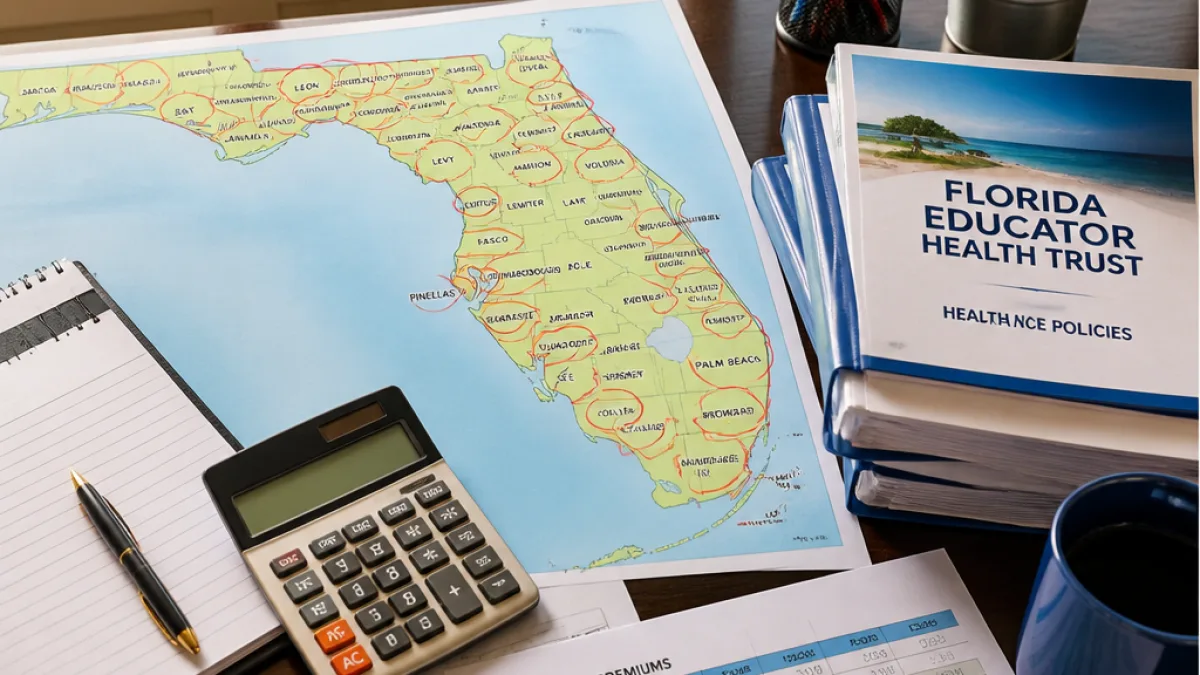
TALLAHASSEE — A growing number of small and mid-size Florida school districts are banding together to trim a major expense: employee health insurance. By joining the Florida Educator Health Trust, districts are switching to a self-insured model that officials say has produced substantial savings at a moment when enrollment declines and voucher expansions are squeezing local budgets.
Why districts are joining forces
As Florida’s public school rolls shrink — driven in part by historically low birth rates and a widening school-voucher program — superintendents and school boards have faced stark choices on spending. For many smaller districts, premium spikes in fully insured plans were adding pressure at a time when staffing and classroom resources are already constrained.
Roughly a third of the state’s 67 school districts have moved into the trust, according to the nonprofit that runs it. Officials say membership grew dramatically beginning in June 2025, swelling from the first three founding counties — Hendry, Hardee and DeSoto — to a group that now includes larger names such as Polk and Brevard counties.
How the self-insured model works
Under the self-insured arrangement, participating districts pay for the actual health claims of their employees rather than purchasing fully insured policies from commercial carriers. The trust pools risk across member districts, allowing them to negotiate prescription and medical pricing and to design benefit structures cooperatively.
Supporters contend the structure gives smaller systems bargaining power they otherwise would not have and provides flexibility to tailor plans to local needs.
- Membership growth: From an initial three districts to 23 members by mid-2025.
- Cost relief: Hendry County superintendent Mike Swindle says his district realized more than $3 million in savings during the first two years after switching.
- Administration: The trust operates under the Florida Association of District School Superintendents, which also runs a separate property and casualty insurance entity.
“When we were fully insured, our insurance premium rose every single year, from anywhere from 6 percent to 20 percent. When we switched to the self-insured model, in the first two years that we were in it, we saved over $3 million. It has been an absolute economic benefit to our district and to our teachers,” said Mike Swindle, superintendent of Hendry County.
Local impacts and teacher concerns
District leaders and some employees report palpable relief: slower premium growth, lower prescription costs and more predictable budgeting. For districts facing enrollment-driven revenue declines, those savings can free up money for classroom needs or help avoid deeper cuts.
But the shift has not quieted all critics. The president of the Florida Education Association, Andrew Spar, said teacher unions have not yet seen evidence that the cooperative model is delivering real, measurable savings for both districts and employees.
“So far, we have not seen any examples of a cooperative approach in which FLEHT has been able to address the out-of-control costs of health care while saving districts and employees money,” Spar said.
The FEA concern underscores a key tension: while districts may save on premiums or claims overall, the distribution of savings — lower employee premiums, reduced out-of-pocket costs, or improved benefits — is not automatic. Negotiations over plan design, copays, deductibles and prescription formularies will determine whether teachers and staff feel the benefit directly.
Which districts have joined, and what’s next
The trust’s early membership included several rural counties that historically have lacked the purchasing clout of larger districts. The decision by larger counties such as Polk and Brevard to join signaled a turning point late in 2025, prompting a wave of interest among other systems weighing their options for next fiscal years.
School officials say the trust model is not a panacea: it requires careful actuarial work, stop-loss coverage to limit catastrophic claims, and active cost-management strategies such as prescription management and disease-management programs. But for districts trying to steady finances as student counts decline, the model offers an alternative to repeated premium increases from commercial carriers.
Practical considerations for districts and employees
School boards considering a move into a pooled, self-insured trust should weigh several practical matters:
- Stop-loss insurance terms and limits on district exposure for high-cost claims.
- How savings will be shared or applied — lower employee premiums, enhanced benefits, or district budget relief.
- Administrative capacity and the trust’s governance structure for making benefit decisions.
For teachers and staff, the key question will be whether any district savings translate into lower premiums, reduced copayments, or expanded benefits. Union leaders say they will continue to press for transparency in that process.
As Florida’s education landscape adjusts to fewer students and shifting state policy, the health-trust experiment will be closely watched. For small districts juggling shrinking enrollments, it has become one practical lever to preserve services and protect employees without further eroding classroom budgets.
— Reporting from Tallahassee.