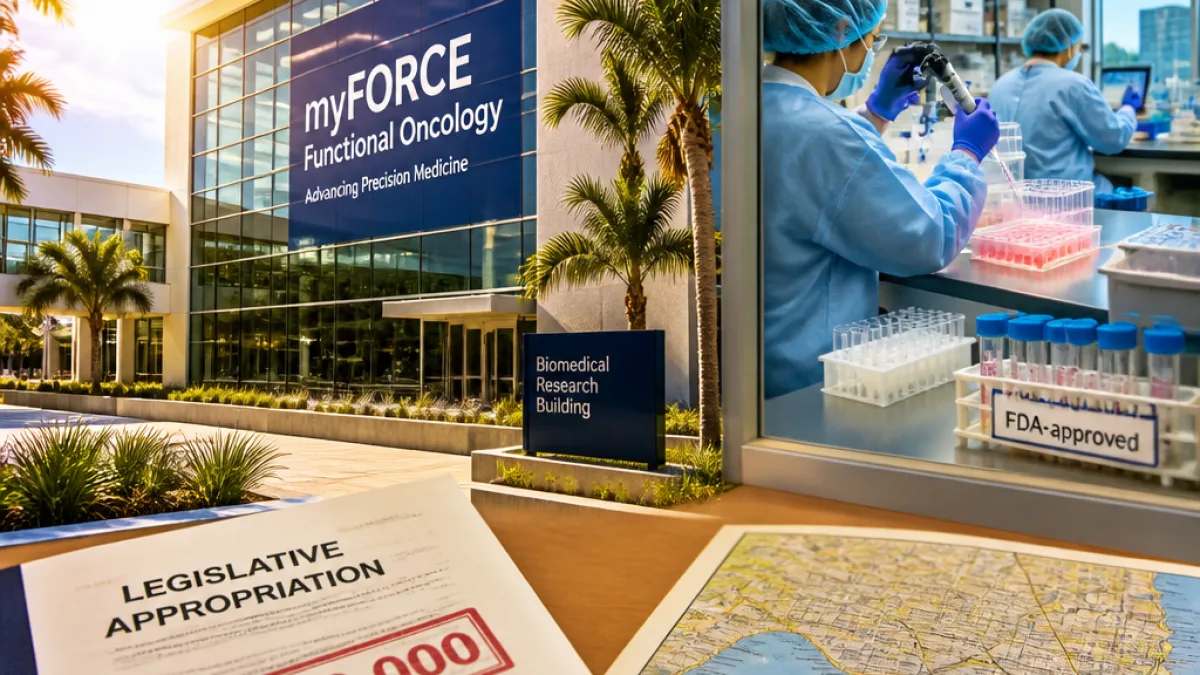
MIAMI — The Florida Legislature has directed $2 million to Florida International University’s effort to tailor cancer treatment to individual patients by testing therapies against their own tumor cells, officials announced Wednesday. The funding will support the university’s Functional Oncology Rapid Cancer Elimination program, known as myFORCE, which is housed within FIU’s Center for Advancing Personalized Cancer Treatments.
From lab bench to bedside in South Florida
myFORCE uses living samples of a patient’s cancer to measure how those cells respond to a range of FDA-approved medications, with the goal of identifying effective, and sometimes less toxic, options when standard therapies fail. The program is led by Diana Azzam, a professor and researcher at FIU’s Robert Stempel College of Public Health and Social Work.
Researchers say the approach is particularly focused on cases where cancer has recurred, resisted prior therapies or exhausted standard treatment paths — situations in which physicians and families are often searching for new options.
Lawmakers frame the investment as hope and leadership
State lawmakers who secured the appropriation said the investment will expand clinical access and position Florida as a leader in precision oncology. Senator Alexis Calatayud said the funding aims to bring tangible hope to families across the state.
“Every family deserves hope in the fight against cancer, and I am proud to have secured this funding to support FIU’s Functional Oncology Rapid Cancer Elimination (myFORCE) Program, an initiative advancing personalized treatment options for pediatric and adult cancer patients,”
Representative Omar Blanco also praised the award, highlighting the potential of the program to deliver personalized options for both children and adults and to elevate Florida’s standing in global research.
“These funds will provide personalized treatment options for pediatric and adult cancer patients across our community,”
Clinical evidence and prior results
Azzam’s methods gained national attention following a clinical collaboration with Nicklaus Children’s Hospital. In that study, researchers exposed tumor samples from pediatric patients with difficult-to-treat cancers to more than 120 medications. Published results in Nature Medicine reported that 83% of patients whose care was guided by this functional-testing approach experienced clinical improvement.
| Program | Focus | Key result |
|---|---|---|
| myFORCE (FIU) | Functional testing of patient tumor cells against approved drugs | 83% improvement reported in a published pediatric cohort |
What the funding will do
According to university officials, the state appropriation is intended to scale the program’s capacity so more patients can receive treatment recommendations informed by functional testing. The precise operational breakdown was not provided in the state announcement, but the money is expected to support laboratory throughput, clinical coordination and broader patient access.
For clinicians, the technique offers an evidence-based supplement to genomic profiling: rather than only reading a tumor’s DNA, functional testing observes how live tumor cells actually respond to drugs in vitro. That can surface potential benefit from therapies not otherwise indicated by genetic tests alone.
Local impact and next steps
FIU’s CAPCT and myFORCE are based in Miami, where the research collaboration with local hospitals has already touched pediatric care. Expanding the program could increase the number of adult and pediatric patients across South Florida who receive customized treatment recommendations derived from their own tumor biology.
- Funding source: Florida Legislature appropriation of $2 million.
- Program lead: Diana Azzam, FIU researcher and professor.
- Published result: 83% response/improvement in patients treated per the testing-guided plan (Nature Medicine).
Officials did not provide a timeline for when expanded services will be available or the number of additional patients who will be served by the appropriation. FIU and state representatives said they will continue to pursue partnerships and clinical trials aimed at validating and refining the approach.
As personalized oncology moves from promise toward practice, South Florida’s research institutions are seeking to translate laboratory gains into options for families confronting resistant or recurrent cancers. The new state funds aim to accelerate that transition locally, boosting the capacity to deliver individualized treatment recommendations derived from patients’ own tumor responses.
(Reporting from Miami.)