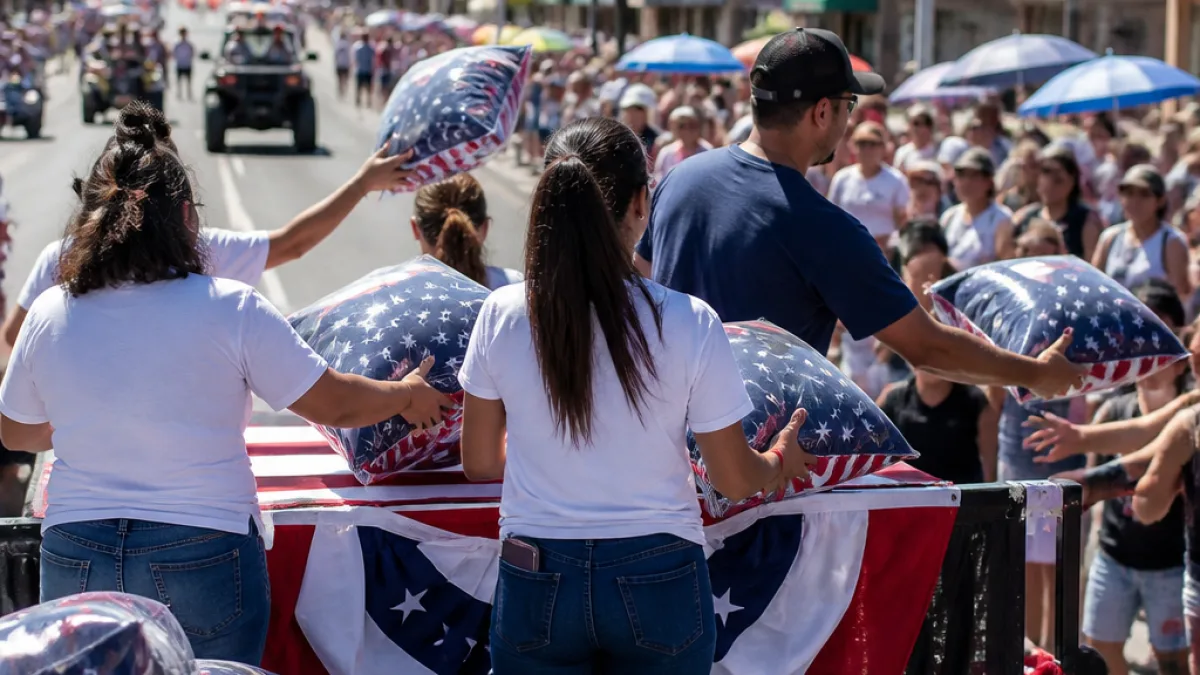
A Hennepin County judge ruled Thursday there is probable cause to believe Republican gubernatorial candidate Mike Lindell violated Minnesota campaign law by distributing pillows bearing his campaign branding at a July Fourth parade in Delano, Minnesota. The decision sends the matter to a three-judge administrative panel for an evidentiary hearing.
Allegations and immediate facts
The complaint, filed July 22, alleges Lindell and campaign staff handed out pillows to spectators during the Delano parade. According to the filing, the pillow packaging read "Mike Lindell for Governor" and listed a retail value of $34.95. Lindell acknowledged at the hearing that campaign operatives distributed the pillows.
At Thursday’s hearing, Lindell submitted affidavits, photographs of the event and an invoice showing the pillows were purchased wholesale for $4.90 apiece. He also said the pillows could be bought with a promotional code for $9.95.
How Minnesota law applies
Minnesota statute makes it a felony to give "any money, food, liquor, clothing, entertainment or other thing of monetary value ... in order to induce a voter to refrain from voting, or to vote in a particular way, at an election." The law includes an exemption for refreshments or food with a value up to $5 consumed at a public or private gathering.
| Item | Amount | Source |
|---|---|---|
| Retail value listed on packaging | $34.95 | Complaint |
| Wholesale purchase price (invoice) | $4.90 | Submitted by Lindell |
| Promotional sale price | $9.95 | Representation by Lindell |
Judge Nicholas Lienesch concluded the evidence presented was sufficient to establish probable cause that the statute may have been violated. The case will now advance to a panel of three administrative law judges, who will hold an evidentiary hearing; no hearing date has been set.
Campaign context and legal questions
The case raises questions around how Minnesota’s ban on giving things of value during elections applies to campaign merchandise that may be distributed in public settings. Central to the dispute will be whether the pillows were given with the intent to influence voters and how the various price points — wholesale, promotional and retail — should be weighed under the statute and exemptions.
- Whether the pillows qualify as a “thing of monetary value” meant to influence votes.
- Whether the retail value listed on packaging or the purchase price determines applicability of the law.
- Whether the statutory exemption for refreshments up to $5 has any bearing on the distribution of non-food campaign merchandise.
Candidate response and political implications
Lindell told the judge his campaign had taken steps to comply with election rules and described the proceedings as a distraction.
"This is a nonsensical distraction, it means nothing. I am focused on my budget," Lindell said.
The candidate, who recently stepped down as CEO of his company MyPillow, is one of the front-runners for the Republican nomination and has been a prominent national figure following his public alignment with President Trump. The episode underscores how campaign activity, even at local events, can draw legal scrutiny when tangible goods and voter influence intersect.
What comes next
Because the judge only found probable cause, the matter is not a finding of guilt. The administrative hearing will allow both sides to present evidence and testimony. If the administrative law judges determine a violation occurred, consequences could follow under state law. The date for that hearing has not been announced.
The case highlights the fine line campaigns must walk when distributing promotional items in public. As this dispute moves into a formal evidentiary forum, questions about intent, valuation and statutory exemptions will be central to how Minnesota enforces its campaign finance and election conduct rules.
Reporting from Delano and the Twin Cities area contributed to this article.