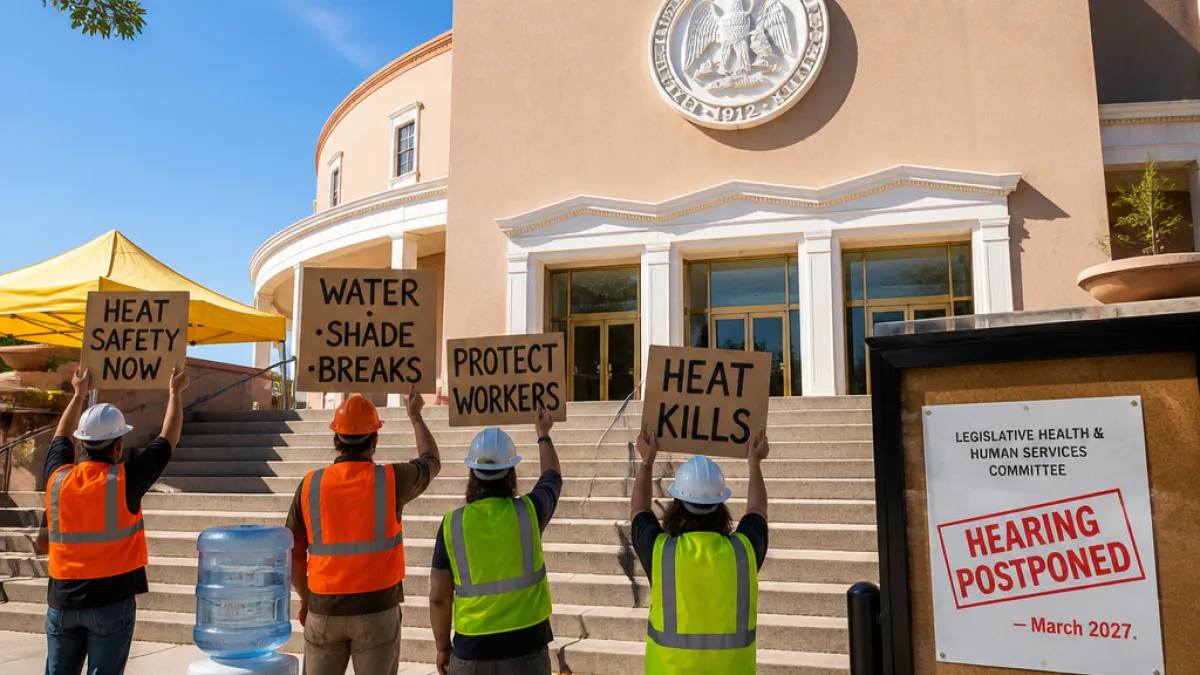
The New Mexico Environment Department has asked state regulators to push back rulemaking on workplace heat protections to early 2027, marking the fourth postponement since the agency first announced the effort in early 2025.
Disagreement stalls final action
In a filing with the state’s Environmental Improvement Board, lawyers for the department said the agency had not reached consensus with the multiple stakeholders involved — including labor groups, employers and public health advocates — ahead of a rulemaking hearing scheduled for Sept. 21. Industry groups representing livestock, oil and gas and utilities have objected to some of the proposed requirements.
The proposals floated by the department would have required employers to provide measures such as rest periods, shaded areas and drinking water when workers face hot conditions. State environment officials initially proposed beginning the rulemaking in early 2025 but postponed that process within months.
Advocates push back on delay
Environmental and worker-safety advocates criticized the agency’s latest request, saying that recent spells of triple-digit heat in the region underscore the urgency of adopting protections for employees who work outdoors or in hot indoor environments.
“Regardless of whether a job is in the field or the classroom, heat has the same impacts on the human body. All workers need protections,”
The comment came from Shelley Mann-Lev, senior program consultant for Healthy Climate New Mexico, who framed the issue as one of basic public health rather than a matter limited to a few industries.
Conservation Voters New Mexico also weighed in, noting the timing of the March 2027 request gives the state’s incoming governor an opportunity to influence who serves on the board overseeing the proceedings.
“As the state moves forward under a new administration, we hope we will see new standards for worker protections adopted,”
That statement was issued by Molly Taylor, chief operating officer at Conservation Voters New Mexico.
What’s at stake and what’s been proposed
Supporters of stronger rules say heat-related protections can reduce heat illness and prevent fatalities, especially for outdoor workers such as agricultural laborers and construction crews, and for indoor workers in poorly ventilated or overheated buildings. Opponents have expressed concerns about operational costs and practical implementation for certain sectors.
- Initial proposal announced: early 2025
- Previously scheduled rulemaking hearing: Sept. 21, 2026
- Department-requested new start: March 2027
| Item | Date |
|---|---|
| Proposal first announced | Early 2025 |
| Scheduled hearing (postponed) | Sept. 21, 2026 |
| Department-requested hearing date | March 2027 |
Board composition and political context
The Environmental Improvement Board, which will oversee any rulemaking, consists of seven members appointed by the governor and confirmed by the state Senate. Because the department has asked for the process to resume in March of 2027, a newly elected governor will likely have the opportunity to appoint or influence the board members who will govern the rulemaking.
Advocates pointed out that federal efforts to set worker heat-safety standards stalled during previous administrations, and they urged New Mexico to move more quickly as temperatures climb across the Southwest.
Immediate implications
For now, employers in New Mexico remain governed by existing state and federal workplace safety standards. The requested delay means that specific, statewide rules mandating breaks, shade and water tied explicitly to temperature thresholds will not be adopted in the near term unless the board or the department changes course.
Labor and environmental groups say they will continue to press regulators and lawmakers to adopt standards while industry representatives have signaled they will keep contesting provisions they say are burdensome or impractical.
The department’s filing reflects a process still in negotiation among multiple parties with competing concerns. With climate-driven heat events becoming more common, the debate over how, and how quickly, to enshrine worker protections in New Mexico remains unresolved.
— Elias Trujillo, NEXO RADAR