Federal investigators say a U.S. military GPS jamming exercise coincided with the May crash of a medical transport plane near Lincoln, N.M., a preliminary report from the National Transportation Safety Board shows. The accident, which occurred on the night of May 13–14, claimed four lives and has drawn fresh scrutiny over the risks that military testing can pose to civilian aviation.
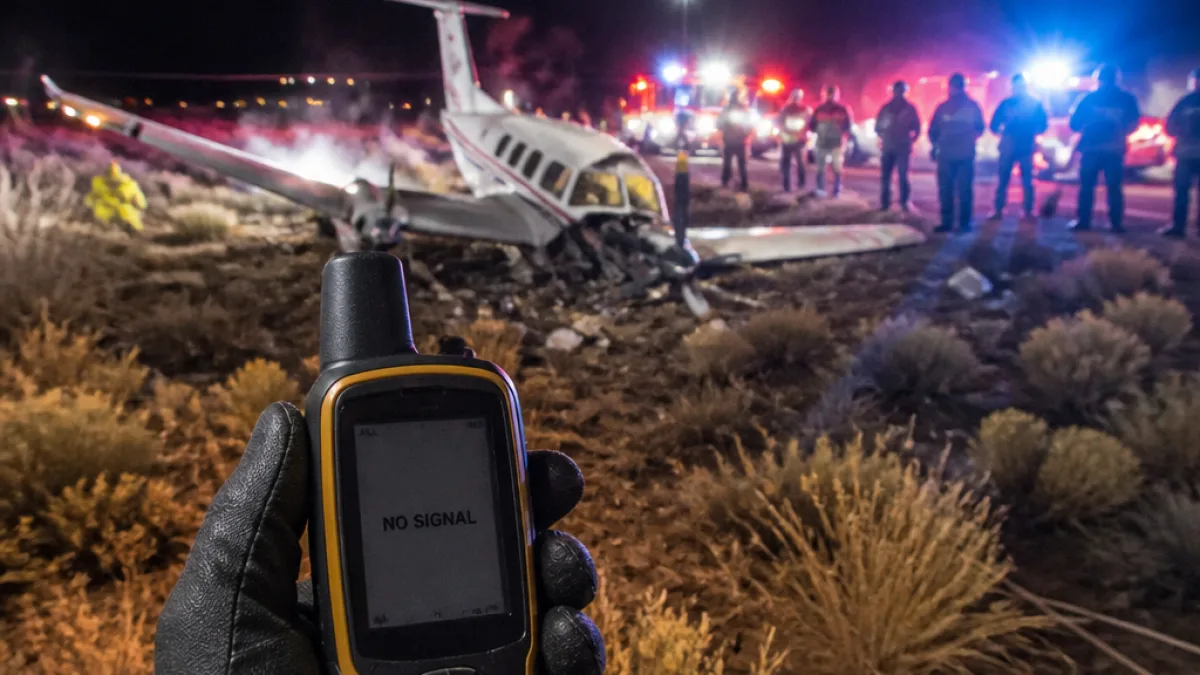
The aircraft, a Beechcraft King Air 90 operated by Generation Jets, departed Roswell Air Center at 11:52 p.m. MT on May 13 bound for Sierra Blanca Regional Airport near Ruidoso. Investigators say the flight lost GPS navigation capability shortly before the crash, which was reported about 12:15 a.m. on May 14 in the vicinity of Lincoln, a rural community along U.S. Route 380 roughly 60 miles west of Roswell.
The plane carried two crew members and two passengers; the passengers were flight nurses employed by Trans Aero Medical Services. All four aboard were killed.
What investigators reported
In the NTSB preliminary report released Aug. 5, investigators noted that "GPS jamming activities that encompassed the area around the accident flight were being conducted by the United States military during the time of the flight." The 746th Test Squadron — the Department of Defense unit charged with evaluating GPS equipment and navigation systems — conducts such tests, and public material shows the squadron operates high-powered jamming devices.
"a visual on Ruidoso,"
Before the loss of navigation, the report says a pilot in the area reported having "a visual on Ruidoso," but that that pilot’s radio transmission "was stepped on by other radio traffic." Shortly after, the Generation Jets aircraft experienced a loss of GPS capability, investigators said.
Local and operational implications
The NTSB report raises immediate questions for aviation operators in New Mexico, where vast stretches of military testing range intersect with civilian routes. Medevac flights are time-sensitive and often conducted at night or in poor weather; they rely on reliable navigation and communications systems. That reliance makes them especially vulnerable to disruptions, including intentional military jamming exercises designed to test resilience of equipment.
Officials have not yet released a determination of probable cause. The NTSB preliminary report is an early step in a longer investigation that can take months or more to reach final conclusions and recommendations. In the meantime, the finding that military jamming activities were occurring near the accident flight will likely prompt questions from local officials, aviation operators and families of the victims about coordination, notification and safety mitigations.
Timeline (preliminary)
| Time (MT) | Event |
|---|---|
| 11:52 p.m., May 13 | Plane departs Roswell Air Center for a medevac pickup |
| Shortly before 12:15 a.m. | Pilot in area reports "a visual on Ruidoso"; transmission interfered with |
| About 12:15 a.m., May 14 | Plane crashes near Lincoln; four fatalities reported |
| Aug. 5 | NTSB releases preliminary report noting military GPS jamming in the area |
Questions for military and regulators
The involvement of the 746th Test Squadron — which is tasked with testing GPS user equipment and navigation systems — underscores a recurring tension in New Mexico: the presence of military testing amid civilian communities and air traffic. The preliminary NTSB account does not assert direct causation, but it documents contemporaneous jamming activity that investigators say encompassed the area of the accident flight.
Key questions now include whether military testers coordinated timing and notice with civilian air traffic control, whether flight crews in the area were alerted to ongoing jamming, and whether alternative navigation procedures were feasible or in place for medevac operations.
- Who should notify civilian aviation when jamming tests occur?
- What protections exist for critical medical flights operating at night?
- How will regulators balance testing imperatives with public safety?
Local residents and officials in Lincoln County previously described their alarm when the medevac failed to arrive that night. The plane and aircrew were based at Roswell Air Center, and the two flight nurses were employees of Trans Aero Medical Services, according to the NTSB report. Beyond the immediate human toll, the crash has reopened a conversation that has echoed across New Mexico for decades: how to coexist with military and federal testing ranges that have long shaped the region’s skies.
The NTSB investigation continues. As federal investigators gather more data, families and regional leaders will be watching for final findings and any recommendations that might change how military testing is conducted near civilian air traffic or how medevac and other critical flights are protected from navigational disruption.
Reporting from the preliminary NTSB report is ongoing; officials from the 746th Test Squadron and other Defense Department entities have not issued an immediate public response in the report released Aug. 5.