RED RIVER, N.M. — New Mexico lawmakers face decisions in the January 2027 legislative session over how the state pays for public school capital outlay and distance-learning programs after fiscal analysts warned the current funding formula can produce costly anomalies.
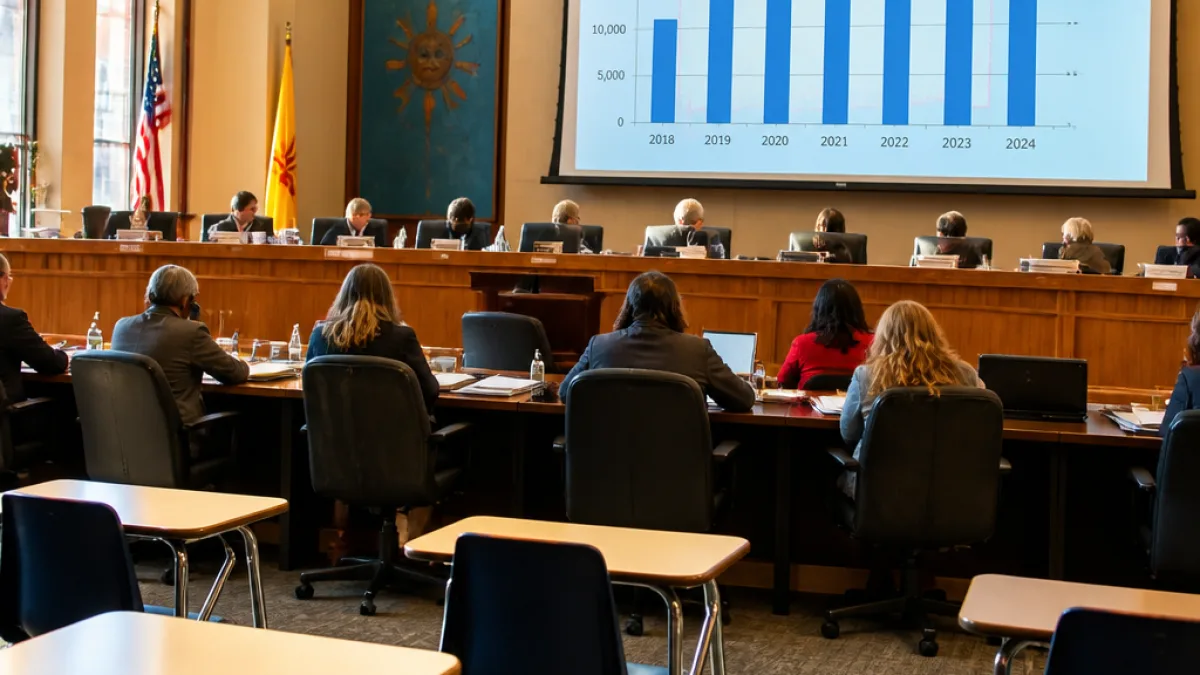
Members of the Legislative Finance Committee heard July 23 from LFC Principal Fiscal Analyst Sunny Liu, who laid out how the funding mechanism that awards distance-learning units and incentives for extended instructional time allowed a situation last year — most notably in Gallup — that produced a roughly $35 million shortfall.
Funding quirks and duplicate units
The core concern is that the formula can double-count students under certain circumstances, particularly when learners move between districts or enroll in distance-learning programs that serve students outside their district’s geographic boundary. During the 2026 session lawmakers enacted temporary measures that altered how distance-learning units are calculated, allowing the state to recoup funds. But those fixes are set to expire: the formula is scheduled to revert to its normal workings in the coming fiscal year.
“We want to ensure that these programs are the student’s best option, not the first option,” Liu said. “And we want to make sure that there’s some accountability for performance because, at the end of the day, that’s what our constitutional obligation is, to ensure that these kids have the best education available to them.”
Liu presented several policy options to the committee, including permanently modifying the formula to prevent duplicate funding units and clarifying when distance learning is appropriate. Those options aim to create clearer boundaries for when a district can claim dollars for an out-of-district participant and when a program should be treated as serving students only within its own geography.
Extended learning incentives under scrutiny
The LFC report also highlighted tensions in the state’s investments to expand instructional time. Since the 2018 Yazzie/Martinez education equity ruling, New Mexico has directed significant dollars at extended learning initiatives. The Legislative Education Study Committee told lawmakers last month that local districts have “largely failed to increase instructional time” despite those investments.
State records show the K12+ Program, introduced in 2023, has not produced the changes intended: participating schools have added an average of just three instructional ... (the original report truncated here). Committee materials noted that, cumulatively, the state has invested $2.6 billion in expanded learning since the initial Yazzie/Martinez findings.
Policy options on the table
The LFC outlined a menu of approaches rather than a single prescription. The options include:
- Adopting a permanent adjustment to how distance-learning units are counted to avoid duplicate funding.
- Defining clearer geographic and programmatic limits for when distance learning can be funded by a district.
- Linking funding to measures of program performance and student outcomes, to ensure the investments deliver educational benefits.
Committee members signaled that the issues are complex: any change to unit calculations could have winners and losers among districts, and adjustments will need to balance fiscal integrity with the constitutional mandate to provide an adequate education.
Numbers at a glance
| Figure | Context |
|---|---|
| $35 million | Shortfall tied to distance-learning enrollment shifts last year (Gallup example) |
| $2.6 billion | State investment in extended learning since 2018 Yazzie/Martinez findings |
| 3 | Average number of additional instructional (reported for K12+ participants) |
What comes next
Lawmakers in the 60-day session beginning in January will need to decide whether to pursue permanent fixes, extend the temporary changes enacted in 2026, or pursue other reforms. The debate will touch on fiscal oversight, program accountability and the continuing obligation policymakers face after the Yazzie/Martinez litigation to ensure at-risk students receive additional time and support.
For districts and education advocates, the question will be how to craft rules that protect state funds from duplication while preserving access to innovative programs — and ensuring that extended-learning dollars produce measurable gains rather than an accounting mirage. The committee’s discussions signaled awareness that technical formula changes can have far-reaching consequences in communities across the state.
The Legislative Finance Committee’s analysis provides the framework state lawmakers will use as they weigh trade-offs next winter. How they reconcile precise funding mechanics with broader educational goals will determine whether the next budget cycle avoids another costly shortfall.