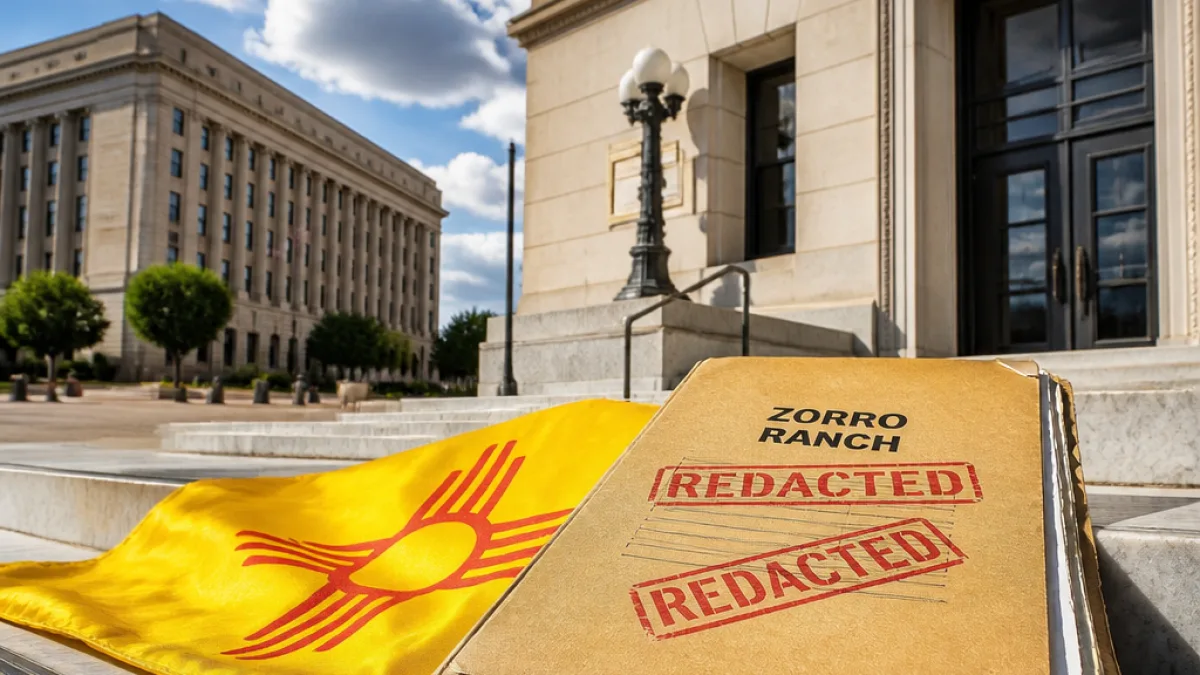
CEDAR CREST, N.M. — The State of New Mexico lodged a federal lawsuit Wednesday accusing the U.S. Department of Justice and Acting U.S. Attorney General Todd Blanche of thwarting the state's criminal investigation into Jeffrey Epstein and others connected to Epstein's Zorro Ranch.
State seeks court order to obtain withheld materials
Filed in the U.S. District Court for the District of Columbia, the complaint asks a judge to compel federal officials to turn over records New Mexico says are critical to identifying victims, witnesses and potential co‑conspirators. The suit contends that the Justice Department's refusal to provide unredacted materials — and its repeated denials to formal requests — have impeded the state's ability to carry its investigation forward.
The action coincides with New Mexico's release of a preliminary report summarizing findings from its ongoing probe of Epstein's activities at the secluded Zorro Ranch near Stanley. The complaint characterizes the Justice Department's stance as not merely uncooperative but actively harmful to survivors and the public interest.
Dispute centers on privacy vs. prosecution
The Justice Department, responding to the lawsuit, said federal court orders and statutory protections bar the agency from disclosing certain materials that could identify victims. The department emphasized its priority of protecting victim privacy while saying it remains willing to assist the state's investigation within the constraints of the law.
“Victim‑identifying information carte blanche” — language the department used to explain why it declined to release some requested material — appears in the state’s court filing as part of the dispute over disclosure.
New Mexico's complaint says it has faced sustained resistance in obtaining documents that historically had been shared between state and federal investigators. According to the filing, Attorney General Raúl Torrez and his senior prosecutors submitted multiple requests — the office has counted 10 separate requests — for specific records and largely met denials or silence.
Why the files matter to New Mexico
State prosecutors argue that New Mexico is one of the few jurisdictions that might still pursue accountability against associates of Epstein and thus obtain a measure of justice for survivors. The withheld materials, they maintain, are needed to identify people who visited or worked at Zorro Ranch and to corroborate alleged criminal conduct that occurred on state soil.
- New Mexico reopened its probe into Epstein earlier in the year and has been assembling evidence tied to Zorro Ranch.
- The state contends some federal documents contain names and details necessary to locate witnesses and corroborate allegations.
- The Justice Department says protective orders and privacy laws limit what it can disclose.
Legal and local stakes
The lawsuit elevates a conflict with national implications to a local courtroom — a flashpoint in the broader, national debate over how far federal transparency around Epstein files should extend and how to balance survivors' privacy against the needs of criminal investigations. For New Mexico, the stakes are immediate: prosecutors say the information could lead to additional charges or reveal facilitators who operated at Zorro Ranch.
For communities in and around Stanley and the Sandia foothills, the case touches on a long memory of secrecy and power. Epstein’s ownership of Zorro Ranch made the property a focal point of scrutiny and suspicion; now the state seeks evidence to turn that scrutiny into prosecutorial action.
What the lawsuit asks the court to do
At its core, the complaint asks the federal court to order the Justice Department and Blanche to disclose the requested files or to provide a legal basis for continued withholding. The state frames the request as necessary not only for law enforcement but for survivors who, the complaint says, deserve the chance for justice.
| Entity | Position in dispute |
|---|---|
| State of New Mexico (Attorney General's Office) | Seeks unredacted files to identify victims, witnesses and alleged co‑conspirators |
| U.S. Department of Justice / Acting AG Todd Blanche | Says protective orders and privacy rules bar disclosure of victim‑identifying material |
How the court resolves the tension between privacy protections and New Mexico’s investigatory needs will shape the next phase of the state's work and could influence other jurisdictions seeking similar access to federal files in the Epstein matter.
As the suit advances, Torrez’s office and the Justice Department could still negotiate a path to share information consistent with court orders; absent agreement, the dispute will unfold under the scrutiny of a federal judge. For survivors and for communities that remember the quiet of Zorro Ranch, the litigation signals that the search for accountability in New Mexico is far from over.