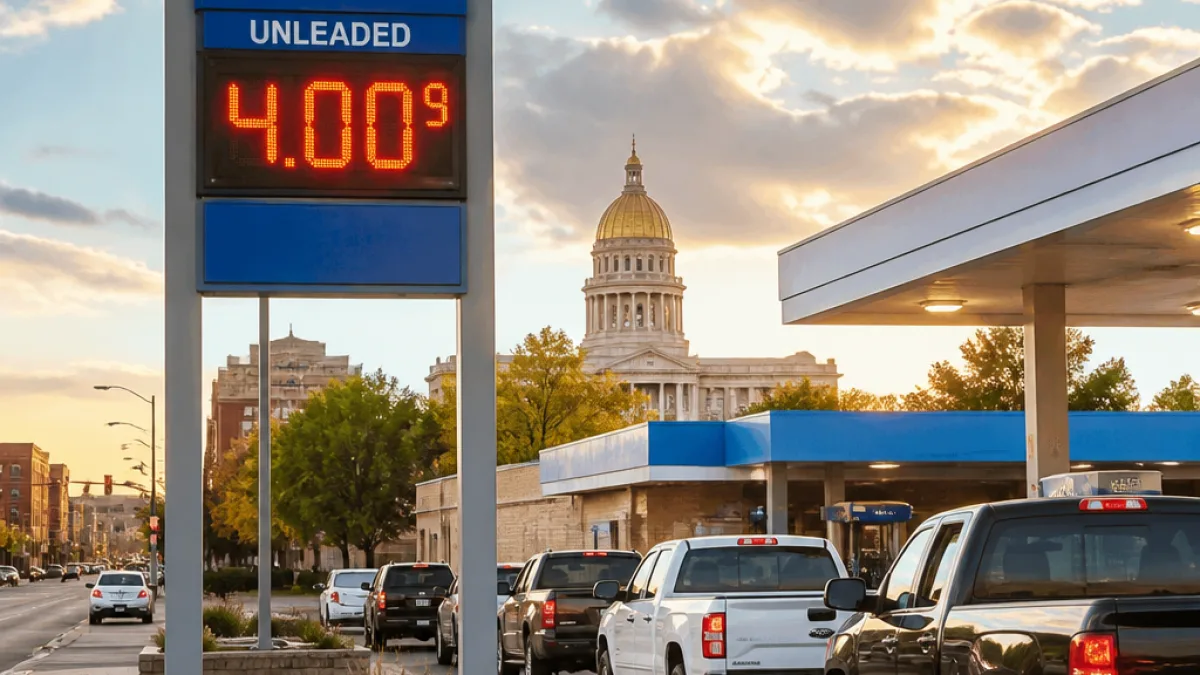
Average retail gasoline prices in Wyoming rose sharply over the past week, according to a statewide survey by GasBuddy, pushing the mean price to roughly $4.00 per gallon on Monday. The increase — about 18.7 cents per gallon from the previous week — narrows the breathing room motorists had seen earlier in the summer.
Numbers that matter
GasBuddy’s survey covered 494 stations across Wyoming. Compared with a month ago, statewide prices remain slightly lower — down about 5.9 cents per gallon — but are still markedly higher than last year, at about 92.1 cents per gallon above the 12‑month mark.
Diesel, by contrast, showed a national easing in the same period: the national average price of diesel fell by 22.3 cents compared with a week earlier and stood at $5.077 per gallon in GasBuddy’s national reporting.
| Measure | Wyoming | National |
|---|---|---|
| Average gasoline price | $4.00/gal | $3.95/gal |
| Weekly change (gasoline) | +18.7¢ | +13¢ |
| Monthly change (gasoline) | -5.9¢ | +6.5¢ |
| Yearly change (gasoline) | +92.1¢ | +85.7¢ |
Range at the pump
Prices remain uneven across the state. GasBuddy’s price reports showed the lowest pump price Sunday at $3.59 per gallon, while the highest registered at $5.99 per gallon — a gap of $2.40 between the cheapest and most expensive stations.
- Survey coverage: 494 Wyoming stations
- Lowest reported price Sunday: $3.59/gal
- Highest reported price Sunday: $5.99/gal
“Average gasoline and diesel prices rose in nearly every state for the second straight week, with the national average price of gasoline likely to reach $4 per gallon within the next 48 hours and diesel already back above $5 per gallon nationally,”
The quote is from Patrick De Haan, GasBuddy’s head of petroleum analysis, who warned that the market’s pressure is shaped less by crude oil alone and more by strains in global refining capacity and disruptions in strategic shipping routes.
What’s driving the increase
GasBuddy’s analysis points to a cluster of supply-side problems: limited refining throughput globally, disruptions to key shipping lanes and attacks that have affected refining operations in parts of the world. Those supply constraints can cause price swings even when crude oil does not spike dramatically. Gas bottles, refinery downtime and geopolitical tensions are all factors that ripple down to local pumps.
Locally, Wyoming’s mix of urban and rural fuel markets means price volatility can hit harder for travelers in remote areas where fewer stations operate and deliveries are less frequent. For commuters and commercial fleets that rely on diesel, even modest price moves can affect household budgets and business operating costs.
Practical guidance for motorists
Wyoming drivers looking to soften the impact of rising prices can consider a few low‑cost steps:
- Watch apps and websites that track local prices and time fills for lower daytime or midweek rates.
- Combine errands and reduce idling to improve fuel efficiency.
- For businesses with fleets, explore hedging and bulk purchasing options where feasible.
While those measures won’t eliminate the larger market forces at play, they can help smooth household and small‑business budgets while national supply issues play out.
Park expansion noted
Also in the week’s local briefs, officials said Grand Teton National Park expanded its holdings by acquiring 35 acres north of Teton Village near Granite Canyon. The acquisition completes purchases of six parcels from the Resor family in that area. The land transaction is a separate item from fuel markets, but together the briefs paint a picture of local change: one affecting conservation and recreation, the other daily life at the pump.
For now, Wyoming motorists should expect continued sensitivity in pump prices as global refining and shipping developments unfold. Those who can plan around fill-ups and track local price lists will fare better while the market finds footing.