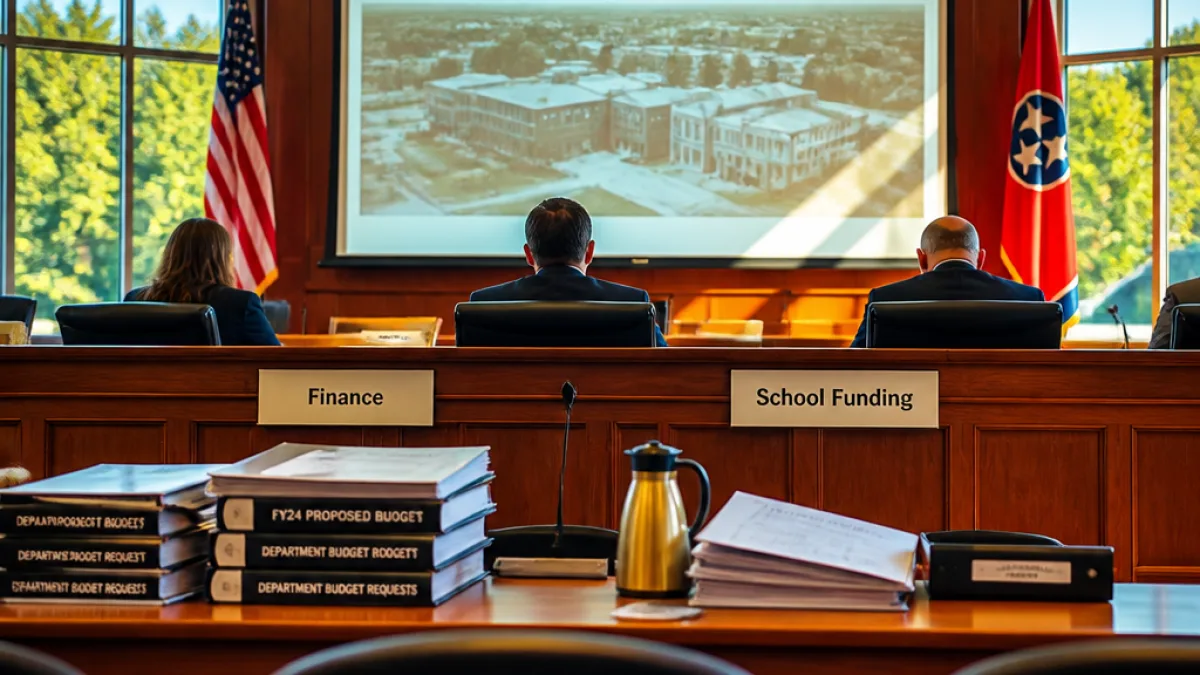
The City of Clarksville will confront a contentious budget question when the City Council takes up a resolution to rescind roughly $3.3 million in annual funding for the Clarksville-Montgomery County School System (CMCSS). The proposal, introduced by Mayor Joe Pitts, failed to advance out of the city’s Finance Committee on July 17 due to a lack of motion, and has been scheduled next for full council consideration on July 28.
Roots of the funding and what’s at stake
The disputed payment traces back to a long-standing agreement tied to a 1977 referendum. Under the current arrangement, the city contributes an estimated $75 million to the school system overall, with the disputed $3.3 million being an additional allocation the city voluntarily provides on top of its state-required sharing of sales tax revenue.
Mayor Pitts framed the proposal as a way to relieve municipal pressure on the city budget. “By law, we are required to give half of our sales tax that is collected within the city limits to the school system,” he said during a special budget session. “We don’t begrudge that at all. This is a deal cut in 1977, and this (amendment) would get us out of that and we would keep the estimated $3.3 million per year.”
- What the city stands to keep: An estimated $3.3 million annually if the resolution passes.
- Current total city contributions to CMCSS: Approximately $75 million, according to Mayor Pitts’ remarks.
- Committee action: Finance Committee did not move the measure forward; it will go to City Council on July 28.
Local officials and public reaction
Supporters of rescinding the payment argue the annual donation amounts to double taxation for Clarksville residents, who already cede half the city-collected sales tax to the school district by law. Several City Council members expressed sympathy with removing the $3.3 million during earlier discussions, saying the city needs the revenue to sustain municipal services without raising property taxes further.
Mayor Pitts stressed the city’s ongoing support for schools even as he advocated for reclaiming the additional funds. He cited city services that rely on local revenue — crossing guards, traffic signals near schools, and sidewalk projects — as priorities that could be affected if the city’s budget remains constrained.
“The city needs the revenue to support the city’s operations which includes crossing guards, to hands school signals, to the sidewalks we have been installing around the schools,” Pitts said.
Questions of precedent and policy
The resolution revives a broader policy debate about how local governments fund public education and how long-standing fiscal arrangements should be reassessed. The $3.3 million figure was first negotiated decades ago and for some council members represents an opportunity to revisit commitments made under different economic circumstances.
Opponents of altering the funding may argue that stable, predictable support for schools benefits long-term planning and that sudden changes could ripple through district operations. The city has not publicly detailed how it would repurpose the reclaimed funds if the resolution succeeds, beyond general references to municipal needs.
| Item | Amount / Date |
|---|---|
| Additional annual payment under review | $3.3 million |
| Estimated total city contribution to CMCSS | $75 million |
| Original agreement reference | 1977 referendum |
Next steps and local consequences
With the Finance Committee declining to move the resolution forward, the measure now heads to a full City Council hearing where councilors will have the opportunity to debate, amend or reject the proposal. The council’s decision will have direct implications for city budgeting and for CMCSS planning.
For Clarksville residents, the debate centers on competing priorities: preserving municipal services and infrastructure versus maintaining supplemental funding that benefits the school system. The council’s action later this month will determine whether a nearly half-century-old funding arrangement remains in place or is altered as the city seeks flexibility in an evolving fiscal landscape.