Little Rock — A federal judge has pared back part of a lawsuit contesting Arkansas’ controversial ban on what the statute calls "Indoctrination," but left intact the plaintiffs’ challenge that the law is vague and violates due process.
Case narrowed to due-process and vagueness claims
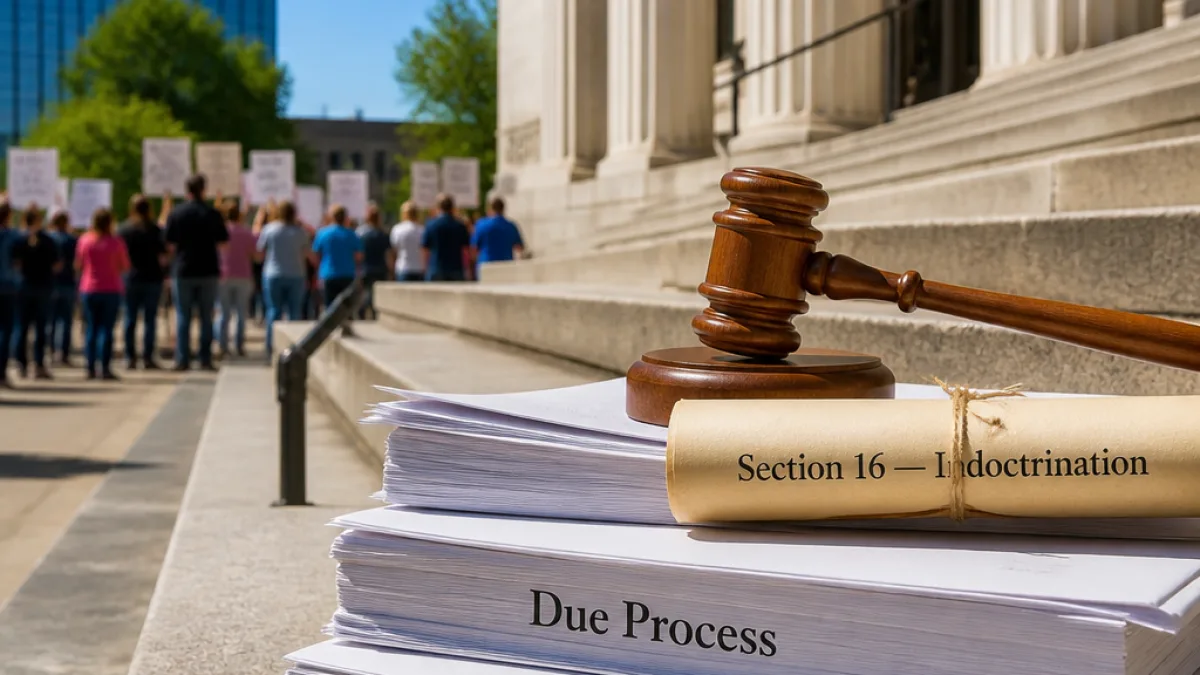
U.S. District Judge Lee Rudofsky dismissed an equal protection claim in an order issued Wednesday and directed both sides to submit new briefs focused on the plaintiffs’ remaining claims. Those claims center on whether Section 16 of the LEARNS Act — titled "Indoctrination" — is unconstitutionally vague and deprives teachers of due process.
The statute specifically requires review of "any items that ... promote teaching that would indoctrinate students with ideologies such as Critical Race Theory." The provision has generated contentious debate since the law’s passage and has been the subject of sustained litigation about what classroom speech and materials it permits or forbids.
"any items that ... promote teaching that would indoctrinate students with ideologies such as Critical Race Theory."
Long-running procedural history
The order comes after a protracted appellate and trial-court tussle. In 2024, Rudofsky granted a preliminary injunction that halted enforcement of Section 16. The U.S. 8th Circuit Court of Appeals later lifted that injunction more than a year before this week’s order, sending the case back onto a narrower track.
Following the appeals court ruling, both sides filed arguments in response to the state’s motion to dismiss. On Wednesday, Rudofsky accepted the plaintiffs’ concession that some claims — including earlier free-speech challenges brought under the First Amendment — must be dismissed, leaving due-process and vagueness arguments as the central issues for the court to consider.
Who is suing and who is sued
The plaintiffs include two teachers from Little Rock Central High School and the Arkansas State Conference of the NAACP. The defendants named in the March 2024 complaint are Governor Sarah Huckabee Sanders, Department of Education Secretary Jacob Oliva and members of the state Board of Education.
| Party | Role in case |
|---|---|
| Plaintiffs | Two Little Rock Central High School teachers; Arkansas State Conference of the NAACP |
| Defendants | Gov. Sarah Huckabee Sanders; Sec. Jacob Oliva; Arkansas State Board of Education members |
Questions before the court
- Whether Section 16 is so vague that teachers cannot determine what speech or materials are prohibited.
- Whether the law deprives educators of constitutionally protected procedural safeguards before punishment or enforcement.
Rudofsky’s dismissal of the equal protection theory reflects the evolving posture of the litigation. The plaintiffs in earlier filings had also advanced free-speech claims under the First Amendment; in his order Wednesday, the judge noted the plaintiffs had conceded those claims must be dismissed.
Local impact and what comes next
The narrowing of issues preserves what could be a consequential ruling on the limits of state control over classroom instruction. Teachers, school administrators and civil-rights groups have argued that ambiguous language in Section 16 could chill classroom discussion and professional judgment, while state officials have defended the law as part of broader efforts to shape public education policy.
Rudofsky ordered the parties to file new briefs on the remaining due-process and vagueness claims. Those filings will determine the next phase of the litigation and could set the scope of evidentiary hearings or further motions. No timetable for additional briefing or a potential hearing was announced in the order.
The case has attracted attention because it tests how courts will apply constitutional protections to classroom speech and state regulatory power. If the court finds Section 16 unconstitutionally vague, it could constrain enforcement statewide and influence similar statutes elsewhere. If the court upholds the law’s language, it may leave enforcement decisions to state educational authorities and local school districts.
For now, teachers and school systems in Arkansas continue to operate amid legal uncertainty. Education officials, classroom instructors and advocacy groups will be watching the next filings closely for guidance about what the law permits — and what it forbids.
Check back for updates as the parties file new briefs and Rudofsky sets the next steps in a dispute that has been unfolding for more than two years.
Reporting from the state capital.