Federal contract aims to keep Charleston Harbor competitive
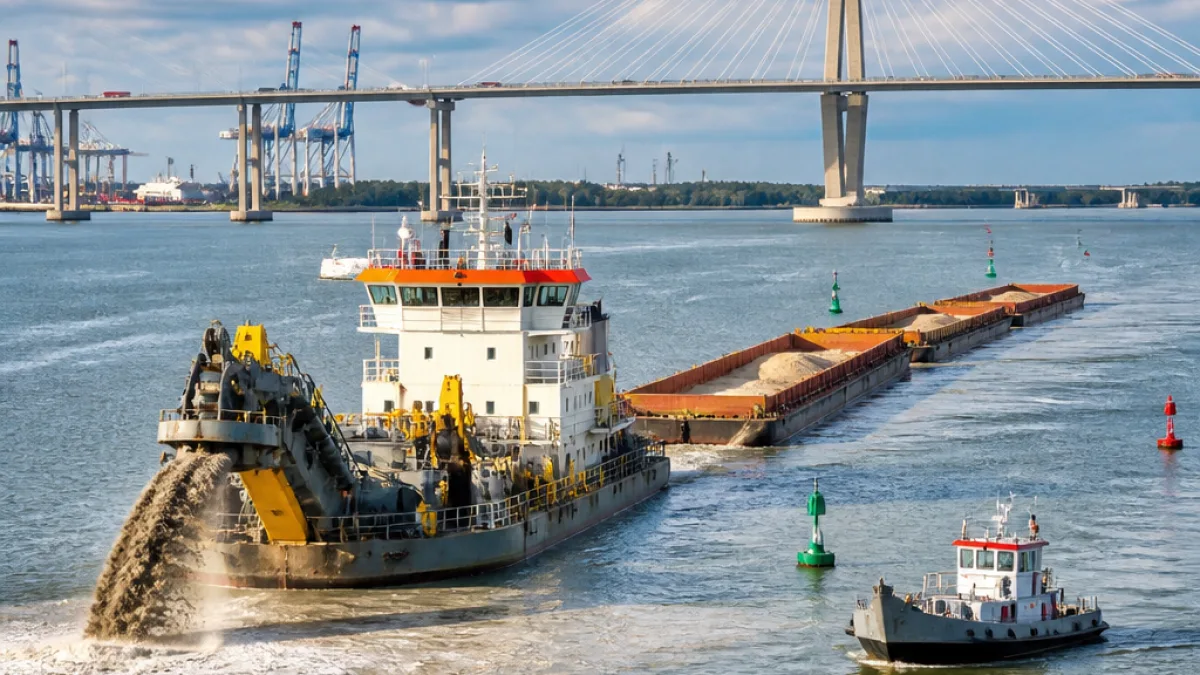
The U.S. Army Corps of Engineers has awarded a $28.2 million firm-fixed-price contract to The Dutra Group to perform maintenance dredging in the Lower Charleston Harbor, officials announced. The work is slated to be carried out in Charleston and is scheduled for completion by Sept. 29, 2027.
The award follows an online solicitation that drew four bids. According to the Corps and Dutra's announcement, the project will remove about 4.2 million cubic yards of material from channel sections serving Wando Terminal, Leatherman Terminal, North Charleston Terminal and Columbus Street Terminal. Dredged material is to be placed at the Charleston Ocean Dredged Material Disposal Site.
"The project will remove approximately 4.2 million cu. yds. of material from channel sections serving Wando Terminal, Leatherman Terminal, North Charleston Terminal, and Columbus Street Terminal."
Lower Charleston Harbor requires annual maintenance dredging, the Corps said, with the entrance channel typically dredged every other year and the upper reaches on roughly a 15- to 18-month cycle. The broader federal navigation project for Charleston comprises nearly 38.6 miles of channel, three turning basins, an anchorage basin and four placement areas.
Charleston's role as a major Atlantic gateway lends weight to the maintenance work. The Corps lists Charleston Harbor among the nation’s 17 strategic ports and identifies it as the fourth-busiest container port on the East Coast. Keeping channels at authorized depths is essential to sustain the larger, deeper-draft vessels that now call on the port.
Funding, environmental safeguards and local partners
The full contract amount was obligated at award from fiscal 2026 civil operations and maintenance funding. Separately, the Charleston District received $37 million in fiscal 2026 appropriations for dredging the Lower Harbor and entrance channel and for maintaining upland placement areas.
The South Carolina Ports Authority serves as the nonfederal sponsor for the navigation project. The federal solicitation also requires compliance with endangered species protections and marine mammal safeguards, reflecting decades of heightened scrutiny of dredging impacts along the coast.
Dutra said it will use its mechanical dredging fleet for the job but did not identify specific dredges, barges or support vessels or provide an anticipated mobilization date in its announcement. The company is based in San Rafael, California.
- Contractor: The Dutra Group
- Contract value: $28.2 million
- Material to remove: ~4.2 million cubic yards
- Completion date: Sept. 29, 2027
- Placement: Charleston Ocean Dredged Material Disposal Site
| Item | Figure |
|---|---|
| Contract amount | $28.2 million |
| Estimated material removed | 4.2 million cu. yds. |
| Federal appropriations to Charleston District (FY2026) | $37 million |
| Project completion | Sept. 29, 2027 |
For Charleston, the work is more than a routine maintenance contract. The harbor’s depth and navigability underpin the region’s trade-dependent economy, from containerized imports and exports to the terminals that support local logistics and warehousing. In recent years, federal and local officials have invested in deeper channels and terminal improvements to accommodate larger vessels and preserve competitive advantage on the East Coast.
Still, dredging carries local trade-offs. Environmental reviews and marine-protection conditions are now standard parts of federal solicitations, and placement of dredged material — whether in ocean sites or upland facilities — continues to be a topic of community attention. The involvement of the South Carolina Ports Authority as nonfederal sponsor also highlights the public-private nature of harbor stewardship.
As the work is carried out, residents and businesses will be watching for its effects on port traffic, local jobs and shoreline ecosystems. The mechanical approach Dutra plans to use typically reduces the plume-related concerns associated with hydraulic dredging, but firm timelines and vessel rosters have not been released. The absence of a mobilization date leaves open questions about scheduling and coordination with terminal operations.
For now, the award secures the necessary federal dollars and assigns responsibility for a multi-year maintenance cycle that keeps Charleston’s maritime gateway moving — and competing — in a crowded East Coast port system.