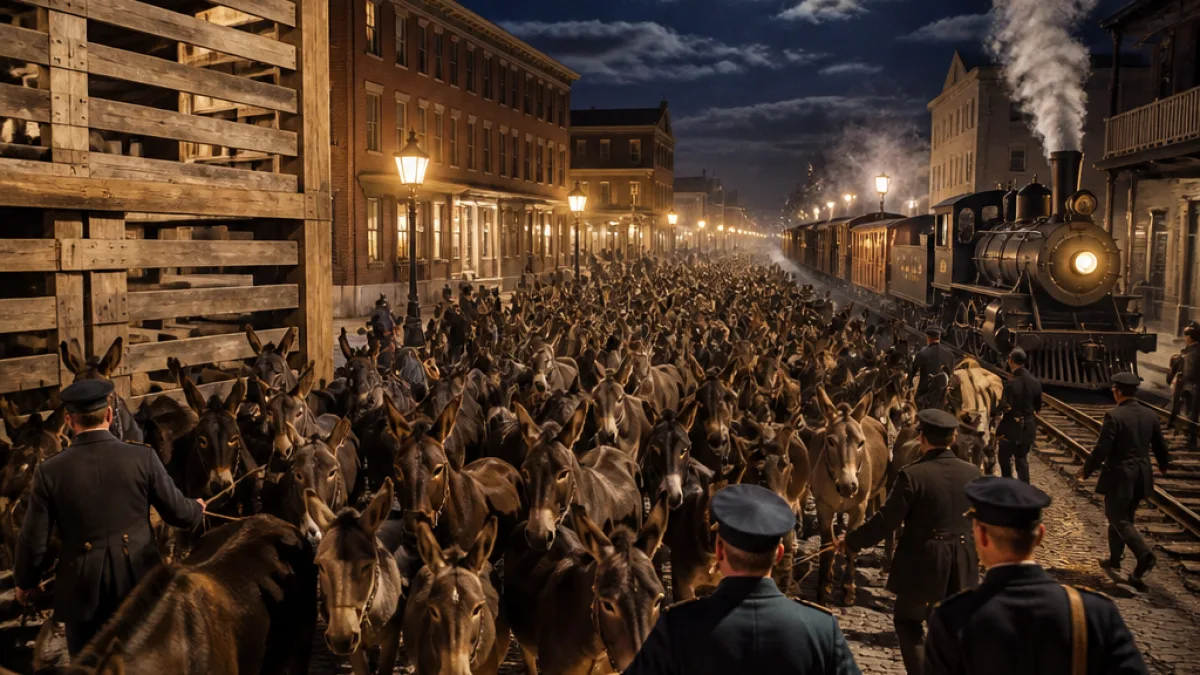
ALEXANDRIA, Va. — On the night of Aug. 2, 1898, the city’s streets became an unexpected theater: nearly 200 Army mules stampeded out of the corrals at the stables of St. Asaph racetrack and scattered across the Duke Street corridor, leaving residents to watch, chase and round them up for hours.
Military logistics collide with neighborhood life
The stampede occurred while Alexandria was serving as a busy military waystation during the Spanish–American War. The U.S. Army had taken over the stables at the old St. Asaph racetrack — a facility in what is now Del Ray — to house animals necessary for transportation in an era before motor vehicles. The racetrack itself had been a local fixture since the early 1890s and operated amenities that drew attention, but by 1898 its grounds also were holding vital Army livestock.
According to contemporary accounts, a passing freight train spooked the animals. The mules broke out of their corral and stampeded in multiple directions, sending them through neighborhoods from the village of West End near Diagonal Road and into downtown Alexandria along the Duke Street corridor.
Hours of cleanup and bewilderment
Residents watched bewildered animals wander streets, crash through property and resist recovery. It took hours for authorities and others to bring the animals back under control. The episode highlights how the war effort — the movement of men, supplies and animals — could spill directly into daily life in Alexandria.
- Location: St. Asaph racetrack stables (present-day Del Ray)
- Date: Night of Aug. 2, 1898
- Extent: Stampede of nearly 200 mules, range of damage across Duke Street corridor
A curious side episode at the police station
That same evening, a separate but odd incident was recorded: a soldier arrived at the Alexandria Police Department without clothing, reporting that "his clothes had been stolen from his body." Officers investigated, and the missing clothing was discovered several hours later scattered inside an area described in the reports. Contemporary notices do not make clear whether the two episodes were connected.
"His clothes had been stolen from his body."
Newspaper and municipal records from the period portray a city adapting to extraordinary traffic: tens of thousands of soldiers, animals and supplies flowed through Alexandria in support of operations overseas. The St. Asaph racetrack, once a center of local leisure and controversy, had by then been repurposed to meet wartime demand.
From racetrack to residential neighborhood
St. Asaph racetrack would remain a notable local institution for a few more years, drawing attention for both recreation and business practices. It was not until 1905 that a determined Commonwealth’s Attorney moved to close the facility. Over the decades the racetrack grounds transformed into the residential, cottage-style neighborhood known today as Del Ray, replacing the chaos and commotion of turn-of-the-century activity with suburban streets and small businesses.
| Year | Event |
|---|---|
| Early 1890s | Gentlemen's Driving Club/racetrack operates |
| 1894 | Renamed St. Asaph after renovation |
| 1898 | Army commandeers stables; mule stampede on Aug. 2 |
| 1905 | Racetrack closed by Commonwealth's Attorney |
The episode is a reminder that Alexandria’s growth and character have long been shaped by the ebb and flow of national events: military needs, commercial ventures and local law enforcement decisions left marks that can still be traced in place names, street corridors and neighborhood histories.
For modern residents walking Del Ray’s tree‑lined blocks or along Duke Street, it is worth recalling that those quiet streets once hosted a very different kind of traffic — and that small, bewildering stories from the past, like a mule stampede and a soldier’s missing clothes, are part of the city’s living archives.