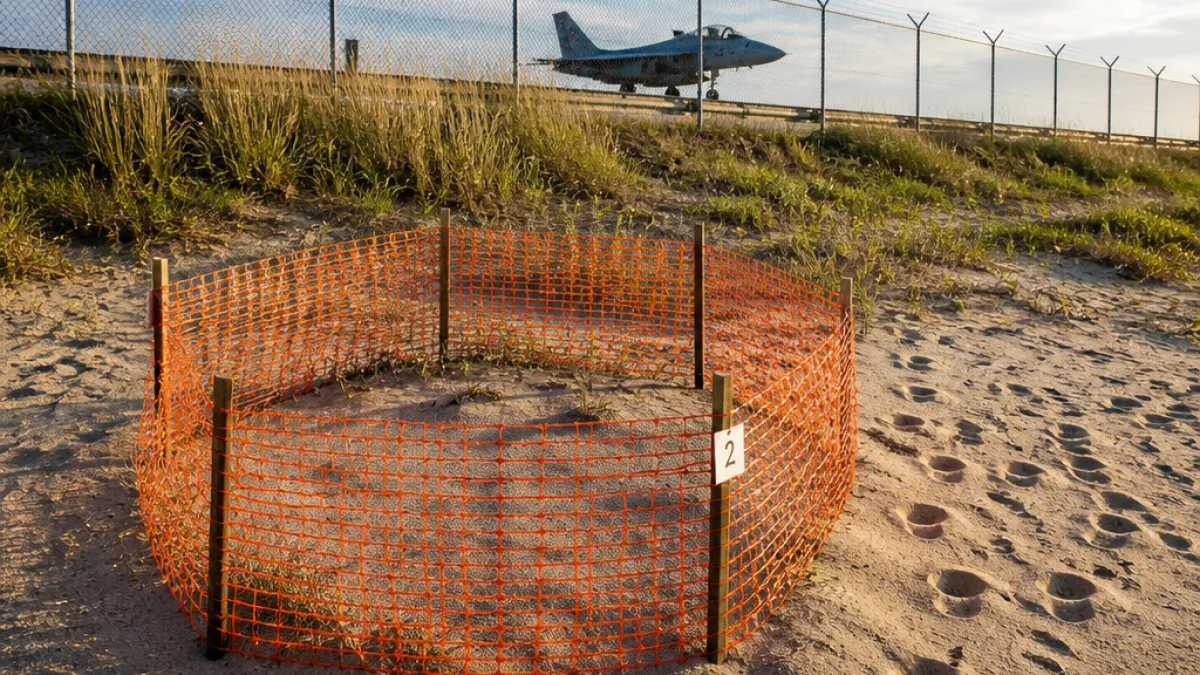
VIRGINIA BEACH, Va. — Federal wildlife officials confirmed that a leatherback sea turtle has laid eggs on Virginia's Atlantic coast, marking the first recorded nesting of the species in the state. The nest was located on a protected stretch of beach in front of Naval Air Station Oceana’s Dam Neck Annex, and officials quickly fenced the site to improve the eggs’ chances of hatching.
What officials found and where
The U.S. Fish and Wildlife Service identified the nest after reports of a nesting leatherback. Because the site sits on military property near Naval Air Station Oceana, access is restricted for both security and safety, providing an immediate buffer from beach traffic and curious onlookers.
Leatherbacks are the largest living sea turtles. According to the Fish and Wildlife Service, adult leatherbacks can exceed 8 feet in length and weigh as much as 2,000 pounds. Unlike other sea turtles, leatherbacks lack a hard shell; they are instead covered by thick, leathery skin that allows them to dive to great depths and tolerate colder waters.
Why this matters
Leatherback nesting typically occurs on warmer beaches from Florida through the Caribbean. Scientists say the appearance of a nesting leatherback this far north is notable for several reasons: it may reflect seasonal shifts in distribution, the species' broad migratory range, or unusual individual behavior. Whatever the cause, the event is a milestone for Virginia conservation records.
Military installations along the Atlantic coast often provide important wildlife habitat because of their large, restricted tracts of land and limited public disturbance. The location of this nest at Dam Neck Annex illustrates how national defense sites can also function as de facto conservation areas for shorebirds, sea turtles and other coastal species.
Protection measures and next steps
Wildlife officials fenced the area around the nest soon after discovery to reduce the risk of accidental disturbance. Protecting nests from foot traffic, artificial lighting and predators is standard practice for sea turtle conservation. Agencies will monitor the site through incubation and until hatchlings emerge and return to the ocean.
- Location: Dam Neck Annex, Naval Air Station Oceana (Virginia Beach shore)
- Species: Leatherback sea turtle (Dermochelys coriacea)
- Notable facts: Can reach 8 feet in length and 2,000 pounds; lacks hard shell
The timeline for hatching varies by the date of nesting and local sand temperatures; officials will keep the site sheltered and under observation until hatchlings emerge. Agencies customarily avoid releasing fine-grained public details about nesting coordinates to limit disturbance and illegal activity.
Local context and conservation implications
Virginia's beaches are monitored annually for sea turtle activity, and most nesting historically has been by species that prefer more southerly beaches. The leatherback is a species of special concern globally because of bycatch, loss of nesting beaches, and other threats. While this single nesting event does not alone indicate a population shift, it underscores the value of continued monitoring and protection of coastal habitats across broader latitudes.
For residents and visitors: officials ask beachgoers to maintain distance from fenced areas, avoid disturbing marked nesting sites, and report any injured or distressed turtles to appropriate state or federal wildlife hotlines. Maintaining dark, quiet beaches at night during nesting season helps adult turtles locate nesting sites and reduces disorientation of hatchlings making their way to the sea.
| Characteristic | Fact |
|---|---|
| Species | Leatherback sea turtle (Dermochelys coriacea) |
| Maximum size noted by agency | Up to 8 feet; up to 2,000 pounds |
| Shell | No hard shell — thick, leathery skin |
| Typical nesting range | Florida through the Caribbean |
The military’s role in this instance is practical: restricted beach access reduced human disturbance. But the discovery also renews attention on regional conservation coordination among the Fish and Wildlife Service, state agencies and local communities — a collaboration that will determine the nest’s chances and inform how Virginia manages future visits from ocean travelers like the leatherback.
As the eggs incubate, wildlife biologists will continue surveillance and protective measures. The nest represents both a rare natural event for Virginia and a reminder that conservation and security interests sometimes converge on the same patch of shoreline.