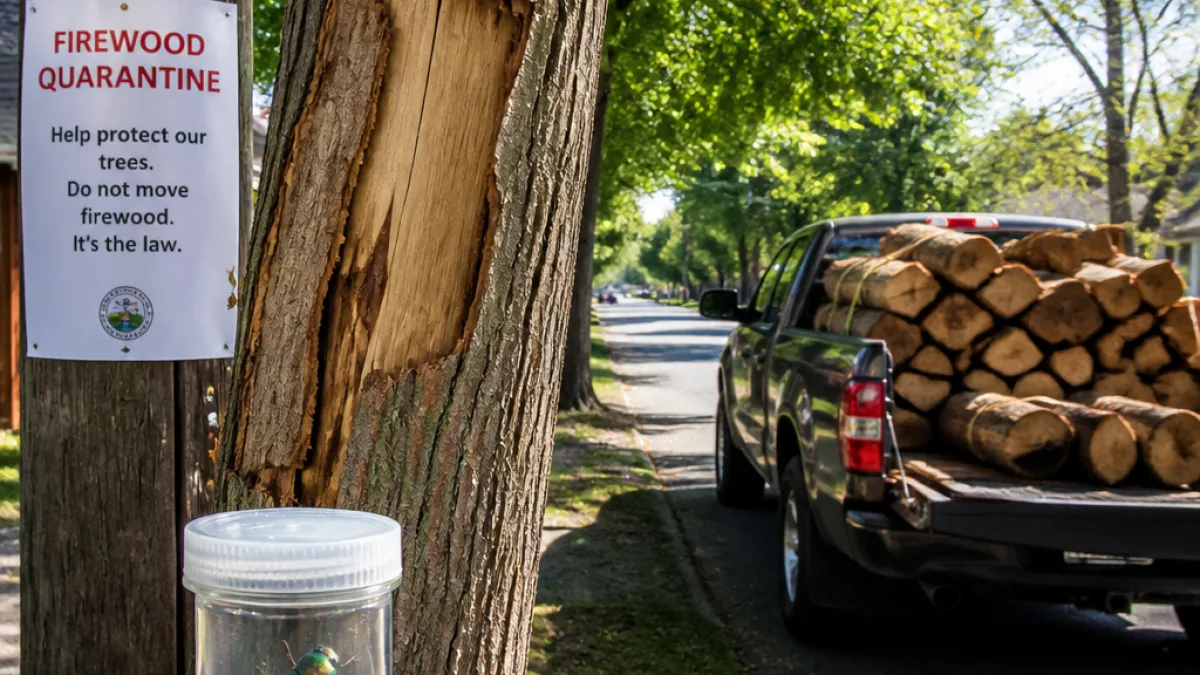
The Washington State Department of Agriculture and federal plant health officials confirmed the presence of the emerald ash borer near Vancouver after members of the public found and turned over a specimen, officials announced in mid-August. The detection prompted the state to place a firewood quarantine into effect on Aug. 18 as one immediate step to slow spread.
How the beetle was discovered
Two residents reported a small green beetle that had landed on their windshield, collected the insect and gave it to the Washington State Invasive Species Council. The council passed the specimen to the WSDA, which submitted it to the U.S. Department of Agriculture Animal and Plant Health Inspection Service for confirmation. The agencies said the insect identified is the emerald ash borer, an invasive species responsible for widespread mortality of ash trees across North America.
Why Vancouver and the region are at risk
The emerald ash borer, native to Asia and a member of the jewel beetle family, has been tied to the loss of more than 100 million ash trees in the United States since it was first detected in Michigan roughly two decades ago. In the Pacific Northwest the only native ash is the Oregon ash, a species that the WSDA says is vulnerable to this beetle.
- Detection method: public report and specimen submission.
- Immediate response: state-imposed firewood quarantine (effective Aug. 18).
- Long-term challenge: no known successful eradication of the species in North America.
What containment looks like and why it matters
WSDA officials outlined limited options for preventing outbreaks. The principal practical measure there is to restrict movement of potentially infested materials such as firewood, and to remove and replace affected ash trees with species not susceptible to the insect. Quarantine and restrictions aim to prevent adults or larvae hidden in wood from being transported to new areas where they could start fresh infestations.
"There has yet to be a successful effort to eradicate the emerald ash borer."
The statement underscores the difficulty of eliminating the beetle once it establishes in a landscape. Because larvae feed beneath the bark and adults can hitch a ride on moved wood, early detection and local compliance with movement restrictions are central to slowing spread.
Coordination, resources and what residents should do
State and federal agencies are working with partners — including the Department of Natural Resources urban forestry program, the Washington State Invasive Species Council and university extension services — to provide guidance and readiness materials. WSDA and collaborators have published an urban forest pest readiness playbook and a state-specific emerald ash borer resource and management guide to help landowners, municipalities and utility managers prepare for and respond to infestations.
| Item | Fact |
|---|---|
| Detection confirmed | Near Vancouver, reported Aug. 2026 |
| Firewood quarantine | Effective Aug. 18, 2026 |
| U.S. ash trees lost historically | More than 100 million |
For Vancouver residents, the practical implications are straightforward: do not move firewood from areas under quarantine, inspect ash trees for signs of infestation, and consult the state’s guidance before removing or treating trees. Municipal tree managers and private landowners will need to consider inventories of ash, prioritize monitoring in high-value urban canopy locations, and plan for potential removals and replacements.
What happens next will depend on additional surveys and mapping by state and federal agencies to determine the extent of the infestation. For now, the discovery near Vancouver serves as a reminder of how quickly a small insect can alter urban and rural tree populations, and how public reporting remains a key early-warning tool.