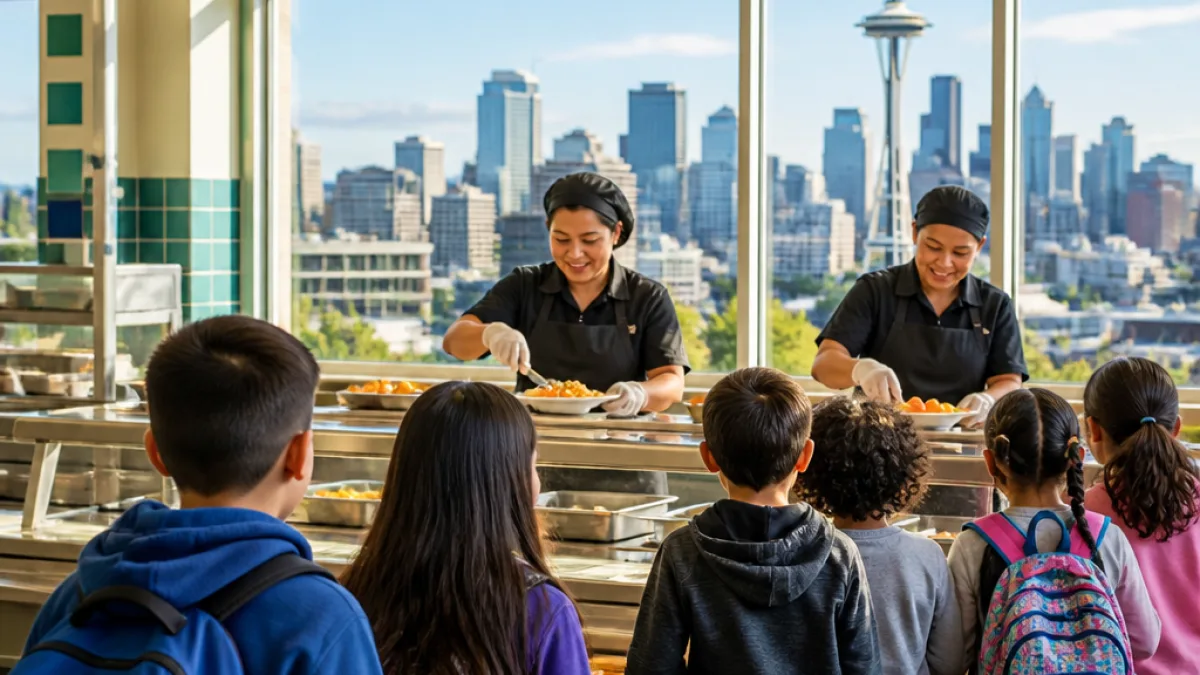
Seattle Public Schools will offer universal free breakfasts and lunches to all students in the 2026-27 school year after the Seattle City Council unanimously approved a $5 million allocation to start the program. The move, endorsed 9-0 by councilmembers, aligns the mayor’s priority for universal school meals with council efforts to expand food supports for families outside the classroom.
How the rollout will work
The initial year of universal meals will be funded with one-time city funds approved by the council. The following year, the plan is to finance the program through the city’s Families, Education, Preschool, and Promise (FEPP) Levy, which will also cover additional nutrition supports targeted at students facing food insecurity when school is not in session.
- 2026-27: Universal free breakfasts and lunches for all SPS students paid with one-time city funds.
- 2027-28 and after: FEPP Levy to fund universal meals and weekend/school-break food for low-income students.
- Coverage aims: In-class meal access for all students and targeted off-campus food assistance for students identified as food insecure.
Policy intent and city leaders’ framing
Mayor Katie Wilson framed the council decision as a major affordability win for families. In a city-issued statement, she said the action makes universal school meals a reality in Seattle “this September,” and highlighted that students who need food most will gain greater access on weekends and during school breaks.
“We are making universal school meals a reality for Seattle this September, and students who most need it will have greater access to food on weekends and school breaks,” the mayor’s office said.
Councilmember Dan Strauss emphasized a dual goal: not choosing between feeding students during the school day and addressing food insecurity outside the classroom. His statement said, in part, that “We can, and we must do both.”
Operational implications for schools and families
For Seattle Public Schools, the shift to universal meals means scaling up kitchen operations, supply chains and staffing to meet demand across the district. Families will no longer need to apply or qualify for free or reduced-price meals to receive breakfasts and lunches at school — a simplification that removes a paperwork barrier and reduces stigma for students.
Logistics the district will need to manage include meal planning to meet nutritional standards, accommodating dietary needs and allergens, and coordinating distribution so breakfasts and lunches are consistently available across elementary, middle and high schools. The district already has policies governing meal programs; this funding commitment changes who pays but not the nutritional or health requirements that schools must meet.
Weekend and break supports remain targeted
While in-school meals will be universal, weekend and school-break food assistance will be targeted to students identified as food insecure. Those supports will shift to FEPP Levy funding starting in 2027-28. The levy’s role is to sustain both the universal in-school meals and the off-campus nutrition assistance without relying on one-time allocations.
| 2026-27 | 2027-28 and later |
|---|---|
| Universal meals funded by one-time city funds | Universal meals and off-campus supports funded by FEPP Levy |
For families, the immediate consequence is practical: children can receive school meals free of charge beginning as early as September 2026. For the school district and city budget planners, the consequence is fiscal: a transition from short-term reserves to an ongoing levy commitment that will need to be maintained and accounted for in subsequent budget cycles.
This policy shift also raises questions about how the city will identify and reach students who need offline food supports during weekends and breaks, and how those programs will be administered through community partners or school-based delivery systems. The council’s unanimous vote indicates broad political support, but implementation will require coordination across city and school systems to ensure reliability and equity.
The approval marks a notable policy outcome for Seattle’s approach to child nutrition and family affordability, combining universal school-based access with targeted out-of-school assistance funded through a dedicated local levy.