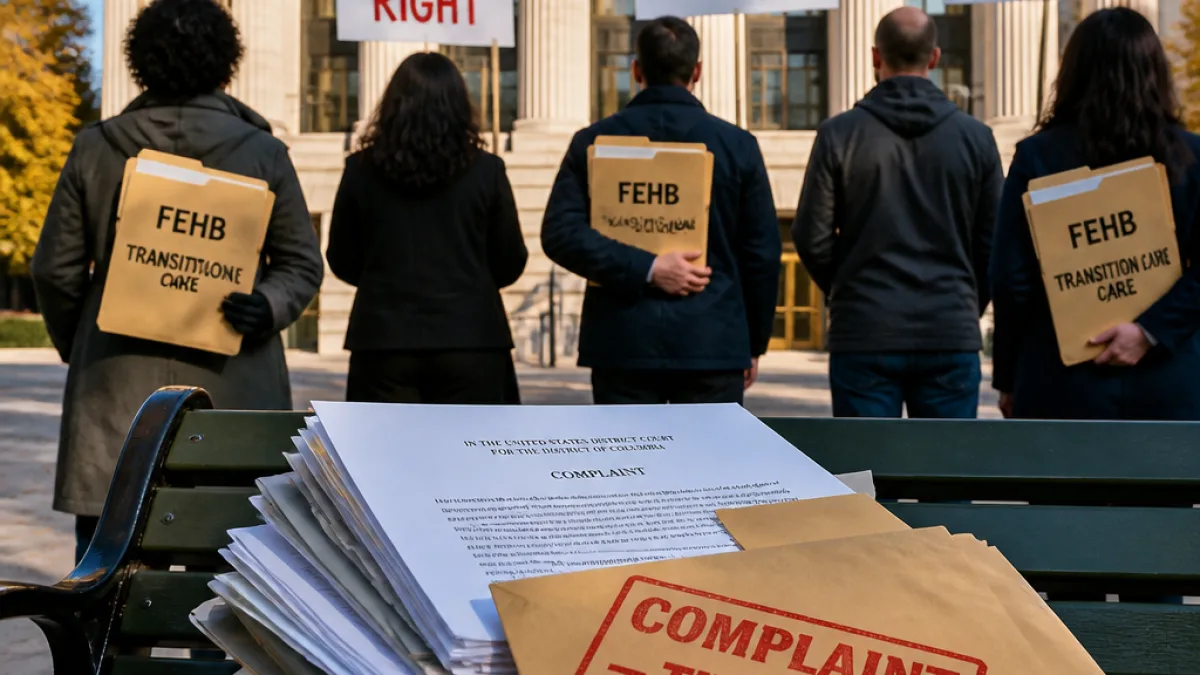
Federal employees brought a civil‑rights lawsuit against the federal government Aug. 3, challenging a directive that instructed insurance carriers to remove coverage for gender‑transition care from federal employee health plans. The complaint, filed on behalf of five workers by the Human Rights Campaign Foundation, argues the Office of Personnel Management's guidance unlawfully discriminates on the basis of sex in violation of Title VII.
What the suit says
According to the plaintiffs, OPM's January instruction to carriers to eliminate gender‑transition services effectively denies medically necessary care to transgender employees enrolled in the Federal Employees Health Benefits Program. The complaint frames the categorical removal of those services as a form of sex discrimination under federal employment law.
“The categorical denial of treatment is akin to denying continuing insulin treatment for someone with diabetes,”
The Human Rights Campaign Foundation, which is representing the workers, contends the move is not a neutral cost‑cutting measure but an impermissible classification that singles out transgender individuals by denying specific types of medically recognized care.
How federal benefits administration works — and where OPM fits
The Federal Employees Health Benefits Program (FEHBP) is administered by the Office of Personnel Management, which sets program rules and issues guidance to participating insurers. Insurers sell plans to federal employees and their families; those plans must operate within the parameters OPM sets.
When OPM issues a directive or clarifying instruction — as it did in January — participating carriers generally adjust their plan coverage accordingly. Legal challenges typically seek to block an agency action or to have it set aside as inconsistent with statutory protections.
Immediate consequences and practical impacts
- Coverage changes: Plaintiffs say the directive removes coverage for gender‑affirming treatments that some employees rely on as standard medical care.
- Timing and uncertainty: Affected employees face immediate uncertainty about whether ongoing treatments will be covered and whether prior authorizations remain valid.
- Potential legal remedies: The lawsuit could seek a court order requiring OPM to restore coverage, or it could push for an injunction while the case proceeds.
Why this matters in Washington state
Washington state employs a substantial number of federal workers across agencies with offices in the Seattle metropolitan area, Puget Sound, and beyond. For those employees, a change in FEHBP coverage is not theoretical: it directly affects claims processing, prior authorization approvals, and access to participating providers.
Local federal human resources offices and union representatives commonly serve as the first point of contact for employees who believe coverage has been improperly denied. Employees seeking clarity should consult their agency HR, benefits administrator, or union representative while monitoring any court orders that could alter benefit rules.
What to watch next
Key developments that will shape the case include whether the plaintiffs request and receive a preliminary injunction, the jurisdiction in which the lawsuit proceeds, and any administrative or regulatory responses from OPM. The court’s initial procedural rulings — on standing, timing and the scope of relief — will be decisive in determining how quickly coverage could be restored if the plaintiffs prevail.
| Event | Date (from reporting) |
|---|---|
| OPM instructed carriers to remove gender‑transition care | January (reported) |
| Transgender federal employees filed suit | Aug. 3 |
What affected employees should do now
- Contact your agency benefits office to confirm the current status of coverage and any prior authorizations for ongoing treatment.
- Keep documentation of prior approvals, medical necessity letters and communications with insurers and HR.
- Consult union representatives or employee advocacy groups for guidance on appeals and administrative options while litigation proceeds.
The case raises legal questions about the intersection of federal benefits administration and civil‑rights protections. Courts will need to decide whether a blanket instruction to insurers constitutes disparate treatment under Title VII or falls within the agency's discretion to define covered services. For now, the lawsuit places OPM's directive under judicial scrutiny and thrusts federal employee benefits policy into a high‑stakes legal test with concrete consequences for workers nationwide.
Reporting for this story relied on the filed complaint and statements from parties represented in public reporting.