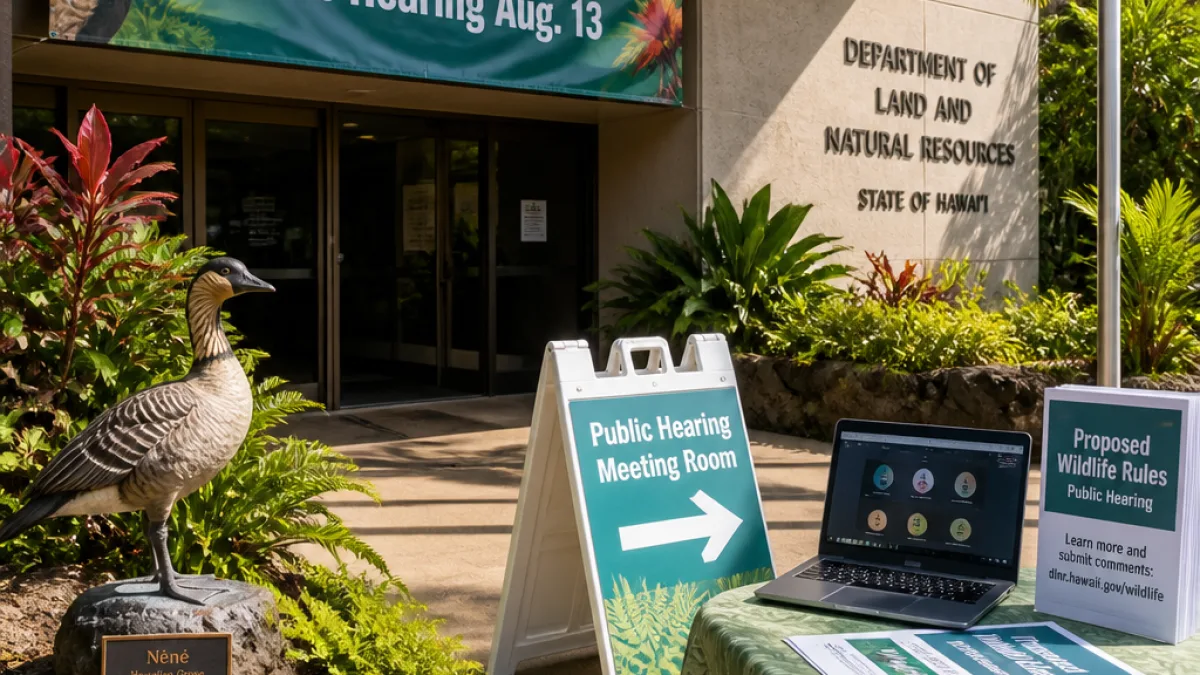
The state of Hawaiʻi is moving to strengthen legal protections for its native animals and their habitats, announcing proposed amendments to Hawaiʻi Administrative Rules Chapter 13-124 and inviting public input through an online survey and a hybrid hearing scheduled for Aug. 13, 2026.
What the proposal would change
The Department of Land and Natural Resources, Division of Forestry and Wildlife (DOFAW) says the amendments are intended to increase protections for what the rules call “indigenous wildlife.” Key elements of the proposal include:
- Prohibiting “take” of indigenous wildlife — expanding the legal definition of take to include harm or harassment.
- Restricting significant habitat modification that harms or kills indigenous, threatened or endangered species where they occur naturally.
- Banning the feeding of indigenous, threatened and endangered wildlife across the state and banning the feeding or abandonment of wildlife and domestic animals on department lands.
- Limiting the movement of injurious wildlife by prohibiting the distribution or sale of plants, equipment or goods that contain or could spread injurious species.
Those measures are aimed at curbing activities that contribute to population decline, injury and disease among native species, and at reducing pathways that introduce or spread invasive, injurious organisms.
How to participate
DOFAW is accepting comments via an online survey and will host a hybrid public hearing where residents can testify in person or via Zoom. The hearing details are:
| When | Aug. 13, 2026, 11:00 a.m. to 1:00 p.m. |
|---|---|
| Where (in-person) | 1151 Punchbowl Street, Room 132, Honolulu |
| Where (virtual) | Zoom (testifiers must pre-register); livestream available on YouTube for observers |
The department’s notice directs those wishing to provide testimony in-person, in writing or on Zoom to the DOFAW comment page at dlnr.hawaii.gov/dofaw/comment, where the proposed amendments and the public input survey are available.
Why the rules matter here
Hawaiʻi’s native species evolved in long isolation and many are found nowhere else on Earth. That uniqueness makes them particularly vulnerable to habitat loss, disease, predation and competition from introduced species. The proposed prohibitions on feeding and on distribution of goods that carry injurious wildlife are designed to reduce human behaviors and commerce that facilitate those threats.
Prohibiting “take,” particularly where that term explicitly covers harm or harassment, tightens the legal tools available to protect animals when development, recreation or other activities disturb them. Likewise, curbing significant habitat modification speaks directly to land use practices that can fragment or destroy the delicate ecosystems some species depend on.
Practical implications for residents and visitors
If adopted as proposed, the rules could change everyday practices on public lands and in neighborhoods near native habitat. Residents, land managers and businesses may need to rethink landscaping, disposal of green waste, sale and distribution of plants and equipment, and practices around feeding feral or wild animals. On department lands, abandoning companion animals or leaving food for wildlife would be prohibited.
DOFAW’s outreach period offers a chance for communities, conservation groups, farmers, the tourism sector and others to raise concerns or support. The department’s comment page includes the regulatory language and survey so stakeholders can identify specific provisions they want to address.
Next steps
Following the public hearing and the close of the comment period, DOFAW will consider the input received and may revise the proposals before any final rules are adopted. The department is allowing both in-person and virtual participation to widen access to the process.
For residents wanting to review the proposed amendments or submit comments, visit dlnr.hawaii.gov/dofaw/comment. The department has provided instructions there for observing the hearing via YouTube, pre-registering to testify on Zoom, submitting written testimony and other procedural guidance.
These proposed changes join a long record of regulatory and community efforts in Hawaiʻi to balance human activity with the conservation of a biologically unique landscape. The conversation the public hearing seeks to open will shape how the state protects those species in the years to come.