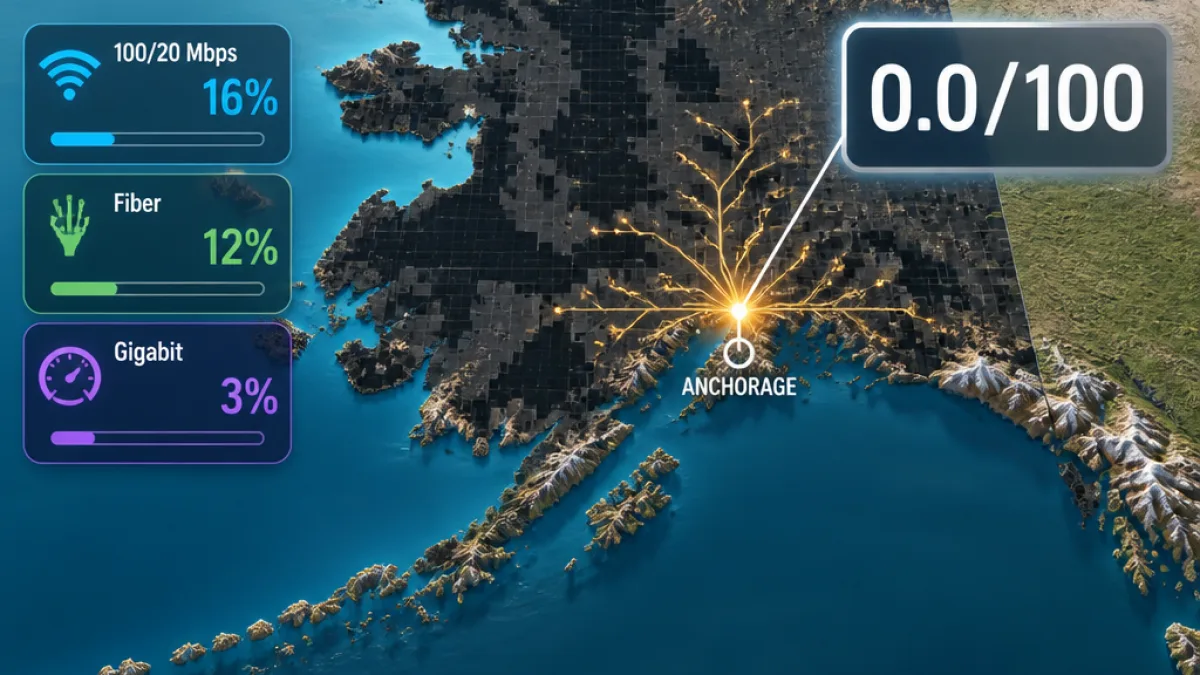
Alaska ranks as the country’s largest internet desert, according to a nationwide analysis released Thursday that used the federal government’s location-by-location broadband data. The report scored all 50 states, Washington, D.C., and Puerto Rico and placed Alaska dead last with a composite score of 0.0 out of 100.
How the index was built
The study by CompareInternet.com used the Federal Communications Commission’s Broadband Data Collection — the same dataset feeding the federal BEAD broadband program — to measure wired residential broadband across four categories: availability of service at 100/20 megabits per second, fiber availability, gigabit-capable lines, and the gap between urban and rural access.
- High-speed access (100/20 Mbps) — weighted 35 percent
- Fiber access — weighted 25 percent
- Gigabit access (1000/100 Mbps) — weighted 20 percent
- Urban–rural equity — weighted 20 percent (the gap between city and countryside access)
For Alaska, the underlying numbers painted a bleak picture: 71.5% of locations reported access to high-speed service at 100/20 Mbps, only 14.2% had reported fiber access, and just 12.5% had gigabit-capable connections. The report also identified a 60-point equity gap between cities and other parts of the state.
“We stress-tested this weighting under four alternative schemes (equal weighting, equity-heavy, speed-only, fiber-heavy),” the analysis said. “In every version, the top five and bottom five states remained essentially the same, with rank correlations between 0.89 and 1.00 against the primary methodology.”
How Alaska compares
The index placed several Western and Mountain states near the bottom, but Alaska stood apart. By contrast, the best-performing state was North Dakota, with a score of 94.1 and reported high-speed availability to 99.2% of homes.
| Jurisdiction | Index score | High-speed access (%) |
|---|---|---|
| Alaska | 0.0 | 71.5% |
| North Dakota | 94.1 | 99.2% |
CompareInternet.com normalized each metric against all 52 jurisdictions and applied the weights above, a method the authors said reduces the influence of any single state’s raw numbers. The firm also tested alternate weightings and reported similar top and bottom rankings across those tests.
Local impact and context
The analysis underscores persistent challenges for Alaska: vast distances, sparse population and rugged terrain make wired broadband deployment costly and technically difficult. Low fiber and gigabit penetration suggest that even where baseline high-speed service exists, residents may lack access to the higher-capacity connections increasingly required for telework, education and business.
Federal dollars already aimed at closing these gaps — including the multibillion-dollar BEAD program — depend on accurate location-level data to direct grants and buildouts. This index draws attention to where Alaska stands in that national competition for funding and private investment.
For residents, the practical effects are immediate: slower video calls, limited telehealth options, reduced competitiveness for remote jobs and extra costs for workarounds. For local governments and utilities, the report highlights the scale of the task to match infrastructure to demand across remote communities and regional hubs.
What to watch
Policymakers and providers will likely point to the FCC’s data and to program dollars as tools to improve Alaska’s standing. The BEAD program and other federal initiatives allocate money based on reported coverage and state plans; a low score in comparative analyses can translate into greater urgency for planning and partnership.
For now, the index is a blunt reminder of disparities that have persisted despite periodic investment: Alaska’s internet landscape remains fractured, with pockets of adequate service surrounded by long stretches of limited connectivity.
The route out of an internet desert — more fiber, targeted deployment, improved data and sustained funding — will require coordination across federal, state and private actors and a willingness to tackle costs that are higher here than in denser parts of the country.