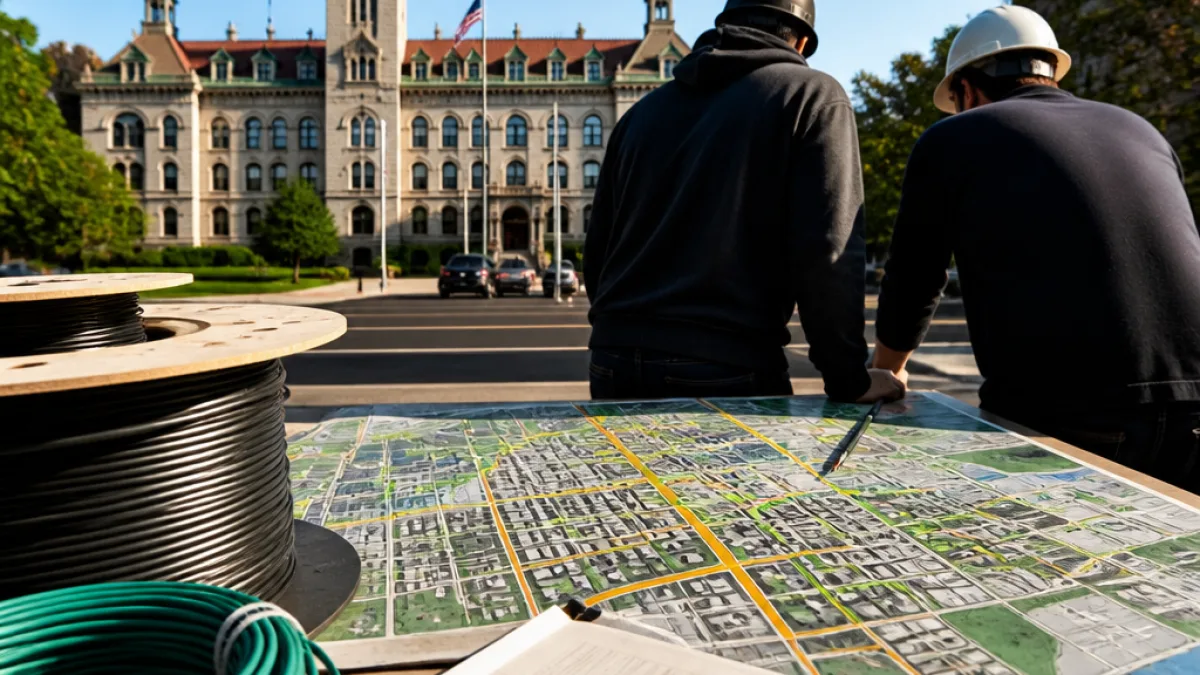
City issues RFI to inform long-term broadband plan
Worcester officials have opened a formal information-gathering process as they consider building a citywide fiber-to-the-premises network, a move intended to expand access to high-speed, reliable and affordable internet across the city.
The city issued a request for information (RFI) Thursday seeking ideas from broadband vendors and other industry stakeholders with experience in broadband infrastructure, network operations, emerging technologies, digital inclusion and public-private partnerships. The RFI is explicitly an information-gathering step and not a competitive bid; responses will not be legally binding, the city said.
“The City of Worcester is actively working to bridge the digital divide,” City Manager Eric D. Batista said in a statement. “This RFI is the next step toward that goal and is part of our broader strategy to strengthen digital equity, expand economic opportunity, and enhance public services.”
Officials framed the initiative as a wide-ranging effort to serve households, businesses, schools and nonprofits. In practical terms, a fiber-to-the-premises network would deliver fiber optic cable directly to individual buildings, a technical configuration that typically supports symmetrical upload and download speeds far above those available through legacy copper or fixed wireless systems.
City Hall is soliciting input on several areas where vendor experience could shape Worcester’s approach, including:
- Design and construction of fiber infrastructure
- Network operations and maintenance models
- Strategies for digital inclusion and affordability
- Opportunities for public-private partnership structures
Responses to the RFI are due by 5 p.m. Wednesday, Sept. 2. Submissions may be emailed to [email protected]. Organizations with large files are instructed to contact the same address to arrange access to a secure file-transfer service.
| Item | Detail |
|---|---|
| Deadline | Sept. 2, 5 p.m. |
| Submission email | [email protected] |
| Project stage | Request for information — not a competitive bid |
For Worcester residents and institutions, the RFI represents an early but meaningful step. Building municipal or municipally guided fiber networks often requires years of planning and coordination, substantial capital investment, rights-of-way work and close collaboration with state and federal funding sources. At this stage, the city is collecting technical, operational and partnership models that could inform a later request for proposals or other procurement steps.
City Manager Batista positioned the RFI within broader policy aims: reducing disparities in access and strengthening economic opportunity. Those goals respond to long-standing concerns in Worcester and similar post-industrial Northeastern cities, where neighborhoods and small businesses sometimes face slower or less reliable internet service that can affect education, telehealth, remote work and commerce.
The scope of responses the city receives will shape next steps. Vendors and stakeholders can offer cost estimates, build-operate-transfer options, ownership models, timelines and digital inclusion plans — all components that cities weigh when deciding whether to pursue a municipally owned network, a public-private partnership, or to rely on incumbent providers and targeted subsidy programs.
Officials did not provide a timeline beyond the RFI deadline. For now, Worcester’s action signals an appetite to explore a long-term framework for broadband that could reshape how the city supports connectivity for its residents and institutions.