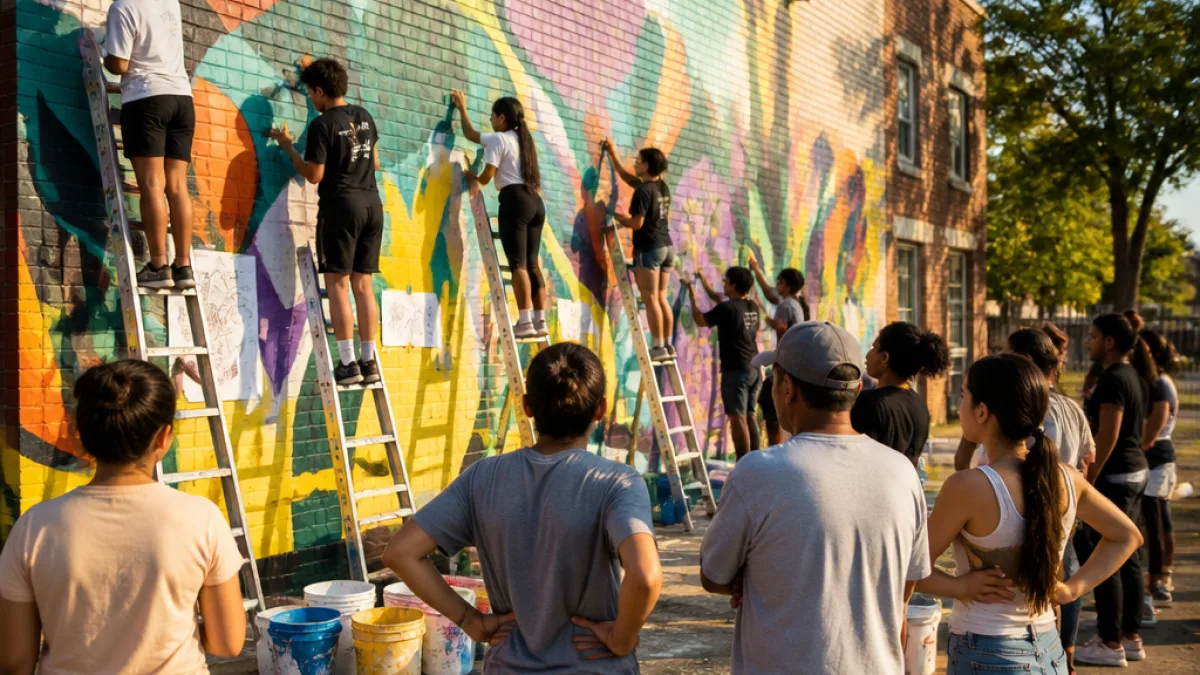
Springfield-based Commonwealth Murals is spending the summer converting blank walls into community canvases while training a new generation of artists and volunteers. Operating from the New North Citizens’ Council Youth Center, the nonprofit has organized a cohort of student volunteers and local artists to design and install murals in partnership with neighborhood organizations.
Hands-on arts as civic practice
The current summer crew includes 10 student volunteers, among them 16-year-old Annalisse Laboy, who said she joined because of a longstanding interest in community outreach. The program emphasizes collaboration: each mural is developed with input from the neighborhood organization that will host it, and the studio environment is structured to encourage risk-taking and peer instruction.
“I’m mainly into community work, which is why I see myself here the most because I love community outreach and hands-on help here,” Laboy said.
Commonwealth Murals’ executive director, Britt Ruhe, described an approach that prioritizes listening to residents and turning those conversations into visual statements. Ruhe framed the studio’s process around what she called “intentional space values,” with presence and listening highlighted as essential steps in turning community needs into imagery.
Scale and training
Since 2019, the organization reports measurable growth: more than 100 murals installed across Massachusetts, collaborations with over 100 artists and teachers, and the involvement of in excess of 1,000 students in school-based painting projects. That footprint reflects a mix of temporary and permanent public art and an educational pipeline that connects youth to hands-on creative work.
This summer Commonwealth Murals also launched a structured development track for artists: a three-month training program enrolling 16 local artists. Participants in that program will paint and install five murals across Springfield as part of their practical experience.
Public access and next steps
Beyond commissioned pieces, the Springfield studio will host open nights so residents can drop in to paint panels and observe the collaborative process. Organizers say the open-studio events are intended to demystify mural-making and widen participation beyond formally enrolled volunteers.
Information on upcoming events and volunteer opportunities is being posted on the group’s Instagram account at @common.wealth.murals.
Local implications
For Springfield neighborhoods, the program carries both aesthetic and civic consequences. Murals can transform underused walls into landmarks that reflect local identity while creating public-facing training opportunities for teenagers at a formative age. The program’s emphasis on partnership suggests murals will more often reflect neighborhood priorities rather than outside design directives.
At the same time, scaling from schools and neighborhoods to larger public projects introduces questions about long-term maintenance and funding. Commonwealth Murals’ growth—documented in counts of murals, artists and student participants—shows organizational capacity, but sustaining murals in public spaces typically requires ongoing agreements with property owners and community groups.
| Metric | Reported figure |
|---|---|
| Murals installed (since 2019) | 100+ |
| Artists and teachers engaged | 100+ |
| Students involved | 1,000+ |
| Current student volunteers | 10 |
| Artist trainees (this program) | 16 |
| Murals to be painted by trainees in Springfield | 5 |
- Commonwealth Murals is operating out of the New North Citizens’ Council Youth Center in Springfield.
- The organization has focused on participatory design, centering neighborhood input in murals.
- Public open-studio nights and a three-month artist training are part of the group’s current summer programming.
As Springfield prepares for the installation of new murals this season, the intersections between youth development, public art and neighborhood identity will play out on brick and concrete alike. The program’s documented reach—over a hundred murals and a four-digit student involvement tally since 2019—suggests a model that other community organizations may watch closely as they weigh arts-based strategies for civic engagement.