Massachusetts health officials’ effort five years ago to set minimum nurse staffing standards for long‑term care facilities has not prevented widespread shortfalls: a months‑long analysis of federal data by the New Bedford Light found that roughly 50% of the state’s 341 nursing homes failed to meet one or both staffing mandates at the end of last year.
Personal pain, systemic shortfalls
One patient’s journal provides a human window into the consequences. While recovering last fall at Plymouth Harborside Healthcare’s rehabilitation unit following a crash that shattered her left leg, 55‑year‑old Lynette Couture recorded repeated requests for pain medication that went unanswered for hours. According to her notes, she asked staff three times between 9:40 and 10:40 p.m. and repeatedly called the nursing station. No nurse responded until a non‑medical staffer on a double shift located someone to administer medication at about 12:15 a.m.
“The angrier I got, the more I cried,” Couture told The Light about the experience.
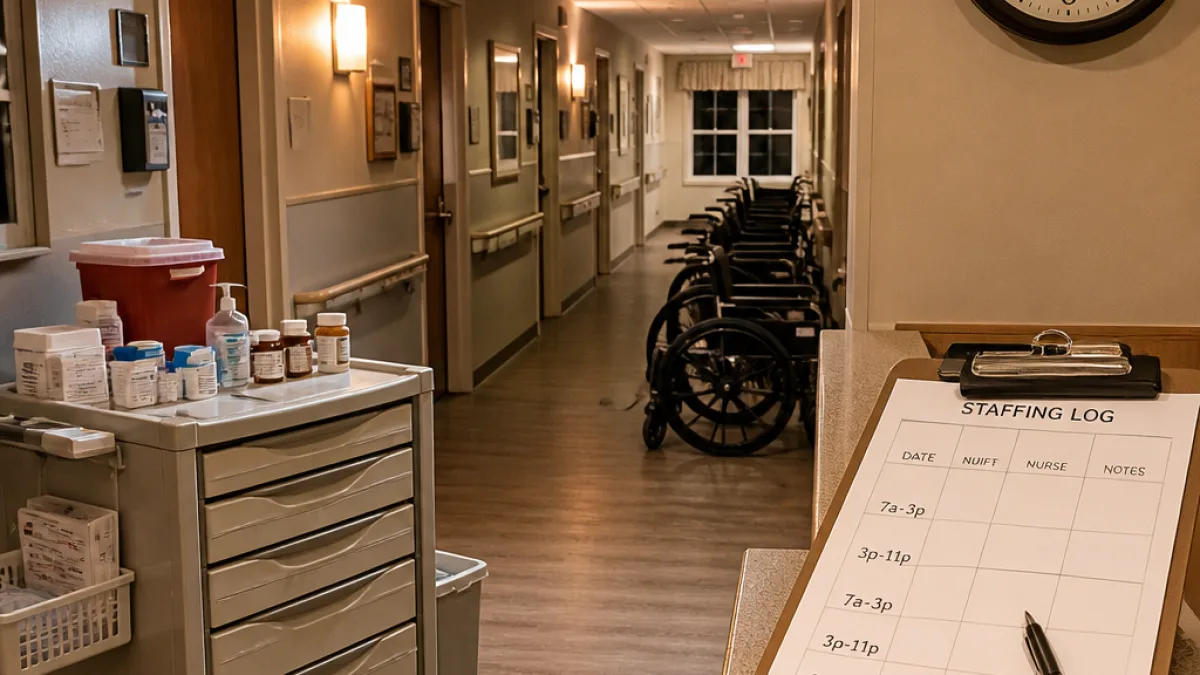
Couture said she was told the facility was short‑staffed. The data indicate she was not alone: when staffing falls below regulatory minimums, experts warn, the quality and timeliness of basic care — from pain management to repositioning and timely toileting — can suffer.
How staffing gaps translate into harm
The Light’s investigation links insufficient staffing to a range of avoidable harms documented by clinicians and advocates. Shortfalls are associated with increased risks of:
- Falls when residents attempt to get up without assistance.
- Urinary or respiratory infections tied to delays in hygiene or clinical monitoring.
- Pressure injuries (bedsores) from inadequate repositioning.
State officials adopted the minimum staffing rules five years ago to counteract those exact risks, but the new analysis of federal facility staffing data shows many homes remain out of compliance.
Scope and scale
The New Bedford Light study used federal staffing reports that nursing homes file regularly. Taken together, those submissions show a statewide pattern of understaffing at the end of last year: roughly half of facilities were not meeting at least one required benchmark. That proportion — approximately 170 of 341 nursing homes — represents a substantial share of the long‑term care sector in Massachusetts.
| Metric | Value |
|---|---|
| Total nursing homes in Massachusetts | 341 |
| Facilities not meeting one or both staffing standards (end of last year) | ~50% (about 170) |
Regulatory background and local impact
Massachusetts’ minimum staffing standards were intended to ensure a baseline of direct care time for residents. The standards specify levels of nursing and certified nursing assistant (CNA) hours that facilities must provide, calibrated to resident acuity. Despite that framework, the data suggest many facilities are operating with fewer hands on deck than state policy intended.
For residents and families, the effects are practical and immediate: longer waits for medication, fewer opportunities for assistance with mobility, and less frequent checks that can detect early signs of infection or dehydration. For staff, chronic shortages can mean mandatory overtime, double shifts and the burnout that drives turnover — conditions that then feed back into understaffing.
What the numbers do — and don’t — show
The federal staffing reports provide a standardized look at hours worked in each facility, but they are limited in what they reveal. They do not capture every detail of day‑to‑day operations, such as whether the mix of staff had appropriate clinical skills for higher‑acuity residents during a given shift. Still, repeated shortfalls across dozens of homes point to a systemic problem rather than isolated incidents.
What comes next
State regulators and advocacy groups face pressure to address the gap between policy and practice. Potential responses include strengthened enforcement of existing rules, increased funding or incentives to hire and retain nursing staff, and support for workforce training pipelines. For families, the investigation underscores the importance of asking facilities about staffing levels, direct care hours and contingency plans for staffing shortages when making placement decisions.
The New Bedford Light analysis places a spotlight on a sector that cares for some of the state’s most vulnerable residents and raises questions about whether current measures are sufficient to guarantee basic, timely care.