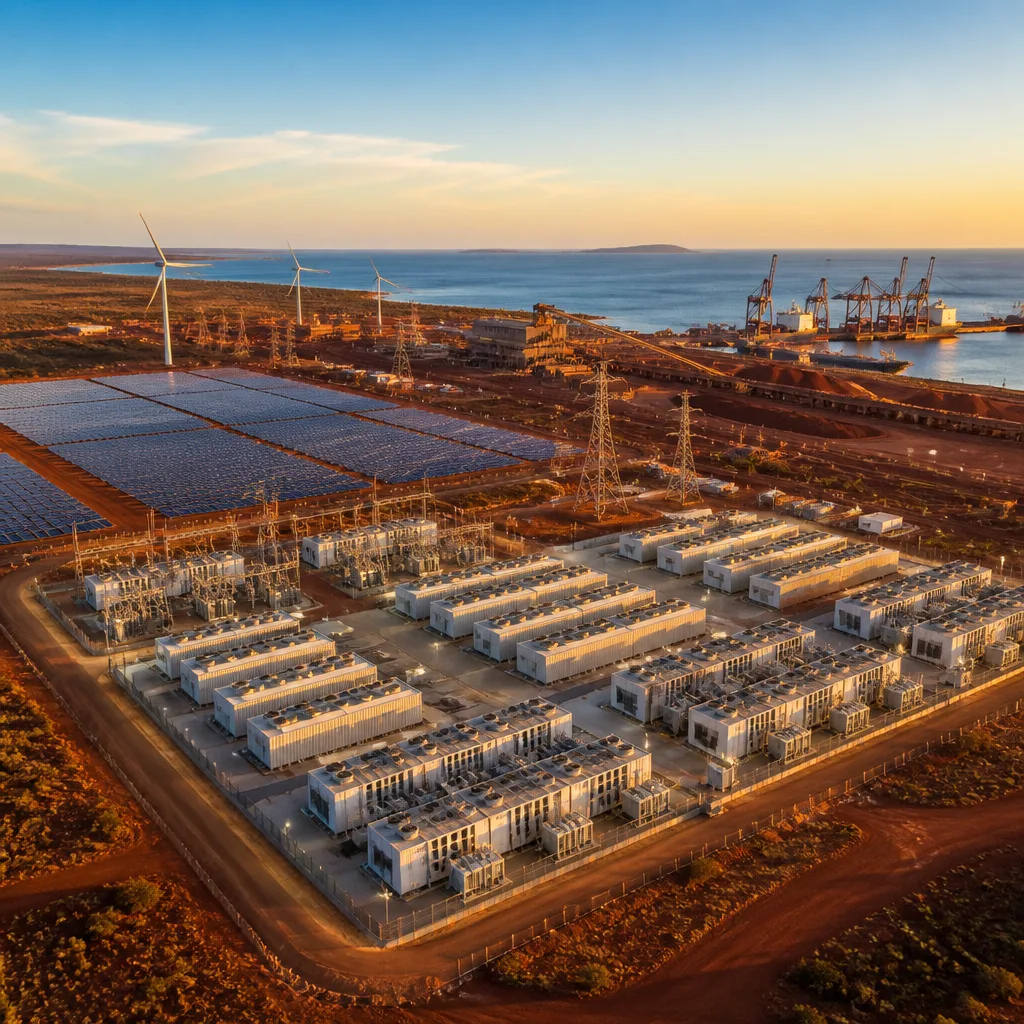
Fortescue Ltd is exploring a major expansion into artificial intelligence infrastructure, reportedly weighing plans to develop and potentially operate up to 2 gigawatts of data center capacity in Western Australia’s Pilbara region near Port Hedland. The proposal, disclosed in media reports, would marry the company's existing mining power network and renewable energy projects with large-scale computing required to train and run modern AI models.
From ore to computing — a new line of business
The plan would mark a material shift for the Andrew Forrest-led miner from supplying raw materials and electricity to owning computing assets that underpin cloud and AI services. Fortescue has already committed about US$680 million to expand green energy capacity in the Pilbara and has a separate 200-megawatt project intended to serve industrial customers including data center operators.
Data centers demand steady, high-capacity power for servers, cooling and ancillary infrastructure — a requirement that becomes even more acute as organizations train larger and more energy-intensive AI models. Fortescue’s existing land holdings, transmission and generation assets in the region could give it an operational advantage over newcomers that would need to construct new long-distance transmission and secure suitable sites.
Commercial partners and regulatory questions
One AI developer, Anthropic, has been linked to the reports as a potential partner, but neither company has publicly confirmed any agreement. The proposed model would move beyond selling renewable electricity to external users; Fortescue would potentially capture revenue from the operation of computing infrastructure itself, exposing the firm to the economics of cloud services and AI workloads.
- Capacity under discussion: up to 2 GW near Port Hedland
- Fortescue green investments: about US$680 million committed in the Pilbara
- Existing project size: a 200 MW project intended for industrial customers
Any move into data center ownership also faces legal and planning hurdles. Local mining laws were flagged as a potential impediment; infrastructure developed on mining tenements often carries regulatory constraints that may limit non-mining uses unless changes are made to governing statutes or approvals are obtained.
| Item | Figure |
|---|---|
| Proposed data center capacity | 2 GW |
| Committed Pilbara green investment | US$680 million |
| Existing targeted project size | 200 MW |
Strategic implications
For the technology industry, Fortescue’s reported interest underscores how critical large, reliable, and low-carbon power has become to the expansion of AI infrastructure. For miners, it illustrates a diversification path that leverages existing assets — transmission, land, and industrial-scale power — into an adjacent, high-growth market.
For governments and regulators, the potential development raises familiar tensions: how to balance mining tenement rules and environmental planning with the economic opportunity to host energy- and data-hungry facilities. Any material shift to allow data centers on mining lands or a new regulatory framework would require steps by authorities in Western Australia — developments that could determine whether the proposal progresses.
The companies involved have not made public confirmations. At this stage the reports reflect discussions and exploratory planning rather than a formal project announcement. Still, the story is a useful illustration of how the economics of AI — dominated increasingly by compute and power availability — can reshape traditional industries and regional development priorities.
As the AI economy grows, expect to see more nontraditional entrants weighing ownership of computing infrastructure, particularly where they control low-cost or renewable power. Fortescue’s reported deliberations place a spotlight on the Pilbara as a potential hub for energy-intensive technology, provided commercial partners and regulators align on the path forward.