Political pulpit stirs debate over church tax rules
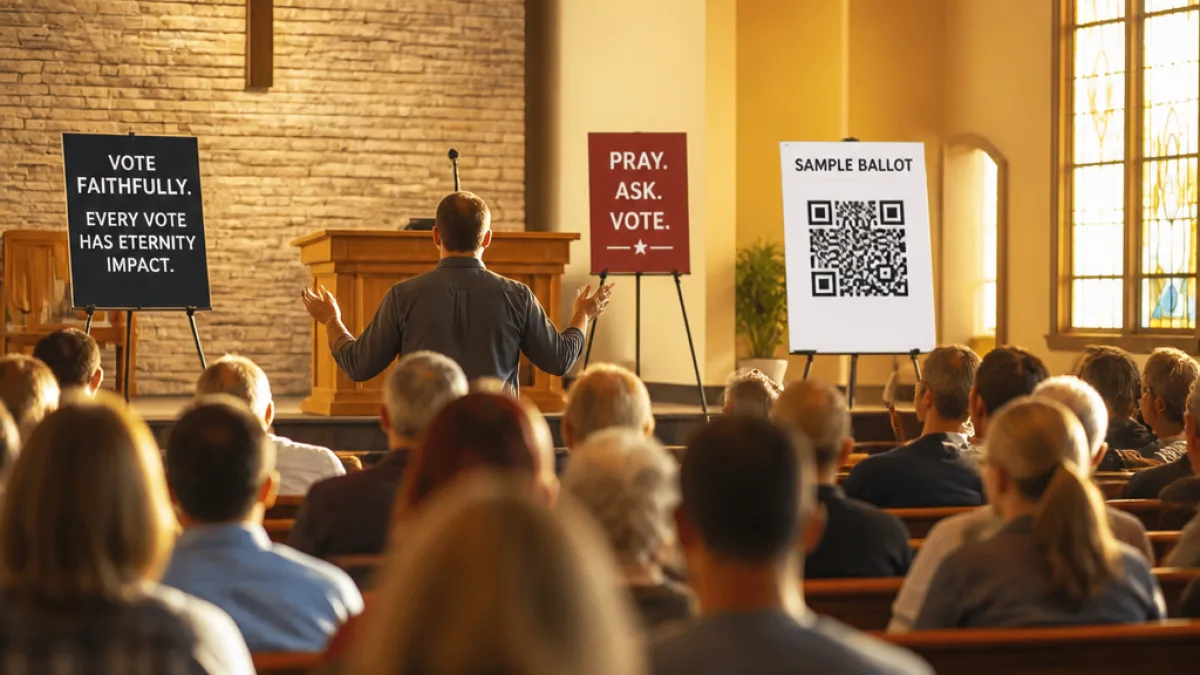
On a recent Sunday morning, the sanctuary at Calvary Chapel in Chattanooga became a campaign stage. Four local Republican candidates spoke from the pulpit to congregants, and a missions and outreach civics leader framed the appearance as an explicit choice against Democrats, drawing local attention to long-standing federal rules that limit partisan activity by tax-exempt religious organizations.
The candidates introduced at the service included Michele Reneau, running for reelection as state representative; Ashley Dillon, a candidate for the Hamilton County District 3 School Board; Derek Greene, seeking a position on the Tennessee State Executive Committee; and Weston Wamp, who is running for reelection as Hamilton County mayor. Each took the microphone during the service to speak directly to worshippers.
Before introducing the candidates, the church's missions and outreach civics leader, Adam Calabrese, declared there were no Democrats on stage by design and criticized the Democratic Party’s positions on a range of social and political issues. His comments included assertions about abortion, LGBTQ+ policy and broader ideological concerns prompting an immediate response from local Democrats.
"I just don't think, as a Christian, as a church, you can really vote Democrat anymore. But if you just pay attention, it's really hard to go into the voting booth and circle D."
Responding to those remarks, Hamilton County Democratic Party Chair Tammy Barnes said she found the remarks at odds with Christian teachings and emphasized her own faith as a motivation for her political affiliation.
"As a Christian, I find it ironic that those who speak loudest about faith are often the first to demonize their neighbors. Jesus called us to love one another, care for the marginalized, and challenge those who exploit religion for power. I am a Democrat because of my faith, not in spite of it."
Legal limits and unanswered questions
The event has revived attention to the Johnson Amendment, the 1954 provision that bars 501(c)(3) organizations — including churches and charities — from endorsing or opposing political candidates. Local reporters contacted the Internal Revenue Service to determine whether Calvary Chapel’s actions violated those rules or whether the agency is investigating.
The IRS declined to comment on any inquiry into a specific organization and referred reporters to its public guidance for tax-exempt entities. The agency’s public materials outline that while houses of worship may engage in some nonpartisan civic activities, direct endorsements of candidates or coordinated campaign activity could jeopardize tax-exempt status.
What happened inside the church
According to those who attended, after the candidates spoke, congregants were directed to scan a QR code that linked to pre-filled election ballots prepared by Activate Hamilton, a conservative-values group. That action — facilitating access to pre-filled ballots — raises questions among election law observers about whether the church was merely providing information or actively steering votes toward particular candidates.
- Four Republican candidates spoke at a Sunday service.
- Church leader publicly discouraged voting for Democrats.
- A QR code was shared linking to pre-filled conservative ballots from Activate Hamilton.
The combination of a public endorsement from a church leader, candidates speaking from the pulpit and a direct pathway to pre-filled ballots creates a knot of fact and law that local voters and watchdogs are watching closely.
Local political reaction and potential consequences
Local Democratic leaders publicly criticized the event and framed it as an example of religious authority being used for partisan ends. The charges refocus a national debate locally: how to balance free exercise of religion with the long-standing federal prohibition on partisan political activity by tax-exempt organizations.
State and local officials have not announced any formal inquiries. The IRS’s standard position — to avoid commenting on specific cases while pointing to public guidance — leaves enforcement questions unresolved for now. For Chattanooga voters, the episode intensifies scrutiny of how political messages are delivered in religious settings and whether existing rules are adequate or enforced consistently.
| Candidate | Office sought |
|---|---|
| Michele Reneau | State representative (reelection) |
| Ashley Dillon | Hamilton County District 3 School Board |
| Derek Greene | Tennessee State Executive Committee |
| Weston Wamp | Hamilton County mayor (reelection) |
The event is likely to reverberate through Chattanooga’s political season, raising practical and ethical questions about the proper role of houses of worship in electoral politics and how those lines are policed. For now, parishioners, party leaders and election observers will watch for any formal actions or clarifications from local authorities and the IRS.
In a city where faith communities and civic life intersect often, the Sunday service at Calvary Chapel has become a focal point for a broader conversation about faith, politics and the rules that attempt to keep them separate.