From mascot to menagerie
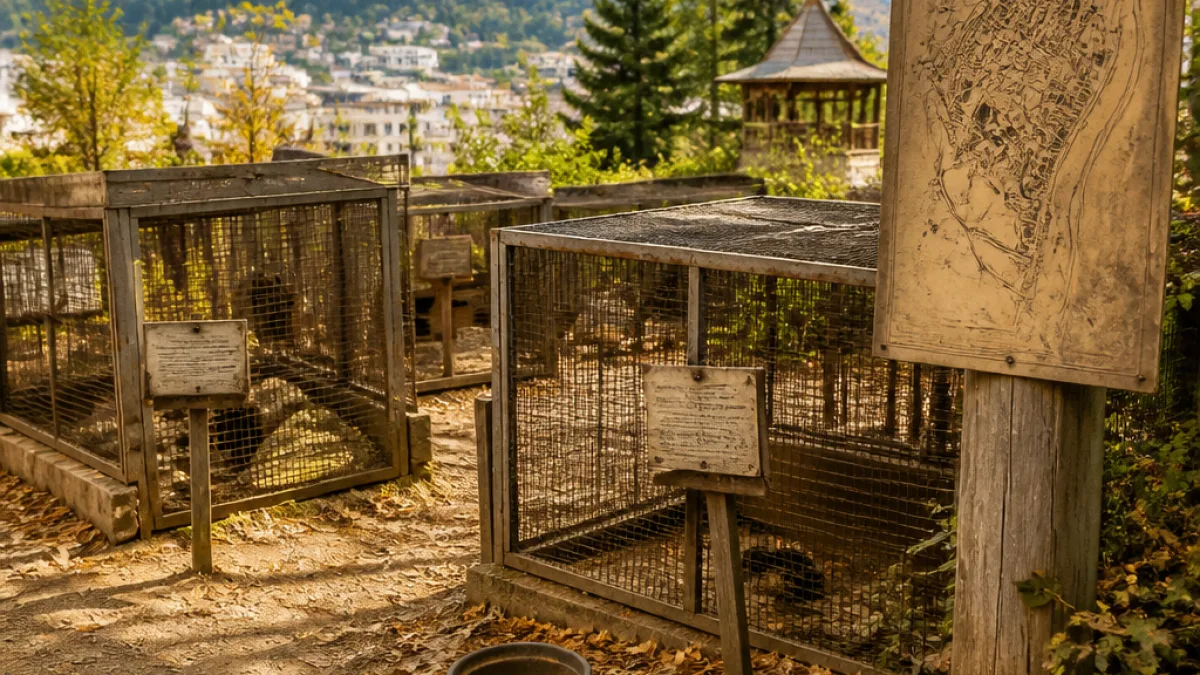
At the turn of the 20th century, Eugene flirted with the idea of being a small-town zoological destination. What began as a gifted bear cub from the Eugene Fire Department in 1906 grew, within a few years, into two separate municipal collections: one on Skinner Butte, near what is now the Campbell Community Center, and another in Hendricks Park, near the present-day Rhododendron Gardens.
Records from contemporary editions of The Eugene Guard chronicle the city’s earnest, if sometimes haphazard, approach to building public amenities. By 1908, the Skinner Butte enclosure had been expanded to house raccoons, porcupines, skunks, pheasants, ducks and monkeys; by 1912 Hendricks Park was being stocked with elk, sheep and deer, items acquired as part of a broader parks push under Mayor F. M. Wilkins.
Tragedy and the end of an experiment
The enterprise never escaped the practical problems that dogged many early 20th-century municipal menageries: limited budgets, basic enclosures and questions about animal welfare. Those problems were compounded by human tragedy. On Jan. 9, 1916, caretaker William Wallace, on the job for roughly a month, was found dead near the deer enclosure at Hendricks Park after being gored by a large buck. The Eugene Daily Guard reported that Wallace’s femoral artery had been severed; contemporaneous accounts indicated a desperate struggle.
"the man and deer fought desperately until death came to Wallace."
The animal was killed the following day, and the episode underscored how ill-equipped municipal operations could be when animals and people shared close quarters without modern safety protocols. Over the following years, reports of vandalism, recurring welfare concerns and mounting costs steadily eroded public confidence in the city’s ability to run such facilities. Eventually, the city shut down both exhibits.
What the brief zoo era left behind
To modern Eugene residents, the idea of two city-run zoos may seem incongruous — our parks are now better known for native plantings, trails and community gardens than for cages. Yet the brief menagerie experiment left a material legacy in the city's landscape and a cautionary tale about civic ambition outpacing expertise.
- 1906 — Bear cub arrives as a fire-department mascot; enclosure built at Skinner Butte.
- 1908–1912 — Additional animals added to Skinner Butte and a separate exhibit opened in Hendricks Park.
- 1916 — Caretaker William Wallace killed by a deer at Hendricks Park; subsequent scrutiny and eventual closure follow.
Those bullet points outline a short chronology, but they don’t capture the broader civic tensions. The early municipal zoos grew out of pride in public spaces and the desire to provide civic entertainments, yet they highlight the trade-offs cities face between aspiration and capacity. What sounds quaint on paper — a parks department acquiring a bear and a few elk — had real consequences for both people and animals when institutions lacked veterinary expertise, sustained funding and adequate safety standards.
Small episodes, larger implications
The rise and fall of Eugene’s zoos is more than a historical footnote. It is an instance of the city testing the limits of public responsibility: when should a municipality operate specialized animal care facilities, and when should it defer to trained institutions? The answers that emerged a century ago—shutting down the facilities—reflect a pragmatic response to risk and cost.
For residents walking Skinner Butte or the rhododendron paths of Hendricks Park today, the story is a reminder that city parks evolve in fits and starts. Sometimes the changes are planned and celebrated; sometimes they unwind under the weight of practical realities. The vanished cages are gone, but the traces of that era survive in archived newspaper pages and in the contours of our parks. They also leave a subtler legacy: the city’s modern approach to animal care and public-safety oversight is, in part, a response to the hard lessons of that short-lived zoo era.
| Year | Event |
|---|---|
| 1906 | Bear cub gifted to Eugene; Skinner Butte enclosure constructed |
| 1908 | Additional animals added to Skinner Butte |
| 1912 | Hendricks Park enclosure established; elk and other stock arrive |
| 1916 | Caretaker William Wallace fatally gored; deer killed; scrutiny follows |
Those entries mark the arc from hopeful public amenity to discontinued municipal experiment. The story is neither wholly romantic nor purely tragic; it is, like much of Eugene’s past, a mix of earnest civic ambition and the sometimes-brutal realities that follow.